In this 10 minute video, Amber Kovarik and I discuss the latest in mortgage rates, unemployment, inflation, and inventory.
Headline:
I would like to address a very specific headline I am seeing more and more often. It is the one that says there are 10 million mortgage borrowers behind on their payments. That is NOT the case. According to the US Census, there are about 10 million renters and borrowers behind on their payments. And according to Black Knight, who does the most thorough analysis of delinquencies and forbearances, about 3.4 million borrowers are delinquent on their payments, and that number includes borrowers in forbearance. With that being said, it is safe to assume that there are about 6.6 million renters behind on their payments. The renter data is tough to collect so I am not sure if that is just the count in large apartment complexes or if that includes single-family renters.
These numbers are important to keep in mind when we look at the future health of the housing market.
Policy:
Today the CFPB proposed furthering the ban on foreclosures through the end of 2021. Under current CFPB foreclosure rules, a borrower must be 120 days delinquent before the foreclosure process can start. I am not sure what the timelines are for those who were in the foreclosure process last year when the moratoriums were put in place. The services want to start where they left off, but will they be able to? It sounds like the CFPB does not agree though. The 120 days is to protect those who exiting their forbearance plan more than 90 days late from immediate foreclosure.
Last week the CDC extended the eviction moratorium for the third time, this time through 6/30/21.
Market Shift:
There is a lot of talk about the market shifting. It is and this is a good thing. Don’t be nervous when you hear other agents are talking about fewer showings and fewer offers. Going from 30 offers to 5 offers is still great for the seller. Demand is dropping faster than supply. Supply has leveled over the past few weeks, it is still 78% below normal while demand is 11% above normal. As long as demand is higher than supply, prices will go up. The 19-20% appreciation rate we are seeing is not healthy and as people are priced out of the market due to sky-high appreciation, demand will continue to slow. Prices will still go up, just at a slower rate.
Our local median sales price reached nearly $360,000 and the national median sales price reached an all-time high of $370,000. That is even higher than the housing bubble highs.
Interest Rates:
The stock markets have hit all-time record highs this morning after being closed all day Friday. The Friday new jobs report, which showed 916,000 new jobs created in March, the best monthly report in 7 months, and today’s better-than-expected ISM index report on the growth of the services sector of the U.S. economy, are the two top drivers of the markets this morning.
In regards to interest rates, there are two independent forces in play that could push up interest rates on 30-year fixed-rate mortgages. The first is a general force that will push up all interest rates, due to a rebounding economy which increases the demand for borrowing and drives inflation rates higher. As the U.S. economy continues to recover, this traditional force of supply-and-demand will naturally push up the rates on 30-year fixed-rate mortgages.
The second important force, which specifically applies to mortgage rates, is the Fed’s monthly mortgage-backed security purchases which are artificially holding mortgage rates 1/2 – 1% below where they would be in a normal market price. The Fed cannot continue these monthly purchases indefinitely and at some point, they will need to reduce and then stop these completely. The Fed will stop when unemployment clearly reaches 4.00-4.50% and inflation consistently exceeds 2.00%.
Second Home Loans:
The MBA and many lenders and mortgage companies have stated opposition to the recent Fannie Mae and Freddie Mac rule only allowing 7% of their portfolios for second home loans. Currently, most lenders are selling closer to 14% of their second home loan portfolio to the GSEs. What many lenders are doing is increasing the interest rates on those loans. Guild has increased refinances by about 1% hoping that satisfies the requirement and allows them to sell those loans to other investors. As more info comes out about these changes, we will be sure to share the news.
Sarah Perkins is an award winning account executive and has been in title sales since 2004. As the Director of Industry Research & Senior Account Executive, Sarah’s role is to bring real estate transactions to Navi Title. Sarah supports her clients by helping them navigate the ever-changing real estate space through thorough research and understanding of current trends impacting today’s home buyers and sellers.
Real estate disruption is all about creating efficiency. As we lead busier and busier lives, fast and efficient is appealing, right? In theory, buying and selling a property with Amazon-like ease sounds great. In reality, our human condition drives us to desire human input, not just in reading interesting articles but in being able to talk to someone about specifics.
For example, in a recent HousingWire article about where Realtors fit into Zillow’s plans, Matthew Blake writes, “Zillow wants to do it all in real estate. And the role of agents in this isn’t nothing. But agents’ role seems more like one worker on an assembly line, instead of a hand-holder amid the dynamic, stressful and inefficient process that is the home sale.” Does an assembly line strategy best serve the consumer? Unlikely. Yes, the industry definitely has inefficiencies to improve but in order to create greater efficiency do we also have to give up individual guidance for the consumers who want it? I don’t think so.
On Tuesday, Brad Inman wrote, “In this fast-changing world, the digital face off will become more pronounced for the consumer. Advertising dollars are flowing into the digital alternatives, giving the customer more choices with a mix of competing benefits. Efficiency versus human touch; higher versus lower fees; and the old way versus something new and often untested.”
Compass successfully completed its IPO and went public yesterday giving it an $8 billion valuation and about $450 million in capital (roughly half of the goal outlined in the initial S-1 filing). Investors and real estate professionals alike are closely watching Wall Street’s reaction to the IPO. Compass has positioned itself as a tech company like Redfin or Zillow with valuations of $28.7 billion and $32 billion, respectively. But many in the industry consider it a traditional brokerage more like Realogy with a valuation of $1.78 billion or RE/MAX with a valuation of $1.19 billion. (despite the huge variation in valuations Realogy and RE/MAX are profitable while the others aren’t) While it is not unusual for valuations to fluctuate, we will soon know how Wall Street defines Compass.
WeWork, a co-working company, announced it is going public via SPAC in Q3 2021 with an expected valuation of $9 billion. In 2019 WeWork attempted and failed to go public via IPO and its valuation dropped from $47 billion to $3 billion.
To be considered a “unicorn” a company must reach a $1 billion valuation (there are about 600 on the planet) and the frequency of real estate tech companies reaching unicorn status is increasing, here are three examples:
Side a back office brokerage and technology platform that keeps teams and agents front-facing.
Pacaso creates co-owner opportunities for second homes.
Divvy Homes offers rent to own solutions and down payment options.
National Real Estate:
Pending home sales declined by 10.6% from January to February; mostly due to low inventory.
“The demand for a home purchase is widespread, multiple offers are prevalent, and days-on-market are swift but contracts are not clicking due to record-low inventory. Only the upper-end market is experiencing more activity because of reasonable supply. Demand, interestingly, does not yet appear to be impacted by recent modest rises in mortgage rates.”
-Dr. Lawrence Yun, NAR’s chief economist
Demand increased in March as people rushed to lock in their rates as they rose. It is too early to see the true impact the rising interest rates will have on buyer demand.
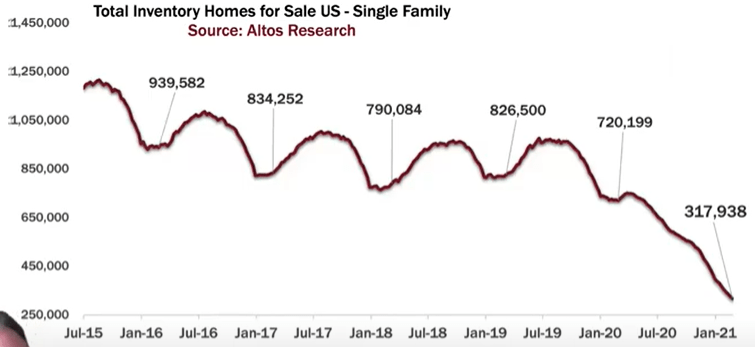
After two weeks of staying relatively flat, this week’s active single family listings nationwide decreased by about 3,000 listings to 312,872.
According to Realtor.com, nationwide, the median sales price in March reached $370,000; up 15.6% year over year. The highest median sales price ever, even above the highs of the 2005 bubble.
Asking prices for new listings has just started to level off after the giant run-up. Leveling off at the end of March/early April is normal seasonal behavior. We will likely see it start to fall towards the end of April, which is also part of the normal seasonal real estate cycle.
Price reductions increased slightly to 16.3% from last week’s all-time low of 16.1%. The number of price reductions is a great way to gauge buyer demand, which based on these numbers remains extremely high.
“Only higher rates will result in more days on the market and thus larger inventory. We need these two things in order for buyers to have more choices and more reasonable price growth. Again, the question remains if rates will get high enough to have this effect on the market before more price damage is done. Right now home prices aren’t high enough to impact demand in a major way.”
-Logan Mohtashami, HousingWire’s lead analyst
As sales prices climb, homeowner equity rises too. According to this chart homeowners in CA and VT have the most equity. It also shows that 32.5% of Arizona’s homeowners have at least 50% equity.
Cromford Market Index (CMI): Is the best leading indicator available (balance is 100, above 100 is a seller’s market, below 100 is a buyer’s market, prices rise at 110, and drop at 90). Yesterday it was 502.7. On 3/20/2020, it reached the pre-COVID peak of 241 and on 5/15/2020 it bottomed out at 145.2 and started increasing continuously until 3/14/2021 when it reached 514.9. It was then that demand continued decreasing while inventory finally stopped dropping, albeit at 78% below normal. As of yesterday demand is 11% above normal.
The supply versus demand imbalance has pushed the median sales price up to $358,250 giving us a 19% year over year appreciation.
The Milken Institute recently published a report ranking top US cities. The ranking is based on jobs, wages, tech growth, housing affordability, and broadband access. Phoenix ranked #7 and is the largest population. Phoenix isn’t just for cowboys, retirees, and spring break. We have a growing high-tech economy with a highly educated workforce.
Elliott D. Pollack & Company
Lending:
For more on forbearance, foreclosures, and inflation check out my update from Wednesday, here.
Purchase mortgage applications declined last week by 1% week over week, mostly due to low inventory. They are 39% higher, year over year. Throughout April, year over year numbers will be will not be a good market indicator since last April we were on lock down and had a curfew.
Freddie Mac announced yesterday that despite the low interest rates, buyer demand has started to pullback. At the beginning of 2021 demand was 25% above pre-pandemic levels and now demand is at 8% above pre-pandemic levels.
“We even see that purchase demand is diminished today as compared to late May and early June of 2020, when mortgage rates were the same level. This is confirmation that while purchase demand remains strong, the marginal buyer is feeling the affordability squeeze resulting from the increases in mortgage rates and home prices we’ve experienced in recent months.”
Marketing platform, BoomTown acquired Brokermint, a transaction management and accounting platform in an effort to offer more of an end-to-end solution.
The real estate market will not stay like this forever. Today the story of a $275,000 fixer in suburban DC that received 88 offers, 76 of which were cash, and 15 sight unseen and sold for $460,000 is surprising. Six months ago it would have been shocking. A year ago, no one would have believed it.
Inventory will increase, appreciation will slow, buyers will once again have options, and sellers will list their houses without the fear of having nowhere to go.
As Ella, my family’s nanny, reminds us regularly, this too shall pass. Strike while the iron is hot, save for tomorrow, and hope for the best.
Sarah Perkins is an award winning account executive and has been in title sales since 2004. As the Director of Industry Research & Senior Account Executive, Sarah’s role is to bring real estate transactions to Navi Title. Sarah supports her clients by helping them navigate the ever-changing real estate space through thorough research and understanding of current trends impacting today’s home buyers and sellers.
“There are decades when nothing happens, and then there are years when decades happen,” Notarize CEO Pat Kinsel said after raising $130 million in funding.
National Real Estate:
Inventory remained flat again this week, now two weeks in a row. We have 316,073 active single-family listings nationwide. This is a good thing for buyers and means that our market is moving towards a more balanced environment. It is less good for sellers; especially those expecting to sell for $50,000 or more over asking. It is normal for inventory to stay low through March, it usually starts climbing by late March, or at least by April 1. Last year our inventory peaked on April 3 at about 750,000 active single family listings. After that inventory started plummeting for 50 weeks straight.
The percent of homes with price reductions is currently at record lows at 16.1%. Enough contracts are coming in over-asking which means very few sellers are reducing their asking price. For Realtors working with sellers and potential sellers, the next 3-4 weeks is likely going to be the absolute peak. The rest of the year will continue to have strong buyer demand and increasing prices, but the absolute peak of the demand frenzy is likely happening right now. So now is the time for sellers to get the biggest premium.
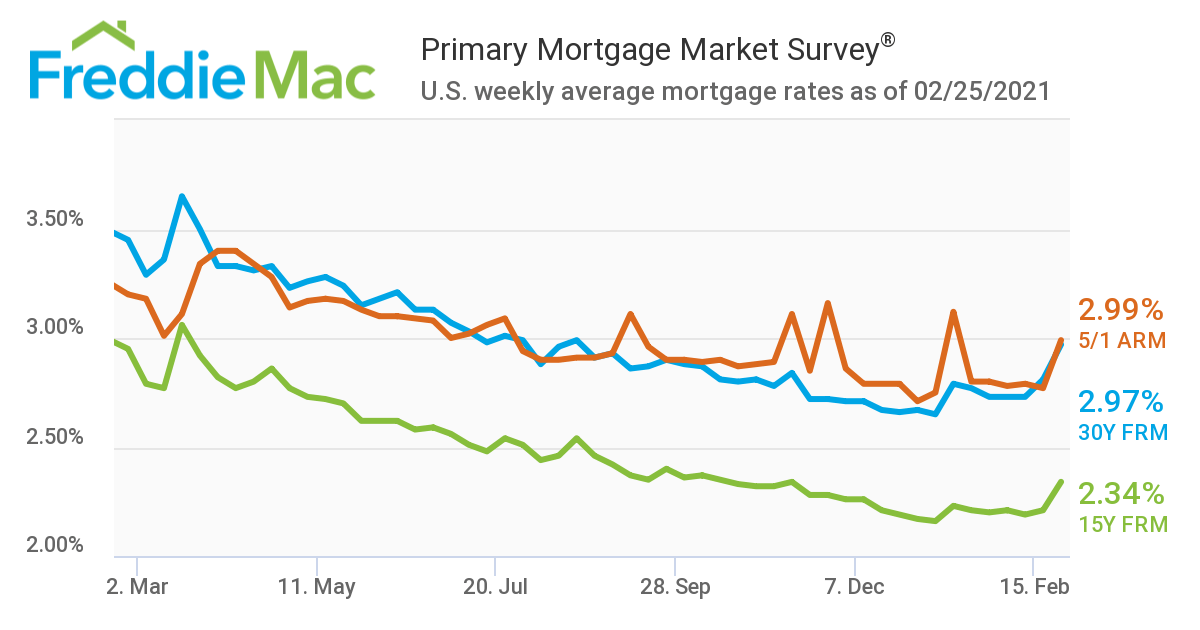
According to Freddie Mac, rates reached 3.17% yesterday, the highest they have been since June. A year ago they were 3.5%. As interest rates increase, home buyers are spending less on discretionary items, like certain upgrades in new homes or waiving inspections or appraisals in resale homes.
About 50% of mortgage borrowers in the US have interest rates at or below 4%. Ivy Zelman is concerned that if rates go too far above 4% that it will lock a lot of homeowners in their current properties, unwilling to take a higher rate which would further reduce inventory.
About 40% of the 138 million residential properties nationwide are owned free and clear. And nearly 57% have at least 50% equity. (KCM)
Market Headlines:
Existing home sales declined 6.6% from January to February. No need to panic though, sales were up 9.1% year over year and the market was strong during February 2020. The decline is due to the low inventory combined with the 15.8% year over year appreciation.
New home sales dropped 18.2% from January to February but are still up 8.2% year over year. New home sales are usually impacted more by interest rates than are existing home sales. Builders are impacted by rising costs too, due to labor shortages, supply chain issues, and lumber costs. A new home now costs $24,000 more, on average, a cost that is pushed to the buyer.
“Despite the drop in home sales for February — which I would attribute to historically-low inventory — the market is still outperforming pre-pandemic levels,”
Dr. Lawrence Yun, NAR’s chief economist
Many economists and housing experts are talking about the inflation impacting our market, not inflation of goods and services but inflation in housing. Anyone wondering when we will be impacted by inflation doesn’t need a crystal ball. It is here and happening now. Every single home buyer looking in this market will agree.
New home permits in Greater Phoenix increased by 24% year over year in February, while nationwide permits decreased by over 10% year over year. (Elliott Pollack)
Locally, inventory has stopped dropping also. Here is some perspective; in January 2019 we had over 18,000 active listings and in January 2021 we had just over 6,000.
As long as there are more pending listings than active listings, we will be in a market frenzy, the extent of that frenzy is based on how wide the gap is.
Forbearance:
For info on forbearance, buyer confidence, and a surprising move by some landlords, click here for my update from Wednesday.
Another Commission Lawsuit:
NAR, a few CA MLS associations, and several large national brokerages were named in the 5th class action lawsuit going after commissions that was filed last week. The plaintiffs in all five lawsuits want to have homebuyers pay their agent directly rather than having the listing agent share their commission.
NAR/DOJ Settlement:
In November the DOJ filed a lawsuit and settlement against NAR requiring 5 changes for NAR to implement by the end of Q1 2021. The most notable change is that the commission offered to the buyer’s agent is to be made public. RE/MAX, Redfin, and a few MLS’s have started making the info available. On Tuesday a spokesperson from NAR said these changes may take months to process. There is no ETA for the actual implementation of these changes and from the sounds of things, they are still working on the details of those changes.
GSE Second Home Policy:
On Tuesday, the Mortgage Bankers Association sent a letter to Treasury Secretary and the FHFA director expressing concern over recent amendments including the 7% limit on the GSE’s portfolio for second home loans, a rate well below the current percentage. The MBA asked for a meeting to discuss the potential “unnecessary disruptions in the housing finance system.” For more information on the portfolio limits, check out my video and post from Monday, here.
Demand for investment properties and vacation homes has risen 84% year over year – more than double the demand for a primary home.
Real Estate Disruption:
Zillow had 9.6 billion visits to its website in 2020, by far the most of any real estate company or portal. This is why real estate was the top performing sector in the entire economy.
Is Zillow becoming a verb? According to a Google Trends report, more people in 2020 searched “Zillow” than “real estate.”
Real estate tech strategist and iBuyer guru Mike DelPrete said, “The point is not that these business are unprofitable and therefore must be bad. Spending (and losing) money to gain market share is a well-worn path. The point is that these companies are actively doing it, and if you’re in the real estate industry, concerning yourself with disruptors willing to lose billions is a good use of time.”
Pete Flint co-founder of Trulia said, “I often say that if something can be commoditized, it will be commoditized, and I look at the financing, title and escrow and all these components of the real estate industry that will get digitized, and will get somewhat commoditized. But if you’re providing value as an agent, which cannot be commoditized, then I think you’re going to be fine.”
Real Estate News:
Offerpad announced it is going public through a SPAC created by former Zillow CEO and co-founder, Spencer Rascoff. Ironically, after Rascoff’s departure, Rich Barton, the current Zillow CEO and co-founder, began heavily investing in Zillow’s iBuyer. After going public, Offerpad expects a $3 billion valuation and will receive up to $650 million in cash. They will use the funds to expand to new markets and increase advertising spends in existing markets.
The CFPB reversed policies from January 2020 which limited its power. The CFPB plans on exercising greater enforcement “consistent with the full scope of its statutory authority under the Dodd-Frank Act.”
Target plans on spending about $4 billion a year expanding and improving its real estate portfolio. After sales in 2020 grew by more than $15 BILLION, more than the previous 11 years combined.
Final Thoughts:
For anyone, buyer or seller, on the fence about what to do next; the answer is clear. Buy now, rates and home prices are going up. Sellers sell now, increased inventory is coming and that will create more competition and, likely, more time spent on the market.
Sarah Perkins is an award winning account executive and has been in title sales since 2004. As the Director of Industry Research & Senior Account Executive, Sarah’s role is to bring real estate transactions to Navi Title. Sarah supports her clients by helping them navigate the ever-changing real estate space through thorough research and understanding of current trends impacting today’s home buyers and sellers.
In this 12 minute video, Amber Kovarik and I discuss the latest in housing, lending, and proposed policy.
Affordability:
Affordability is and will remain the biggest issue in real estate this year. Not only are prices increasing quickly, but builders are also struggling with the supply chain, labor shortages, and lumber increasing by 200%. The average additional cost to builders is $24,000 per home and that is being pushed to the buyers.
The increased cost, increased interest rates, and cold winter are all reasons why builders slowed their production in February.
Offerpad:
Offerpad is going public with former Zillow CEO, Spencer Rascoff’s SPAC. Since Rascoff left Zillow, Rich Barton has poured tons of money and resources into building up Zillow Homes, Zillow’s iBuyer. This will give Offerpad an equity position of $3 billion and up to $650 million in cash.
PRO Act:
The PRO Act is currently moving through Congress and President Biden said he would sign it. As it stands now it impacts independent contractor status and would make it so that anyone who is not incorporated will be considered an employee. Most Realtors create an LLC or PLLC and are employees of their entity. This impacts the 27 right-to-work states including Arizona. I have read arguments on both sides and I have no idea if it will pass or not but if it does, there could have an immediate impact on real estate.
The timing is interesting as we see many companies following Redfin’s path of employee agents. Zillow, Opendoor, and Homie all have agent employees. Last week Homie announced that they are hiring 1000 buyer agents nationwide.
The AZ Market:
Locally, active listings have, finally, stopped dropping. This could be for several reasons. The best one is that maybe we are going back to some element of seasonality and March is the time of year when we have the most inventory growth. Now the numbers are not going up, but they are not dropping. We have like 10 more listings than we had a month ago. Demand is dropping though, faster than supply. It remains nearly 14% above normal while supply is nearly 78% below normal. This means that sellers are getting 10 offers instead of 50 and that appreciate rates will slow. We do not need 20% appreciation rates so this is good for the market. We are currently unsustainable. The market needs some stability and allowing inventory to rise and demand to fall will get us there. And as long as demand remains above supply, prices will continue to go up. No one is expecting a crash or for values to go down.
The demand dropping is primarily due to buyer exhaustion, affordability challenges from quickly appreciating prices, and interest rates going up, but not as much as one would think.
Lending:
Interest Rates:
Interest rates have been on quite the tear lately. The market headline is that interest rates hit 14-month highs due to market expectations of a recovering economy and increasing inflation.
Today there is a small glimmer of hope for interest rates as the 10-year Treasury bond yield, which hit a high of 1.754% on Friday did not keep going higher so far today.
The pause in the continuous rise of the Treasury bond yields over the past six weeks, is giving hope that interest rates might stabilize for a while.
Amber also discussed the importance of talking with all pre-approved buyers, rates are 3.5% now. If a buyer wins an offer in this competitive market it is important that they still qualify for the loan and make the monthly payments.
Fannie Mae & Freddie Mac Restrictions:
She also explains what the new Fannie and Freddie regulations mean for second home and investor purchases. Just because the GSEs loan portfolio is now limited to 7% for second home loans; that doesn’t mean those are the only options. There are other options for second home borrowers but they will come at higher interest rates which could further slow demand. As the changes are implemented, we will continue to share the implications and options for these buyers.
This chart is a recent MBA chart of the week and it shows the growth in second home mortgage applications, either for purchase or refi. The MBA provides this commentary, “In February 2021, 10.1 percent of all applications in the retail and consumer direct channels were for a non-primary residence. This was an increase from 9.5 percent the previous month. 2019 and 2020 saw annual averages of approximately 8 percent. Breaking down the categories, second-home transactions accounted for 3.6 percent of all applications and investment properties were 6.5 percent, totaling 10.1 percent. Average loan sizes as of February 2021 were $430,000 for second homes and $263,000 for investment properties.”
Mortgage Banker’s Association 3/12/21 Chart of the Week
Sarah Perkins is an award winning account executive and has been in title sales since 2004. As the Director of Industry Research & Senior Account Executive, Sarah’s role is to bring real estate transactions to Navi Title. Sarah supports her clients by helping them navigate the ever-changing real estate space through thorough research and understanding of current trends impacting today’s home buyers and sellers.
Once again, today is all about the AZ market. Recently, Lawyers Title hosted a presentation with Tina Tamboer with the Cromford Report. She always shares pertinent and timely information. Below I have combined a lot of her information from her presentation, along with additional information from my research.
What affects supply?
New Homes
FSBOs
Appreciation/Depreciation (equity)
Foreclosures/Household Formation (shrinking)
Relocation (Outbound)
Divorce/Illness/Death/Job Losses/Tragedy
Consumer Sentiment
What affects demand?
Interest Rates
Appreciation/Depreciation (affordability)
Relocation (inbound)
Employment/Income
Loose/Tight Lending Practices
Population Growth
Household Formation (growing)
Consumer Sentiment – this could be the most important of them all.
The recent announcement that Fannie Mae and Freddie Mac must restrict second home and investment property loans to only 7% of their total portfolio (far less than it is currently) may negatively impact demand. This move could force second home buyers to pay higher interest rates on their loans.
Employment:
AZ is on track to see 11% job growth over the next 2 years.
519 new companies came to AZ in the past 5 years.
The AZ job market has diversified a lot in the past 12 years. We have gone from the majority of our population working in hospitality and housing to also have an emphasis on tech, biotech, manufacturing, health care, etc.
Arizona’s unemployment rate is 6.3% and the national rate is 6.7%. 5% is considered full employment.
Initial claims were at 4,108 the first week of March, normal is 3,807.
Continuing claims remain significantly heightened. We are running 65,000 continuing claims a week and normal is about 19,000.
People will less education have been more negatively impacted than have those with a college degree or higher.
Renters:
Due to the high unemployment rates for younger workers and less-educated workers; renters are struggling more than homeowners. In addition to the additional renter’s assistance in the latest stimulus plan, Arizona has quite a few options for rental assistance. Landlords are able to register on behalf of their tenants. For more information visit: https://des.az.gov/ERAP
Forbearance:
There are people who think it will be raining homes when the forbearance period ends. This is not going to happen.
Every 3 months we see an improvement, as more borrowers exit their forbearance plans. But the past few months have been flat. Hovering around 2.6 million borrowers in a plan. The recovery continues making slow progress. At the end of March, we will likely see a lot of forbearance plan exits. There have been additional filing extensions. For more information on forbearance, delinquencies, and demand please see my forbearance update from Wednesday, here.
Foreclosures:
What happens with the moratoriums are lifted? We will see a wave of foreclosure filings but not of short sales. After 18 months of no foreclosures, there will be a backlog. But they will mostly be sold normally as owners have more equity today. According to KCM, on average nationwide there are about 69,000 foreclosure a month, during normal times.
Population:
Population growth is creating demand.
When you lose population, you have extra homes, when you gain it, you have insufficient supply.
AZ is #2 for incoming migration behind Idaho.
All of the moving companies agree, people are leaving CA, NY, IL, WV and are moving out to AZ, ID, and TX.
The majority of AZ’s population growth is from people moving here domestically. It is not from lots of babies or international migration.
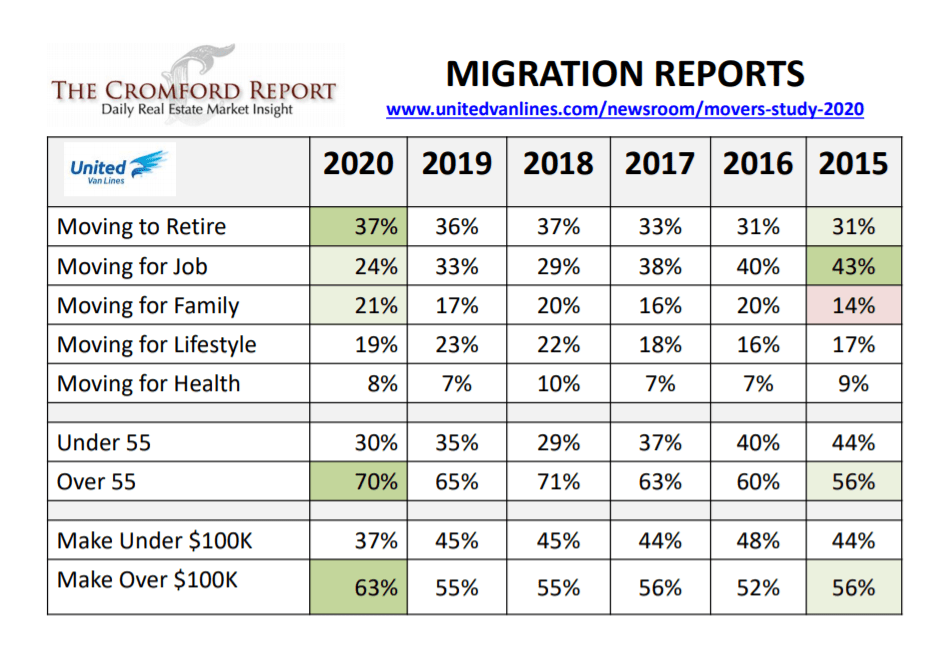
Most people started moving here to retire versus people moving here for a job in 2018. Look at the ages of the people moving here, their income, and retirement. Our domestic migration is older, wealthier, highly trained, more experienced population and finishing up their career and then retiring.
Affordability:
The ideal range for housing affordability is 60-75. Through Q4 2020 in Phoenix someone earning the median income, they can afford 60.6% of what is for sale. In LA it is 9.1% and San Francisco it is 11%.
Household Income:
Maricopa county association of governments, shows demographics, click here for the demographics map. Density is increasing in new luxury areas. South Chandler, a lot of Gilbert, east Mesa, and South Mountain is getting bluer. Showing new emerging luxury markets.
Job Centers:
Jobs are created by freeways. The heavier the employment area the bluer. A lot of job growth, biomedical, and tech, fueling demand, bringing in people who make a lot of money. Click here for the interactive map.
100 is balanced and prices rise at the rate of inflation, below 100 is a buyer’s market, above 100 is a seller’s market, prices drop below 90, prices rise at 110.
On 2/5/2020 we were at 215.1
On 3/20/2020 we were at 241
On 5/15/2020 we were at 145.2
Yesterday we were at 512.6.
We peaked on 3/11/2021 at 514.9
Prior to this run, the previous peak was 312.9 in the spring of 2005.
CMI is the predictor, it moves first and then appreciation follows. Cannot predict the CMI.
Demand is 14.5% above normal and supply is 77.7% below normal. Despite demand dropping by one percentage point a week and faster than supply is dropping, the market is still in a frenzy. As inventory stabilizes, which it will, this market is unsustainable, things will calm down. Buyers will once again be able to get a house without having to write 10+ offers before one is accepted.
With the CMI dropping, prices will not go down, they will increase more slowly, which is what we want. This appreciation rate is not sustainable. This doesn’t mean that we will crash. Indicators wants to be together. Markets want to be balanced. Buyer’s markets do not happen because it is time. There are reasons for buyer’s markets, there has to be a cause. Demand needs to be lower than supply in order for prices to drop.
Is it a good time to buy? Yes! It is best to buy and sell in a seller’s market. Sellers make money and buyers see appreciation right away.
What will slow it down? Affordability.
Affordability in Q1 2021 will likely drop below 60 which puts pressure on prices. the level of demand doesn’t start dropping until we are below 60. How long will it take to get to lower demand? It could take months, who knows. Demand, once it goes to the low side of normal and then we will see supply go up.
Number of Sales:
ADRE is adding 500 new licensees a month, not all in residential but it is increasing the amount of competition as more people will be fighting for a certain number of monthly sales.
Supply will come up when demand goes below normal, prices will continue to go up until demand is lower than supply.
As transaction counts decrease, it will impact all of our jobs. We need to position ourselves for the 2nd half of the year. Focus all efforts on listings. We have the demand but the competition will be increasing significantly in the 2nd half of the year.
Interest rates:
The recent big hike could be a reason for the drop-off in demand. Even though 3% is great, people get scared when it increases. It does limit options for some buyers.
Those who waited for prices to go down are now paying $20,000 more for the median sales priced home just since December due to rate increases. Since 2018 the median sales price has increased by $80,000 but monthly payments have only gone up by $133.
Rents:
Rents are more expensive than mortgages. Rents are rising quickly. The median house rents for $250 more a month than the going rate for a mortgage for the same house.
Rents are rising = not a bubble, rents decline due to false demand. Rents are declining in San Francisco while houses are still rising, equating to false demand. San Francisco could be considered over-valued. Prices only drop due to vacancies. The number one risk in housing is vacant houses.
Vacant Homes:
77% of sales in Q4 2020 were owner occupied purchases.
The remaining 23% were iBuyer, investor buy & hold or flip, vacation rental, 2nd home properties.
Second homes are always counted as vacant. The new Fannie and Freddie rules may impact this market.
The new lending guidelines will not impact international buyers.
Supply:
Supply stopped dropping for the first time in a year.
It actually increased by 100 listings in one week.
This is the worst year in the past 20 years for new supply, even with the slight increase and despite being the best quarter ever for sales.
Sales:
Selling 2500 houses a week, listing 2000 a week.
Pendings have been flat for 1.5 months, we can’t increase properties under contract when there isn’t enough supply.
And still are having the best quarter ever.
Appreciation is pushing 24% year over year, but most price ranges it is about 10%-15%.
These markets do not stay like this forever. We will not see then impact of the pullbacks for about a month. Then we may see a slow down in sales. Need more inventory under $500,000.
Sales Over Asking:
49% of sales closed over asking the first week of March.
40% of sales closed over asking in February.
The median amount over asking is $10,000.
50% of all accepted contracts were on the market for only 6 days.
Population Growth and New Builds:
We overbuilt for 10 years before we started underbuilding for another 10 years and population growth outpaced building. In 2019 we ate up the last of the glut of housing.
Developments:
Without new listings we have to look at new construction which is a challenge due to labor shortages and lumber prices are up 200%, adding, on average an additional $24,000 in cost to the average new build.
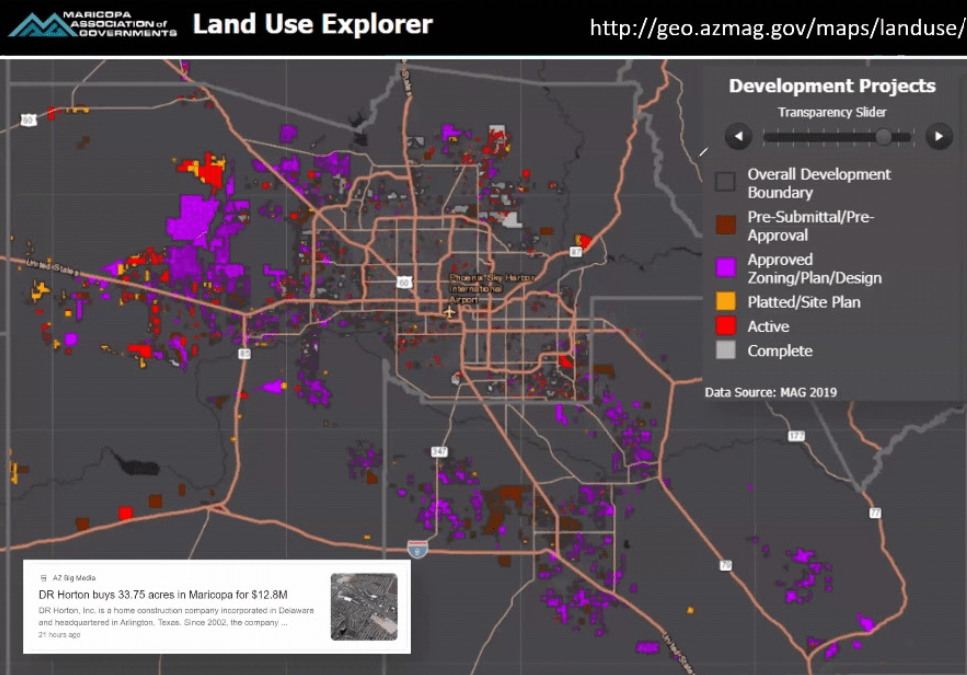
Most developments are going into the south and west, due to cheaper available land. Very little in the north. Values are increasing the most in the north. Click here for the interactive map.
Contract Ratio:
On March 1 the contract ratio was 300. That means for every 100 active listings there are 300 pending listings.
Final Thoughts:
Supply is down 77.7% below normal.
Demand is 14.5% above normal.
Year over year appreciation is pushing 24%.
Sales prices are not going to decline this year.
There will likely be fewer sales in 2021 than in 2020 due to the low inventory levels.
Sarah Perkins is an award winning account executive and has been in title sales since 2004. As the Director of Industry Research & Senior Account Executive, Sarah’s role is to bring real estate transactions to Navi Title. Sarah supports her clients by helping them navigate the ever-changing real estate space through thorough research and understanding of current trends impacting today’s home buyers and sellers.
In this 15 minute video, Lydia Wietsma and I discuss the latest in mortgage forbearance, delinquencies, and declining demand (not prices).
Forbearances:
We have some good news and progress in regards to forbearance and delinquencies. The rates of mortgages in forbearance declined again week over week. We are now down to 5.14% from 5.20% keeping the number about 2.6 million.
Forbearance by Stage:
14.1% are in the initial stage, down from last week’s 14.6%.
83.3% are on an extension, an increase from just below 83% last week.
2.6% are re-entries, the same as last week
Forbearance exits from June 1, 2020 through March 7, 2021:
42.3% of forbearance exits are current upon exiting their plan.
14.1% represented borrowers who did not make all of their monthly payments and exited forbearance without a loss mitigation plan in place yet.
Delinquencies:
Remember unpaid loans in forbearance are also counted in the mortgage delinquency numbers. The following information comes from the Black Knight Mortgage Monitor report. For the full report, click here.
From December to January total delinquent loans decreased by 3.82% to 5.9% of loans are delinquent. This is the first time it has been below 6% since March 2020.
Early-stage delinquencies continue to stay below pre-pandemic levels, with the number of borrowers with a single missed payment down 24% and 60-day delinquencies down 6%.
However, despite some slight improvement in January, the 2.1 million serious delinquencies (90+ days) remain 5X or 1.7 million more than their pre-pandemic levels.
Here in AZ, we have had an increase of 2.8% in seriously delinquent loans, year over year. That is lower than most states. Hawaii has the highest rate at 5.2% and Idaho has the lowest 1.6%.
Black Knight Mortgage Monitor – January 2021
370,000 borrowers who were current on their mortgage became 30 days delinquent in January, marking the lowest inflow in the past 12 months.
However, the number of borrowers rolling from 30-to-60 and 60-to-90 days delinquent were up 31% and 75% year-over-year respectively as borrowers may be rolling to later stages at higher rates because of participation in forbearance plans.
While the rate of improvement could accelerate/decelerate based on broader economic factors, borrowers have limited incentive to leave forbearance plans early and we could see just a 20% decline in serious delinquencies between now and the end of Q3 2021 if current trends hold true.
Not only does this place continued pressure on servicing entities, but forborne interest as well as tax and insurance payments have a negative impact on borrowers’ equity positions.
The industry must now walk the fine line of providing ample borrower protections while at the same time trying to limit equity erosion and servicer advance risk. Which is why it is important for struggling borrowers to get into a forbearance plan within their specific loan’s guidelines. The timelines are a little confusing too.
Timelines:
Anyone can get started in a forbearance now, borrowers have until June 30, 2021 to get started. Then each loan type has different timelines for extensions. We will post the dates for each loan type.
They also announced that borrowers who have been on a COVID-19 forbearance plan on or before June 30, 2020 may request up to six months of additional mortgage payment forbearance, in three-month increments, which provides up to 18 months of deferment.
HUD extended the deadline for the first legal action against FHA borrowers and the reasonable diligence time frame to 180 days from the date of expiration of the foreclosure and eviction moratorium.
It also announced that borrowers who are on a COVID-19 forbearance plan on or before February 28, 2021 may request up to three months of additional mortgage payment forbearance, which provides up to 15 months of deferment.
Demand:
We will likely have fewer transactions in the 2nd half of the year due to low inventory but also dropping demand partially due to rising prices and rising interest rates and the market is trying to stabilize. Demand is currently dropping faster than supply. Nationwide supply did not drop last week, for the first time in a year. Dropping demand is hard to notice when you go from 50 offers to 15 offers, or even 15 offers to 3 offers. This does not mean that prices are dropping or will drop. It just means sales will not be as far above asking and it is not the time for sellers to overprice their listings. Expect increased competition in the coming months.
Sarah Perkins is an award winning account executive and has been in title sales since 2004. As the Director of Industry Research & Senior Account Executive, Sarah’s role is to bring real estate transactions to Navi Title. Sarah supports her clients by helping them navigate the ever-changing real estate space through thorough research and understanding of current trends impacting today’s home buyers and sellers.
One year ago yesterday, the World Health Organization officially declared the coronavirus a worldwide pandemic. Despite our efforts, no one accurately predicted the following 366 days. The light at the end of the tunnel is getting brighter. Kids are going back to school, vaccines are being distributed, the economic conditions are improving, and residential real estate – the sector that carried the entire economy for a year.
Real Estate Disruption:
Two weeks ago I wrote about real estate becoming less grassroots, more Wall Street, and Zillow’s new Zestimate. You can read the update here. On Wednesday, Brad Inman wrote about 8 of the 10 largest real estate firms being publicly traded. Those firms represent nearly 45% of all Realtors. There are upsides and downsides to Wall Street in real estate. Read his article here.
Last year Compass lost $270 million (details below). Zillow’s iBuyer and Opendoor combined lost $607 million in 2020. In 2019 they lost a combined $650 million. How is it that two companies can lose over $1.2 billion dollars in two years and remain in business? These companies are spending big money fighting for market share in the strongest sector in the economy. Why? Because US residential real estate is valued at $39.3 trillion, which is nearly double the 2019 US GDP ($21.4 trillion) and it is the nation’s most valuable asset. It is followed by equities at $37.2 trillion and commercial real estate at $20.4 trillion. With so much value in residential real estate and it being an industry that dodged disruption for a long time, Wall Street and Silicon Valley will continue to create and fund disruptors until they can figure out how to turn a profit.
Compass:
Compass, one of the fastest-growing real estate firms in the country has made a lot of waves over the past few years spending big money on advertising and up to $250,000 agent signing bonuses. CEO, Robert Reffkin has raised millions from investors like Softbank, Opendoor’s biggest investor before going public. Compass is spending money buying tech companies and Realtors. They recently filed their IPO and showed that despite bringing in $3.7 billion in revenue in 2020, it had a net loss of over $270 million. The filing notes stated, “may not be able to achieve profitability and we may continue to incur significant losses in the future.” Reasons given are market expansion costs, declines in real estate sales, and increased competition in the market. Compass is counting on its tech investments to drive profits.
Opendoor:
On its recent earnings call, CEO Eric Wu said that Opendoor’s offer requests have increased 50% year over year. By the end of 2021, Opendoor will have doubled number of markets and will continue entering new markets, with a goal of being in 100 markets and serving 70% of US homes. In order to gain market share the company has expanded its buy box and is continuing to build its vertical integration by offering title, escrow, and mortgage services along with traditional brokerage services.
REX’s Lawsuit:
On Tuesday, discount brokerage, REX, filed an anti-trust lawsuit against Zillow, Trulia, and NAR. The company charges roughly 2% commission, 1% goes to the brokerage and 1% to the listing agent. It is not a member of any MLS and does not pay buyer’s agents a commission. REX markets all of its listings online, including on Zillow and Trulia. The complaint states that NAR’s rules, enforced by the MLSs, requires that a seller pay a buyer agent’s commission. Now that Zillow is also a licensed brokerage it has joined the MLSs and must follow local MLS rules. As Zillow has adjusted its platform to be compliant, non-agent listings are now in a different section from the agent-represented listings. Zillow’s spokesperson said Zillow’s goal is to change the MLS rules so that all available listings would be located in one place on the site, allowing for easier searching. However, currently, the MLS does not allow for that.
One of the reasons for our low inventory nationwide is due to the low interest rates we have had for over 10+ years. 5% in 2009 was a record low. While our housing market recovered slowly after the Great Recession, many people moved up but kept their previous homes as rentals. Since 2013 about 7 million single family residences have become rentals, removing their availability from the resale market.
The supply to demand imbalance continues to push up sales prices and more properties are selling for over asking than ever before. Nationwide we hit a record low for the amount of homes taking a price reduction, the average is about 35% of active listings have at least one price drop before going under contract. Today it is just under 17%.
The AZ Market:
Here in Phoenix 44% of sales in the past 30 days closed over asking.
Greater Phoenix has fewer than 3800 active listings and only 2700 active single family homes available which explains our 19.5% year over year appreciation.
Join us today for a Zoom meeting at 11am for a deep dive in the Greater Phoenix market with Tina Tamboer with the Cromford Report. To register, click here.
Lending:
Mortgage interest rates tend to follow the 10-year treasury yield so it is often used to predict mortgage rates. This chart shows them moving together for the past 50 years.
Going deeper, here they are for the past 10 years. The 10-year treasury rate has been increasing since October and interest rates only started catching up in February. An increasing treasury rate means a growing economy because as the treasury rate goes up, investors become more confident in the market.
Last week purchase mortgage applications were up 7% week over week and 2% year over year. Demand remains higher than supply, both nationally and locally. It is impressive that applications increased when rates have increased as quickly as they have. A big reason for the continued demand, according to several leading economists, is based on today’s demographics. The largest group of the largest generation is about 26-34; prime home-buying age. These ‘Replacement buyers’ as some call them, will keep demand high through the end of 2024.
For forbearance and foreclosure news, check out my update and video from Wednesday, here.
Real Estate News:
UWM, the country’s largest wholesale lender recently announced it will not work with mortgage brokers who work with Rocket Mortgage or Fairway Mortgage. Does this set a precedent of big companies stating, “If you do business with them, I will not do business with you.”?
Walmart is partnering with Ribbit Capital, a fintech investment firm to create a new fintech that will offer “innovative and affordable” financial products. They even hired the head of Goldman Sachs’ consumer unit to run it. This is in addition to Walmart’s debit, credit, and check cashing services. While they haven’t specifically said they are going into mortgages, many experts in the field believe that is exactly what Walmart is creating, affordable mortgages.
Two weeks ago Federal judge in Texas ruled that the CDC’s eviction moratorium is unconstitutional. The court stated that Congress lacked the authority to give the CDC power to halt evictions, and that the moratorium infringes upon landlords’ rights under state law. The DOJ promptly filed a notice to appeal the ruling.
Initially created for apartment complexes, SmartRent (based in Scottsdale), which offers home technology services just announced a $31 million partnership with home builder, Lennar. One of SmartRent’s features is self-guided tours which allows the perspective buyer to tour the property at any given time (scheduled a little as 1 minute ahead of time, online). The company’s website states this allows builders longer tour hours and reduces a builder’s Realtor costs.
Logan Mohtashami of HousingWire said, “Once schools are open again, parents will be free to re-enter the job force: By September 2022 or earlier, we should have regained all the jobs lost to COVID-19. These positive economic factors warrant higher mortgage rates as we are no longer in recession in America. Now, we want to get all the jobs back that COVID-19 took from us.”
Please share this with your colleagues and clients.
Sarah Perkins is an award winning account executive and has been in title sales since 2004. As the Director of Industry Research & Senior Account Executive, Sarah’s role is to bring real estate transactions to Navi Title. Sarah supports her clients by helping them navigate the ever-changing real estate space through thorough research and understanding of current trends impacting today’s home buyers and sellers.
In this 12 minute video, Lydia Wietsma and I discuss forbearance, demand, specific industries, and our one-year anniversary.
Last week was our final week of having normal year over year comparisons. As of this week, the one year anniversary of our economy beginning to shut down, the year over year comparisons will get weird.
What we do know is that last week purchase mortgage applications were up 7% week over week and 2% year over year. Demand remains higher than supply, both nationally and locally. I am impressed to see the application increase when rates have increased as quickly as they have. The reason for the continued demand, according to several leading economists, is based on today’s demographics. The largest group of the largest generation is about 26-34; prime home-buying age. These ‘Replacement buyers’ as some call them, will keep demand high through the end of 2024.
We need to keep the expected, elevated demand in mind when we look at the forbearance numbers and speculate about foreclosures.
Forbearance:
Currently, there are about 2.6 million borrowers in forbearance or about 5.2% of loans. While this number has stayed flat over the past few months, it did decrease to a new low since the forbearance plans were introduced last March in the CARES act.
Forbearance by Stage:
14.6% of forbearance plans are in their initial stage, which is either 3 or 6 months depending on loan specifics.
Nearly 83% of all plans are on extension.
2.6% are re-entries.
Forbearance exits from June 1, 2020 through February 28, 2021
Nearly 43% of all forbearance plan exits are current on their mortgage upon plan exit.
13.8% of forbearance exits, exit without a loss mitigation plan in place.
Foreclosures:
There is increasing talk of foreclosure challenges coming. While, yes I do expect there to be an increase in foreclosure filings, because there are virtually none now, I do not expect a huge amount of foreclosures going to auction. 90% of borrowers have equity and these homeowners will have the ability to do a normal sale and walk away with money in their pocket. We are not in the overleveraged situation we were in 12 years ago. And with the replacement buyers, there will be buyers to purchase the properties as they come on the market.
Remember over the past 22 years, on average there are about 67,000 foreclosures a month nationwide. They are to be expected but we will not see a wave for foreclosures.
Stimulus:
The latest stimulus package, which is being debated in the House today, has several provisions for housing and how those provisions are implemented could impact struggling borrowers, landlords, renters, and future buyers. We will know more about the specifics very, very soon.
Lydia did a deep dive into the travel industry and what is happening, particularly with airline employment. The newest stimulus does have more provisions that are industry-specific. The stimulus is back in the House now and once it is approved it goes to the White House for President Biden’s approval to be signed into law. It will happen soon.
For more details on the TSA travel numbers, check out this website.
Also, Lydia’s inspection requests have decreased. After reaching nearly 10 a day recently, they have dropped down to 1 or 2 a day. We are looking into the reasons for such a dramatic decrease and will have more info for you next week.
Sarah Perkins is an award winning account executive and has been in title sales since 2004. As the Director of Industry Research & Senior Account Executive, Sarah’s role is to bring real estate transactions to Navi Title. Sarah supports her clients by helping them navigate the ever-changing real estate space through thorough research and understanding of current trends impacting today’s home buyers and sellers.
In this 9 minute video, Amber Kovarik and I discuss the latest in real estate and lending.
M & A and Industry Changes:
There is news of new mergers and acquisitions nearly every week. Two weeks ago it was Zillow’s $500 million acquisition of ShowingTime and last week it was Redfin’s $608 million acquisition of RentPath.
Many companies are spending big money on PropTech investments and acquisitions. Their end goal is to create the end to end platform for real estate transactions. That may look different from company to company, state to state but for real estate, the speed of new tech adoption is increasing drastically.
Zillow announced last week that in 20 markets, including Phoenix, their Zestimate will also be their iBuyer offer from Zillow Homes, as long as the property qualifies. In order to qualify, a property must fit Zillow’s buy box which is an average sized home, around the median price, that only needs light renovations.
Regardless of the reality of the situation, consumers will now expect, at a minimum listed Zestimate. It now seems like an initial offer and not an opinion. This is all about perception; not the reality that a property has to qualify. Because now, sellers see a clear bottom price. Why would they ever accept an offer less than the Zestimate? Yes, in today’s market, getting above the Zestimate, even above the appraised value, is not difficult. However, this too shall pass; nothing lasts forever, especially not in real estate.
If you do not already, I highly encourage you to check out the Zestimate before going on another listing appointment. Sellers do their homework and they know that number when you arrive.
The Zestimate live offer feature is available to qualifying homes in Phoenix and Tucson, AZ; Charlotte and Raleigh, NC; Miami, Jacksonville, Orlando and Tampa, FL; Portland, OR; Denver, Colorado Springs and Fort Collins, CO; Nashville, TN; San Diego, Los Angeles, Riverside and Sacramento, CA; Dallas, Houston and San Antonio, TX; Las Vegas, NV; Atlanta, GA; and Minneapolis, MN.
Inventory:
Inventory remains low. Crazy low. Demand, which has been elevated is now dropping faster than inventory. Our demand is now about 19% higher than normal and inventory is over 76% below normal. Prices continue to go up with no end in sight. The limited inventory is the cause of the decreasing number of pending listings each month. We are still running 13% above last year when we had significantly more listings available.
Notarize:
Notarize is offering free notarizations to update old documents, like CC&Rs, to remove racist language in an effort to fight systemic racism in real estate. Learn more here and here.
Lending:
Amber discusses the rise of interest rates and the reasons why. A stronger economy, lower unemployment, more confidence, the light at the end of the tunnel. There is a lot of activity and the markets are responding favorably.
As the economy gains strength, expect the Fed to pull back on its mortgage backed securities. This is all part of the normalization of the market. The low rates were manipulated to aid the economy during the height of the pandemic but as there is improvement, the Fed will back off and rates will normalize at the levels that match the market.
Continue setting expectations with buyers and make sure that they prepared for the day-to-day changes happening in housing and lending.
Sarah Perkins is an award winning account executive and has been in title sales since 2004. As the Director of Industry Research & Senior Account Executive, Sarah’s role is to bring real estate transactions to Navi Title. Sarah supports her clients by helping them navigate the ever-changing real estate space through thorough research and understanding of current trends impacting today’s home buyers and sellers.
While real estate remains local; the big business behind it is anything but. 2021 has seen many mergers and acquisitions and we expect to see many, many more this year. The journey towards the undefined end-to-end platform continues on, gaining speed in the form of millions and billions of dollars.
What is end to end? Is it buying a house with a click of a button? Is it bundling real estate, title, and mortgage services from one company? Is it the Zestimate value as the offer amount? Real estate isn’t a grassroots industry anymore.
The New Zestimate:
Zillow’s Zestimate is 15 years old and provides a valuation for about 100 million properties nationwide. In recent years Zillow has put a lot of effort into increasing the accuracy of the Zestimate. It uses tax records, machine learning, and artificial intelligence that pulls data from photos. Despite all of that Realtors could easily explain the Zestimate inaccuracy. That was until January 1, 2021. That was when Zillow Homes, the brokerage joined NAR and the local MLS’s. Now armed with an IDX feed, the accuracy improved overnight.
Yesterday Zillow announced the follow up from a recent promise; the Zillow Zestimate (in 20 markets and on homes that quality) is now a live offer from Zillow Homes; the iBuyer. The company claims only a 1.9% error rate.
Jeremy Wacksman, Zillow’s Chief Operations Officer said, “There’s a set of houses where we’re getting really confident because there’s a lot of houses like it, or we have a lot of data about your house. Ultimately the offer that Zillow Offers makes is intended to be the actual, precise market value of your house once you tell us more about and we come to see it.”
The Zestimate live offer is available for qualifying homes that fall within Zillow’s “buy box” which is basically, an average-sized home, around the median price, that only needs light renovations.
Despite the specific buy box, this impacts how all homeowners will now view the Zestimate. It now seems like an initial offer and not an opinion. For example, a CMA can say a house is worth $350,000 but Zillow just said they’d write a check for $340,000. This is all about perception; not the reality that a property has to qualify. Because now, seller’s see a clear bottom price. Why would they ever accept an offer less than the Zestimate? Yes, in today’s market, getting above the Zestimate, even above the appraised value, is not difficult. However, this too shall pass; nothing lasts forever, especially not in real estate.
If you do not already, I highly encourage you to check out the Zestimate before going on another listing appointment. Sellers do their homework and they know that number when you arrive, so you should too.
This impacts FSBOs. They will no longer need help pricing the property. This impacts flippers and do-it-yourself iBuyers, who often purchase for less than the major iBuyers. This impacts the major iBuyers. Redfin has a valuation option already. Opendoor will build one. Could it impact how you build a CMA or how an appraiser appraises? Likely.
The Zestimate live offer feature is available to qualifying homes in Phoenix and Tucson, AZ; Charlotte and Raleigh, NC; Miami, Jacksonville, Orlando and Tampa, FL; Portland, OR; Denver, Colorado Springs and Fort Collins, CO; Nashville, TN; San Diego, Los Angeles, Riverside and Sacramento, CA; Dallas, Houston and San Antonio, TX; Las Vegas, NV; Atlanta, GA; and Minneapolis, MN.
Real Estate News:
Notarize is offering free notarizations to update old documents, like CC&Rs, to remove racist language in an effort to fight systemic racism in real estate. Learn more here and here.
Redfin is getting into the rental market through its $608 million acquisition of RentPath, owner of Rent.com and ApartementGuide.com. The FTC recently rejected CoStar’s attempt to acquire RentPath.
From February 8 – February 14, Manhattan luxury real estate had its best week in 5 years with 38 sales over $4 million for a total volume of $351.6 million.
“New home sales activity started 2021 at a strong pace, with purchase mortgage applications for newly constructed homes jumping nearly 19 percent compared to last January. These results are consistent with the still-increasing pace of single-family housing starts and permitting activity reported over the last several months. The low supply of existing homes on the market, and changing household preferences toward newer, larger homes, continue to spur buyer demand.”
Joel Kan, MBA’s Associate Vice President of Economic and Industry Forecasting
The AZ Market:
Join us next Friday as Tina Tamboer does a deep dive into the AZ market. Click here for details and registration.
There are two major features of the latest proposed stimulus bill that impact housing. The $15,000 first time home buyer tax credit, while a definite benefit for buyers, will move demand higher eroding some of that benefit. Logan Mohtashami said, “The best economic sector in the world with rates this low doesn’t need government assistance.”
The second, likely to have a greater impact, is the repeal of 1031 exchanges for investors making over $400,000 a year. This 100 year old tax law allows investors to exchange property and defer capital gains taxes. Surveys from NAR and Ernst & Young reveal a potential economic slowing, GDP reduction, damages small businesses, and 96% of Realtors surveyed said it would decrease both sales quantity and value.
National Real Estate:
According to Redfin, two thirds of its buyers in Q4 2020 wrote offers on properties sight unseen.
Pending sales declined from December to January by 2.8% but increased 13% year over year. The decline is due to lack of supply.
“Sales easily could have been even 20% higher if there had been more inventory and more choices. Home sales continue to ascend in the first month of the year, as buyers quickly snatched up virtually every new listing coming on the market.”
-Dr. Lawrence Yun, Chief Economist for NAR
Although we cannot see it or feel it; on a national level, weekly new listings are increasing. They are still being absorbed as quickly as they are listed, leaving us with a total of 336,924 active single-family listings nationwide.
Another way to look at the market is the rate of price increases on flipped properties. In some markets, it is upwards of 20%. Nationwide the average is 7.4%, double the average.
Final Thoughts:
Housing is 17% of the GDP; a massive number. The industry is changing. Yesterday, Rob Hahn wrote, “The big picture remains the same: certainty, speed, convenience. Consumers want them. We as an industry have to provide them to the best of our abilities. They want to be able to count on us like one, two, three. Provide that, and we should be able to count on them like four, three, two. Zillow has taken a step; now we see how everyone else reacts.” And it isn’t just about Zillow. This applies to everything.
Please share this with your colleagues and clients.
Sarah Perkins is an award winning account executive and has been in title sales since 2004. As the Director of Industry Research & Senior Account Executive, Sarah’s role is to bring real estate transactions to Navi Title. Sarah supports her clients by helping them navigate the ever-changing real estate space through thorough research and understanding of current trends impacting today’s home buyers and sellers.