In this 10 minute video Lydia Wietsma and I discuss the latest developments in forbearance trends and numbers.
We do these videos to share the information with real estate professionals and struggling borrowers. People have options. There is no need to panic sell.
The Numbers:
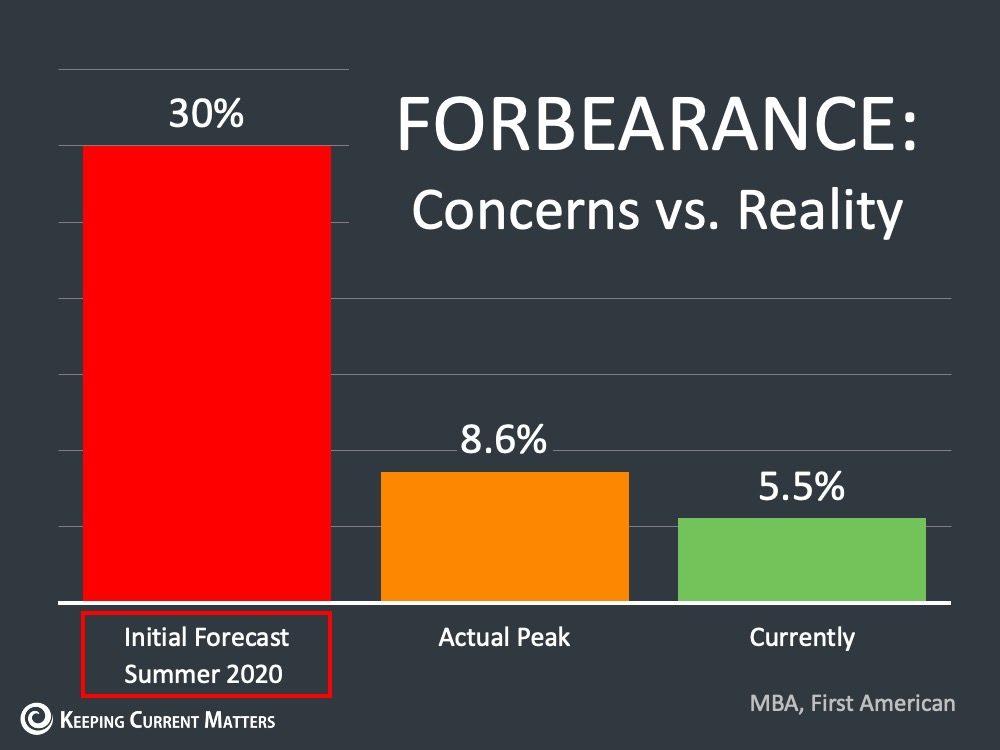
Last week the total number of loans now in forbearance decreased from 5.53% to 5.46% or about 2.7 million homeowners are in forbearance plans.
By stage: 18.49% of loans in forbearance are in their initial stage. Up slightly from 18.27%. 79.85% are in extension, up from 79.61%. The remaining 1.66% are forbearance plan re-entries, down from 2.11% last week.
Of the cumulative forbearance exits for the period from June 1 through December 27, 2020 about 45% are current and 13.2% left with no loss mitigation plan in place. The others either sold, deed in lieu, loan modification, etc. It is the 13.2% of borrowers that are the ones who need extra guidance.
“Surging COVID-19 cases caused economic activity to stall in December, with a monthly job loss for the first time since April, and with those jobs mostly concentrated in the leisure and hospitality sector. We expect that this slowdown will prevent any rapid improvement in the forbearance numbers over the next few months.”
Mike Fratantoni, MBA’s Senior Vice President and Chief Economist
One thing to note is that most forbearance exits happen at the beginning of the month and entries at the end of the month. As the size of the overall change diminishes, we will see the numbers decrease at the beginning of the month and either stay flat or increase at the end of the month.
Equity & Inventory:
Year over year inventory has dropped by nearly 51% while contracts are up nearly 26%. Monthly median appreciation is 16%. And closings are up 26% year over year. We have 0.7 months of inventory. The supply imbalance is pushing prices up quickly.
With equity increasing , struggling homeowners have more and more options.
Sarah Perkins is an award winning account executive and has been in title sales since 2004. As the Director of Industry Research & Senior Account Executive, Sarah’s role is to bring real estate transactions to Navi Title. Sarah supports her clients by helping them navigate the ever-changing real estate space through thorough research and understanding of current trends impacting today’s home buyers and sellers.
In this 12 minute video, Amber Kovarik and I discuss the latest in lending and real estate. We cover political implications and what that means for interest rates, inventory, headlines, and demographics. There was a lot of movement in the past 7 days.
One – Politics:
With the Georgia run-off results, we no longer have a split Congress, what does that mean for real estate?
Real estate responds to policy, not to the controlling party. However, given that Congress and the White House will all be on the same side of the aisle, it will be easier for President-elect Biden to push through his proposed policies. While this is the case, both the house and the Senate majorities have TINY majorities. In the house, in order to have the majority, a party needs to have at least 218 seats. Currently, House Democrats have 222 seats, the smallest majority in over 20 years. The Senate is 50/50 plus the Vice President’s deciding vote. Since all of Congress is nearly evenly split it is unlikely super progressive policy will pass. Experts hope that this will lead to centrist voting.
One thing that does bode well for housing is that it is very bi-partisan, both sides of the aisle support housing initiatives.
As part of his campaign promises, President-elect Biden has two proposed policies that directly impact real estate.
The first is getting rid of 1031 exchanges altogether. The 2017 Tax Cuts and Jobs Act eliminated all 1031 exchanges outside of real estate. Previously you could do a 1031 on anything from airplanes to artwork. Now the proposal is to cut the 100-year-old tax law completely. The additional tax revenue would then be slated for free pre-kindergarten and senior care. This impacts both commercial and residential real estate. This is very unpopular in commercial real estate. Experts are afraid that it will significantly decrease the number of transactions each year. NAR opposes this.
The second proposed policy is a $15,000 first time home buyer tax credit that buyers will be able to use as part of their down payment. Lawmakers and politicians are trying to help first-time homebuyers compete in quickly appreciating markets but they do not understand real estate enough to know what kind of impact that will have on the markets. Creating more demand in an already tight market will only drive prices up further and faster. NAR supports this.
Two – Headlines:
Headlines continue mentioning month over month sales declines at the end of 2020 while they exclude the 26% year over year sales increase in existing home sales through November. Inventory shortages are the primary culprit. Buyers cannot buy houses that are not for sale. (NAR)
Nationwide, available single-family homes dropped down to 419,000 as of Monday. That is 60% below normal. (Altos)
In Greater Phoenix, we are running 70% below normal for inventory. Right now, in Maricopa and Pinal Counties we have fewer than 5300 active listings. Inventory continues to drop while demand remains at 30% above normal. A year ago demand was 2.4% above normal and it was a strong market.
Three – Housing Demographics:
Logan Mohtashami of HousingWire explains economics as housing demographics and the recent years have set the stage for an incredibly strong housing market from 2020 through 2024 due to the roughly 32 million Millennials aged 27-33; prime home-buying age. Not only is the Millennial generation the largest, but it is also the most highly educated generation. Not all 32 million will be buyers but First American estimates that 15 million of them will buy homes in the next 10 years. These are what Mohtashami calls replacement buyers, keeping the demand high and inventory low for years to come.
He warns that the biggest problem facing this housing demographic is runaway prices and increasing mortgage interest rates.
Four – Interest Rates:
They are going up now and there is definitely a new sense of urgency.
Amber shared, “The stock markets were down in all three major indices this morning as the markets continue to digest the implications of a Democrat controlled government to the U.S. economy. Goldman Sachs announced today that they have updated their forecasts as a result of the Georgia elections and they are predicting greater fiscal spending, faster GDP growth, more inflation, and higher interest rates.
Mortgage backed securities prices have consistently trended down every day since January 4. (MBS prices trending downward causes mortgage rates to rise). The markets had expected that Republicans would win at least one race in the Georgia Senate runoff elections, and a divided government scenario would continue. In a divided government scenario, it would have been difficult for Democrats to do larger future stimulus packages and substantial increases in personal and corporate tax rates. The daily drop in MBS prices, and the daily increase in the yield on the 10-year U.S. Treasury bond are a reflection of the markets adjusting to the new perceived landscape for the next 24 months until the next mid-term elections would occur.
Many people are wondering if mortgage backed security prices will rebound after a week of consecutive daily drops (MBS price drops, means higher interest rates). It is very possible that lower MBS prices are the new normal for the market.
Some people have asked if the Federal Reserve would increase their daily MBS purchase levels to try to offset the impact of the Georgia elections on the bond markets. The Fed has never previously communicated that they had a specific targeted mortgage rate in their stimulus strategy, so there appears to be a low probability that the Fed would be increasing the level of their stimulus efforts in the near term. The Fed is being very transparent to clearly signal the markets in advance on what their daily MBS purchase levels will be.
There have been no Fed communications that indicate the Fed is considering increasing the daily levels. The Fed communications so far have continued on the theme that they will hold to their current levels until they have clear signs that the economy is beginning to recover at which point they will allow rates to rise.”
Sarah Perkins is an award winning account executive and has been in title sales since 2004. As the Director of Industry Research & Senior Account Executive, Sarah’s role is to bring real estate transactions to Navi Title. Sarah supports her clients by helping them navigate the ever-changing real estate space through thorough research and understanding of current trends impacting today’s home buyers and sellers.
Welcome to 2021. May this year bring the end of the pandemic, physical/mental/emotional healing, and full classrooms.
Looking back at 2020, no one expected residential real estate to be the sector to save our economy. The years of underbuilding came to a head as demand increased fueled by record-low mortgage interest rates. Existing homes appreciated by 17% in Greater Phoenix.
“Nothing sells like a shortage. We have underbuilt new housing relative to demand for a decade. Building will have to exceed household formation for a number of years to reduce the housing stock ‘debt’ we have accumulated.”
Odeta Kushi, Deputy Chief Economist for First American
Looking forward, 2021 looks like it will shape up to be another very strong year for housing.
Politics:
Just before the November election I wrote about politics and housing and discussed how markets are the strongest with a split Congress. Click here for that post. With the Georgia run-off results, we no longer have a split Congress, what does that mean for real estate?
Real estate responds to policy, not to the controlling party. However, given that Congress and the White House will all be on the same side of the aisle, it will be easier for President-elect Biden to push through his proposed policies. While this is the case, both the house and the Senate majorities have TINY majorities. In the house, in order to have the majority, a party needs to have at least 218 seats. Currently, House Democrats have 222 seats, the smallest majority in over 20 years. The Senate is 50/50 plus the Vice President’s deciding vote. Since all of Congress is nearly evenly split it is unlikely super progressive policy will pass. Experts believe we will see more centrist voting.
One thing that does bode well for housing is that it is very bi-partisan, both sides of the aisle support housing initiatives.
As part of his campaign promises, President-elect Biden has two proposed policies that directly impact real estate.
The first is getting rid of 1031 exchanges altogether. The 2017 Tax Cuts and Jobs Act eliminated all 1031 exchanges outside of real estate. Previously you could do a 1031 on anything from airplanes to artwork. Now the proposal is to cut the 100-year-old tax law completely. The additional tax revenue would then be slated for free pre-kindergarten and senior care. This impacts both commercial and residential real estate. This is very unpopular in commercial real estate. Experts are afraid that it will significantly decrease the number of transactions each year. NAR opposes this.
The second proposed policy is a $15,000 first time home buyer tax credit that buyers will be able to use as part of their down payment. Lawmakers and politicians are trying to help first-time homebuyers compete in quickly appreciating markets but they do not understand real estate enough to know what kind of impact that will have on the markets. Creating more demand in an already tight market will only drive prices up further and faster. NAR supports this.
There is also the question of mortgage regulation. The Biden administration is appointing new leadership for many agencies including the CFPB. Under the Obama administration, the CFPB was heavy into policing and fining financial institutions, like mortgage lenders and title companies. And under the Trump administration, much of the CFPB’s regulatory power was stripped. What it will look like under the Biden administration is still unknown.
National Real Estate:
Nationwide, available single-family homes dropped down to 419,000 as of Monday. That is 60% below normal. (Altos)
In late December a second stimulus package was signed by President Trump. In this recent post, I discuss the stimulus’s impact on housing.
Headlines continue mentioning month over month sales declines at the end of 2020 while they exclude the 26% year over year sales increase in existing home sales through November. Inventory shortages are the primary culprit. Buyers cannot buy houses that are not for sale. (NAR)
“In the short term, existing home sales and housing data will moderate to a more normal trend. And this will be a good thing, so don’t buy into any doom and gloom forecasts based on some moderation of the ‘not-normal’: parabolic data. Keep in mind that the years 2020-2024 have the best housing demographics ever recorded in history, which means we have a healthy number of replacement buyers. Only higher mortgage rates can cool off demand – and that could be a good thing because the best housing market is a stable one.”
Logan Mohtashami, Analyst & Economist for HousingWire
Housing Demographics:
Mohtashami explains economics as housing demographics and the recent years have set the stage for an incredibly strong housing market from 2020 through 2024 due to the roughly 32 million Millennials aged 27-33; prime home-buying age. Not only is the Millennial generation the largest, but it is also the most highly educated generation. Not all 32 million will be buyers but First American estimates that 15 million of them will buy homes in the next 10 years. These are what Mohtashami calls replacement buyers, keeping the demand high and inventory low for years to come.
Lending & Forbearance:
After hitting all-time lows 16 times in 2020, mortgage rates did it again yesterday, hitting a new all-time low of 2.65% for a 30 year fixed mortgage. Despite the newest low, the chief economists of Freddie Mac and MBA both expect rates to move closer to 3% throughout the year. (Freddie Mac)
In a recent article, Tim Glaze with HousingWire said, “Consider the state of mortgage rates over the last 40 years: In the 1980s, Len Kiefer of Freddie Mac noted, 30-year mortgage rates averaged 12%; in the 1990s, they averaged 8%; in the 2000s, they averaged 6%; and in the 2010s, rates averaged around 4%.”
Frank Nothaft, Chief Economist for CoreLogic said, “The housing industry is the most interest-rate sensitive sector in the economy. When mortgage rates are low, they drive buyer demand and owner refinance, fueling home sales and home purchase and refi originations. We expect home sales in 2021 to be more than in 2020. In fact, we expect home sales relative to the housing stock, a measure of home ‘turnover’, in 2021 to be above the average annual turnover rate of the prior two decades.”
Forbearance info changes regularly. This post from Wednesday includes the most recent forbearance numbers and exits. The bottom line is that 13% of the forbearance exits, leave without a loss mitigation plan in place. (MBA)
The AZ Market:
Join us on Zoom next Thursday as Tina Tamboer with the Cromford Report does a market update all about Greater Phoenix. Click here for details and registration.
Inventory is very low; 70.6% below normal and 53% below this time last year.
Demand remains high. It is 31% above normal, a year ago it was 2.4% above normal.
We have just over 4 buyers for every listing available on the market.
The preliminary census numbers are showing that AZ has had about 1 million people move here from 2010-2020. This could entitle us to another seat in Congress. California had its first-ever drop in population. The counties that drive the largest relocation to AZ is LA County and San Diego County. The full Census data should be released in March.
Valley new home permits are up 16% year over year. (Home Builders Association of Central Arizona)
Real Estate News:
PLS, formerly The Pocket Listing Service, rebranded and relaunched as The Property Listing Service after altering its business to fit within the Clear Cooperation Policy and now shows exclusive listings to the public. (Inman)
CoStar purchased the URL houses.com, furthering its entry as a real estate portal with intentions to compete with Zillow. This came shortly after the FTC approved the $250 million acquisition of Homesnap. (Inman)
RedfinNow, Redfin’s iBuyer launched in Phoenix this month. Before Opendoor went public RedfinNow referred iBuyer business to Opendoor in markets where RedfinNow did not have a presence. It seems as though that referral partnership is no longer. (HousingWire)
Final Thoughts:
Continue being the voice of reason for scared sellers and nervous buyers. Use your market knowledge to bring value and confidence to your clients. And let’s continue being part of the solution.
Please share this with your colleagues and clients.
Sarah Perkins is an award winning account executive and has been in title sales since 2004. As the Director of Industry Research & Senior Account Executive, Sarah’s role is to bring real estate transactions to Navi Title. Sarah supports her clients by helping them navigate the ever-changing real estate space through thorough research and understanding of current trends impacting today’s home buyers and sellers.
In this 11 minute video, Lydia Wietsma and I discuss this weeks’ biggest news in forbearance. Each week, the plans, numbers, options, and timelines change.
One – Timelines:
There have been changes in the world of forbearance. And that is a good thing for struggling borrowers. Initially in the CARES Act, the COVID forbearance protection plans were to expire in October 2020. They were then extended to the end of 2020. Now, a recent announcement by the CFPB shows new timelines.
According to the Mortgage Bankers Association, for the third week in a row, forbearance numbers stayed relatively flat. There are about 2.7 million borrowers in a forbearance plan which is roughly 5.53% of mortgages. For all of November and December we hung out at around 5.5%.
At the very end of the year forbearance entrances and exits slowed, likely due to the holidays. Weekly forbearance requests declined last week to the lowest levels since the week of March 15.
Hopefully, the latest stimulus provides aid to the struggling borrowers, despite not having any specific forbearance programs.
The forbearance numbers by stage are more telling. Borrowers entering the initial stage and borrowers re-entering forbearance both decreased. However, borrowers on extension increased to nearly 80% of all loans in forbearance.
Three – Forbearance Exits:
Of the cumulative forbearance exits for the period from June 1 through December 27, 2020:
About 45% of borrowers leaving their forbearance plan are current on their payments.
The group to pay attention to is the 13% of borrowers who left their plan without a loss mitigation plan in place. The others either refinanced, sold, deed-in-lieu (not much in AZ) or did a loan modification.
Many experts believe that struggling borrowers are more likely to sell rather than foreclose. This will benefit those struggling as a regular sale does not negatively impact credit and buyers have very limited options. Any additional inventory is welcome. In Maricopa County, there are only 4,100 single-family homes available and all of ARMLS has fewer than 6,000 listings available. We are 70% below where we should be. Nationwide we only have about 419,000 single-family homes available; low inventory is a challenge everywhere.
Four – Servicing:
Inspection requests have increased over the past 3 weeks. iBuyers are now hiring the servicing companies to do inspections on properties they are buying. They are having 2-3 inspections per acquisition.
Five – Options:
Struggling borrowers still have options. Forbearance continues to be available and American homeowners have more equity that has been available in years. The bottom line is this: Don’t panic sell.
Sarah Perkins is an award winning account executive and has been in title sales since 2004. As the Director of Industry Research & Senior Account Executive, Sarah’s role is to bring real estate transactions to Navi Title. Sarah supports her clients by helping them navigate the ever-changing real estate space through thorough research and understanding of current trends impacting today’s home buyers and sellers.
In this 15 minute video, Lydia Wietsma and I discuss this weeks’ biggest news in forbearance. For a short holiday week, a lot is happening.
One – Forbearance Numbers.
When the CARES Act passed in March, creating forbearance plans, it was expected that around 40 million borrowers would enter an available plan. In reality, since March, about 4.3 million entered a plan. Now, as we end the year, 5.5% of loans or about 2.7 million borrowers remain in a forbearance plan. And nearly 79% of those in forbearance are on extension. Initial plans are 3 – 6 months long and the extensions are 3 – 6 months long.
Based on these timelines, a huge number, 367,000, forbearance plans are set to expire in January. How many will go on extension remains to be seen.
Roughly 45% of borrowers leaving forbearance are caught up and current on their payments.
Two – FHA Extension.
The biggest news in forbearance is FHA’s extension for entering a forbearance plan. If a borrower has an FHA loan they can now call their servicer through February 28, 2021 to get started on a forbearance plan.
For all other mortgage types, the deadline is tomorrow.
Three – Delinquencies.
The biggest news in forbearance is FHA’s extension for entering a forbearance plan. If a borrower has an FHA loan they can now call their servicer through February 28, 2021, to get started on a forbearance plan.
For all other mortgage types, the deadline is tomorrow.
Four – Equity.
For anyone concerned about what the market is doing right now, please keep in mind these things:
Demand continues: Mortgage applications are still increasing and for the week ending on 12/18, mortgage applications are up 26% year over year.
Prices have been increasing since 2012.
American homeowners with a mortgage have an average of $195,000 in equity, a struggling homeowner can sell their home and walk away with cash in their pocket.
In 2020 housing has been the leading sector in our entire economy. Experts predict more of the same in 2021. Rates are expected to stay low with demand high. Many expect to see a strong spring selling season, as long as inventory increases.
Five – Increased Inspections.
Lydia is seeing a lot more servicing requests from the loan servicing company she works with. Last week had a 3 day work week and this week is 4 and each week she has gotten 10 inspection requests, which is more than she has received in two back to back weeks this year. She was told that they are hiring and training more employees now too. Does this mean that they are gearing up for some big things in 2021? The answer remains to be seen.
Six – Not Free Money.
The forbearance plan deferrals are not forgiven, they are to be repaid. This is not free money. Lydia shared another concerning story about borrowers who were not negatively affected by the pandemic who took forbearance and spent the money elsewhere. How many instances of this will come out? We know there will be consequences. The significance of those consequences will be seen in the coming months.
Sarah Perkins is an award winning account executive and has been in title sales since 2004. As the Director of Industry Research & Senior Account Executive, Sarah’s role is to bring real estate transactions to Navi Title. Sarah supports her clients by helping them navigate the ever-changing real estate space through thorough research and understanding of current trends impacting today’s home buyers and sellers.
In this 8 minute video, I cover 4 topics impacting greater Phoenix real estate this week.
One – the Market:
Be mindful of the headlines. Demand remains way above normal but it has fallen slightly below its peak in November. This is causing all kinds of headlines claiming the sky is falling. While our demand is the highest it has been in 9 years, inventory is at the lowest, maybe ever, at least in the past 20 years. Inventory is down 20% just since last month and 51% from a year ago. There are about 6300 available listings. That is it. We could literally use 20,000 more listings in our market, like tomorrow. Nationwide there are fewer than 450,000 single-family residences available.
Also, remember, the market is cyclical, it is normal for activity to slow at the holidays. The best kind of housing market is a stable housing market. For us to move towards more cyclical norms is a good thing.
Existing home sales have declined slightly from November. However, there are still about 25% more pending sales than there were at this time last year.
For new homes, over the past 10 years the average decrease in activity from mid-November to mid-December is 25% and for the same time period, new home sales are up 20% year over year.
The strength of the market is driven by low inventory, high buyer demand, and super-low mortgage rates. This strength is expected to continue into 2021 with, hopefully, an increase in listings.
Two – Population/Migration:
The biggest challenge, that we know of today, is the quickly rising prices, we are up 17% year over year. Increasing supply will slow the price appreciation which will help keep today’s buyers engaged. Over the past 10 years, nationwide, builders have underbuilt for the demand, and it is coming to a head now.
Combine the low inventory with population growth and supply diminishes even faster. The full census numbers come out in March but the preliminary numbers for 2020 are in and Arizona’s population growth is just over 105,000. 2020 actually had slightly fewer people move here than in 2018 and 2019. Over the past 10 years, about 890,000 people moved to Arizona, of which about 80% or 712,000 moved to greater Phoenix.
Further data shows that the mass exodus from big cities has not been what was initially expected. Fewer than 1% of the population left the biggest cities in the country. If you take the homeowners that moved this year in the 50 biggest cities in the country, about 84% stayed in the same city.
Three – Stimulus Bill:
Yesterday, the president signed the $900 billion relief bill into law. There will be a stimulus check, expanded unemployment programs extended through 4/19/2021, additional $300 in weekly benefits extended through 3/14/2021, additional funding for PPP, and an extension to the eviction moratorium through 1/31/2021.
The biggest news for our industry is the $25 billion in rental assistance which allows landlords to apply for funds to cover rents in arrears, utilities, and other housing costs. This is great for landlords as the majority of landlords are mom & pop investors.
Forbearance timelines are not addressed in this stimulus bill. Although last week, FHA announced a 2-month extension on both the foreclosure moratorium and forbearance initiation. This means struggling borrowers who have FHA loans can get started on their initial forbearance plan through 2/28/2021.
Only FHA has extended these, any other struggling borrower who needs to get started on a forbearance plan must call their servicer by the end of the day Thursday.
Four – News:
Last week, another commission based class action lawsuit was filed. This one did not name NAR but did name the local MLS and industry giants like Realogy, Keller Williams, and RE/MAX.
Luxury builder, Camelot Homes will now allow you to take a house for a test drive so to speak, they just announced their “Stay and Play” experience for a new community in Desert Mountain in north Scottsdale.
2021 is expected to be another big year for mergers and acquisitions also, we should expect more IPOs and SPACs for businesses going public.
Sarah Perkins is an award winning account executive and has been in title sales since 2004. As the Director of Industry Research & Senior Account Executive, Sarah’s role is to bring real estate transactions to Navi Title. Sarah supports her clients by helping them navigate the ever-changing real estate space through thorough research and understanding of current trends impacting today’s home buyers and sellers.
In this 13 minute video, Lydia Wietsma and I discuss the most recent five things you need to know about forbearance. The majority of borrowers leaving forbearance are current upon plan exit, only 13% of borrowers leaving their forbearance plan do so without having a loss mitigation plan in place. There is not much time left if someone needs to take advantage of these CARES Act benefits.
We do these updates to help real estate professionals and consumers understand forbearance, and to let struggling borrowers know that although experts are forecasting a tough winter, there are options.
One.
Last week total number of mortgage loans now in forbearance increased slightly from 5.48% to 5.49% as of December 13, 2020. According to MBA’s estimate, 2.7 million homeowners are in forbearance plans.
While the news of an increase is not great, we need to remember total loans in forbearance was expected to hit 30% and our peak was 8.6%.
Two.
Forbearance Numbers by Stage:
18.78% of total loans in forbearance are in the initial forbearance plan stage, which is up very slightly from the previous week which was 18.72%.
78.54% are in a forbearance extension, this is down from the previous week which had 78.72% in extension.
2.69% are forbearance re-entries which is up from the previous week of 2.56%. This group has been slowly growing over the past few weeks.
About 13% of the borrowers exiting forbearance are still behind on their payments and left their program without a loss mitigation plan in place. This is the group that needs to know their options.
When you look at this slide, this means that we are looking at roughly 116,000 borrowers in this situation who will need guidance.
Three.
While the new stimulus bill covers renters, landlords, extends the PPP loan options for small businesses, extended unemployment benefits, and more, it does not extend forbearance plan protections.
Eviction and foreclosure protections were extended through 1/31/2021.
Four.
Borrowers who want to get started in a forbearance plan have 4.5 business left to call their servicer to get started. Time is of the essence.
Five.
Lydia is receiving more and more inspection requests from the servicer she works with. So far this week she has received 10 requests. The activity is picking up.
When exiting forbearance borrowers have a number of options; not all of them require the owner to sell their property. Some of these options include:
Utilizing a 401K in two ways.
Individuals are allowed to borrow from their 401K with the option of paying themselves back with interest, since it is a loan being paid back, essentially paying yourself back there are no penalties. Talk to your 401K administrator for details.
Through provisions of the CARES act, an individual can also withdraw an amount of their 401K with no penalties. Again, talk to your 401K administrator for details.
Permanent loan modification or refinance, after making 3 payments in a row, to something that allows borrowers to stay. Some scenarios include adding the forborne amount at the end of the loan, some pay a lump sum to get caught up, some offer payment plans to get caught back up.
Rentals are in high demand with quickly appreciating values. What about moving out of the property and renting it out to make up the difference in payments.
Sell and buy something more affordable, after 3 payments in a row have been made. Pay off the loan and get a new loan with more agreeable terms.
Sell, pay off the loan and forborne the amount, and rent/move in with family.
Sarah Perkins is an award winning account executive and has been in title sales since 2004. As the Director of Industry Research & Senior Account Executive, Sarah’s role is to bring real estate transactions to Navi Title. Sarah supports her clients by helping them navigate the ever-changing real estate space through thorough research and understanding of current trends impacting today’s home buyers and sellers.
In this 7 minute video, I talk about the 4 things you need to know about greater Phoenix real estate this week.
One – Inventory:
After stabilizing for a few months this summer and fall, available listing inventory is dropping again. We are down to 6,800 active listings. That is down 18% since last month and 50% year over year. It is also 67% below normal.
Our demand is 34% above normal, coupled with incredibly low inventory buyers are struggling to get offers accepted. Despite seasonal demand decreases, we still have about 4 buyers for every available listing.
Two – Appreciation:
The very low supply and above normal demand has pushed prices up all year. We have been in an appreciating market for 8 years. Year over year, the greater Phoenix is running at about a 17% appreciation rate. The huge increases have made some people afraid we are in a bubble, however, today’s market is dramatically different. Dr. Lawrence Yun said, “There is no comparison” between today’s market and the bubble from 2004-2006.
Today, we have true demand versus the false demand we had in 2005. Rents decreased during the bubble, people bought houses solely to park money, today people are living in the property and single family rents are appreciating faster than houses for sale. In 2005, there were extremely loose lending options available requiring no money down and lending up to 120% of the purchase price. Today in order to get a loan, a borrower must have a down payment and meet certain criteria.
Today, the average American homeowner with a mortgage has $194,000 in equity, providing owners with a lot of options. When the market crashed in 2008, few were left with options.
Three – Lending:
2020 is on pace to hit nearly $4.4 trillion in first-lien mortgage originations, the largest volume in history.
Of the roughly 138 million US housing units, 42% have no mortgage, of the roughly 77 million that do have a mortgage about 50% have interest rates in the 4s% or higher. (KCM)
While the Fed does not control mortgage interest rates, it’s consistent purchasing of treasuries and mortgage backed securities has kept rates low. At the most recent meeting, the Fed announced that it would continue purchasing at the same rate until there is “substantial progress” towards an overall stronger economy. Chairman Powell realizes that this will take time and is prepared to stay the course throughout the recovery.
Four – Built to Rent:
About 6% of new single family homes are built-to-rent and will not enter into the market at all. It is expected that nearly 700,000 will be built by 2030. Nationwide, roughly 35% of rentals are single family properties and the demand is rising. There are about 84 million single family residences across the country.
Phoenix-based Christopher Todd Properties is currently developing 943 single-family built to rent homes in greater Phoenix. These communities have apartment-style amenities like gated entry, community pool and fitness area, and carports for parking. Many of these are 1-2 bedrooms and are roughly 1,000 square feet renting for about $1900 a month.
Courtesy of Christopher Todd Properties. Christopher Todd Communities at Stadium, a built-for-rent property of 300 houses in Glendale, AZ.
Sarah Perkins is an award winning account executive and has been in title sales since 2004. As the Director of Industry Research & Senior Account Executive, Sarah’s role is to bring real estate transactions to Navi Title. Sarah supports her clients by helping them navigate the ever-changing real estate space through thorough research and understanding of current trends impacting today’s home buyers and sellers.
Unsurprisingly, the US housing market will finish out the year as the best performing sector in our entire economy. It is good to be part of the solution. Given the performance, low inventory, and low-interest rates driving up demand, a new challenge is emerging – affordability.
Experts forecast a stabilizing housing market for 2021. A stable housing market is good. It is expected that inventory will rise and prices will continue to increase, only at a slower rate. This is not a collapse, it is normalization and it is the path towards stability. Be mindful of the fear-mongering headlines, no bubble, no collapse, no foreclosure crisis. In 1710, writer Jonathan Swift wrote, “Falsehood flies and the Truth comes limping after it.” Somethings never change.
Economy.
Elliott Pollack summed it up with, “The economy will normalize in the second quarter of 2021 due to having COVID-19 vaccines in wide distribution. There is significant pent-up demand in the real estate market, and people are sitting on gobs of cash because they’ve had nowhere to spend it for the past nine months, so we will see explosive growth at first, then continue to grow at above normal trend lines through 2023.”
The Phoenix metro area ranks as the top U.S. job market in 2020 among bigger cities and Arizona has the third-best job market among states trailing only Utah and Idaho. (Elliott Pollack)
Real Estate News.
On 12/21/2020 Opendoor will be publicly traded on the NASDAQ with the symbol “OPEN.”
Mr. Cooper, formerly Nationstar, settled with the Consumer Financial Protection Bureau (CFPB) and will refund $90 million to customers and will pay $6.5 million in damages for foreclosing on borrowers after loan modifications were completed. (HousingWire)
Knock Nest is now available in Phoenix. It is a leaseback program that allows homeowners to sell their property Knock and then rent it back from them. Leases have 12 month terms after which the seller turned renter has the option to renew the lease, buy the property back, or move out.
Last week Airbnb had the largest IPO in 2020 with an opening trade valued at $101.6 billion; as of opening day, Airbnb is worth more than the three largest hotel chains combined, which are Hilton, Marriot, and Intercontinental. (Business Insiders)
Forbes is launching an exclusive, international luxury listing marketplace. The platform is invite only and the minimum listing price allowed is $2 million.
CoStar is unlikely to unseat Zillow’s clear position as the most visited portal. However it continues to make moves to create more competition between the two companies. With the acquisition of Homesnap, CoStar is creating new competitors for subsidiaries of Zillow’s who currently have no competitors, such as StreetEasy in NYC. (Inman)
The AZ Market.
Cromford Market Index (CMI): The CMI is the best leading indicator available (balance is 100, above 100 is a seller’s market and below 100 is a buyer’s market. Prices rise at 110 and drop at 90). Yesterday it was 400.1, an all-time record high. A week ago it was 387.7, a lot of movement in a week! On May 15 it hit bottom at 145.2.
Supply: The reason for the CMI’s height is low inventory. After stabilizing for a few months this summer and fall, available listing inventory is dropping again. We are down to 6,645 active listings excluding UCB. That is down 18% since last month and 50% year over year. It is also 66.4% below normal.
Demand: Our demand is 34.4% above normal, coupled with incredibly low inventory buyers are struggling to get offers accepted. Despite seasonal demand decreases, we still have 4.2 buyers for every available listing.
The Taiwan Semiconductor Manufacturing Company just paid $89 million for 1,128 acres in north Phoenix. The factory expects to bring 1,600-1,900 new jobs. (Rose Law Group)
According to Realtor.com, Phoenix is #6 of the top 10 strongest housing markets expected in 2021, rankings based on job market strength, affordability (despite rising prices, we are the cheapest big city in the country), and proximity to other major metros.
NAR and 20 economists forecasted the top 10 strongest metros for economic strength based on domestic migration, low unemployment, mobility, and more…and Phoenix came in at #1!!
National Real Estate.
As of Monday, there were only 469,000 single-family residences for sale nationwide. There is a total of 84 million single-family residences which means only 0.6% is on the market. (Altos)
With 1.4 million NAR members and only 469,000 listings there are 3 Realtors for every available single family listing in the country.
Inventory usually drops from Thanksgiving through the second week of January, at which point could see 50,000-60,000 new listings hitting the market each week thereafter. (Altos)
Appreciation.
The average national, annual appreciation since 1991 is 3.8%. This is where the 3-4% average came from. (KCM)
The average national, annual appreciation since 2012 is 6.1%. (KCM)
Greater Phoenix has seen a nearly 17% appreciation year over year, which has created some concerns about the 2005 bubble, however today’s market is dramatically different.
Earlier in the year, the average American homeowner with a mortgage had $177,000 in equity. Today it is $194,000, few had that kind of equity in 2005.
“Such a frenzy of activity, reminiscent of 2006, raises questions about a bubble and the potential for a painful crash. The answer: THERE IS NO COMPARISON. Back in 2006, dubious adjustable-rate mortgages taxed many buyers’ budgets. Some loans didn’t even require income documentation. Today, buyers are taking out 30-year fixed-rate mortgages. Fourteen years ago, there were 3.8 million homes listed for sale, and home builders were putting up about 2 million new units. Now, inventory is only about 1.5 million homes, and home builders are under producing relative to historical averages.”
Dr. Lawrence Yun, Chief economist for Nar
Forbearance.
After 25 weeks of decreases, we had 2 weeks of increases, followed by a week of staying flat, and now last week, we had a decline in total mortgage loans in forbearance. It dropped from 5.54% to 5.48% or roughly 2.7 million borrowers. This is good news, since 3 weeks makes a trend.
While people are leaving their forbearance plans, more are leaving through a loan modification which indicates that not everyone has been able to get caught back up, even if they are working.
Forbearance numbers by stage:
Just under 19% are in the initial stage.
Just under 79% are on extension.
About 2.5% are re-entries.
Of the total forbearance exits from June 1 through December 6, 2020:
30% continued to make their payments throughout the term.
16% were caught up upon plan exit.
13% did not make all of their payments and exited forbearance without a loss mitigation plan in place.
For more details on this, click hereto see my latest forbearance video.
Delinquencies.
While yes, there will be homeowners impacted by foreclosure, it will not be a giant number like we saw in 2009-2012. We are not in a bubble, the today’s price appreciation is due to a supply and demand imbalance, not false demand as was the case in 2005.
Keep in mind all loans in forbearance that are late are marked as delinquent despite not being penalized for being late. (Black Knight)
Delinquencies improved in October, decreasing by 3.3% to 6.44%, their lowest level since March. At 1.8 million, seriously delinquent loans, which are 90+ days late is dropping but is still 5x what it was in February. (Black Knight)
Arizona’s delinquency rate is 5.4%, (national is 6.4%) there are 13 states with lower delinquency rates than AZ so we are almost in the top-performing quarter of the states. (Black Knight)
Delinquency rates are the lowest for condos at 4.7%, then 6.8% for single-family houses, and over 9% for 2-4 unit multifamily properties. (Black Knight)
“The COVID-19 pandemic has primarily hit renters, but it has impacted a lot of homeowners, too. As the housing market muscles its way through the current economic downturn, I see foreclosures forming more of a trickle rather than a flood.”
Matthew Gardner, Chief Economist for Windermere
Lending.
Yesterday, for the 15th time this year we hit another all-time low for mortgage interest rates. (Freddie Mac)
2020 is on pace to hit nearly $4.4 trillion in first-lien mortgage originations, the largest volume of any year on record.
Q3 2020 set records across the board, with the largest single quarter of purchases ($455 billion), refinances ($867 billion) and total lending ($1.3 trillion) ever recorded. (Blackknight)
Through September, about 6.4 million homeowners refinanced their primary mortgage, with that number expected to reach over 9 million by the end of the year.
Of the roughly 138 million US housing units, 42% have no mortgage, of the roughly 77 million that do have a mortgage about 50% have interest rates in the 4s% or higher. (KCM)
While the Fed does not control mortgage interest rates, it’s consistent purchasing of treasuries and mortgage backed securities has kept rates low. At the most recent meeting, the Fed announced that it would continue purchasing at the same rate until there is “substantial progress” towards an overall stronger economy. (MBA)
Commercial Real Estate.
Prior to COVID roughly 6% of employees worked from home. In April, 85% of employees worked from home. In mid-October 73% of employees worked from home and our numbers have stayed about the same since. Dallas has the lowest rate of working from home at 60% and San Francisco has the highest rate of 87%. (Elliot Eisenberg)
93.6% of renters living in large, professionally managed apartment complexes paid their rent through the end of November. That number was 95.2% through November 2019; a decrease of 1.6%. Despite the decrease, it is better than initially expected. (Elliot Eisenberg)
About 6% of new single family homes are built to rent and will not enter into the market at all. It is expected that nearly 700,000 will be built by 2030. (RCLCO real estate advisors) According to a 2018 National Bureau of Economic Research study, roughly 35% of rentals are single family properties and the demand is rising.
Phoenix-based Christopher Todd Properties is currently developing 943 single-family built to rent homes in greater Phoenix. These communities have apartment-style amenities like gated entry, community pool and fitness area, and carports for parking.
Courtesy of Christopher Todd Properties. Christopher Todd Communities at Stadium, a built-for-rent property of 300 houses in Glendale, AZ.
Final Thoughts.
Logan Mohtashami of HousingWire said it perfectly, “And remember, my friends, always be the detective, not the troll. Math, facts, and data matter, and the rest is storytelling.”
Please share this with your colleagues and clients.
Sarah Perkins is an award winning account executive and has been in title sales since 2004. As the Director of Industry Research & Senior Account Executive, Sarah’s role is to bring real estate transactions to Navi Title. Sarah supports her clients by helping them navigate the ever-changing real estate space through thorough research and understanding of current trends impacting today’s home buyers and sellers.
In this 13 minute video, Lydia Wietsma and I discuss the most recent five things you need to know about forbearance. The majority of borrowers leaving forbearance are current upon plan exit. There is not much time left if someone needs to take advantage of these CARES Act benefits.
We do these updates to help real estate professionals and consumers understand forbearance, to let struggling borrowers know that although experts are forecasting a tough winter, there are options.
One.
Lydia and I have been watching the numbers very closely. We had our first 2 weeks of increases, followed by a week of staying flat, and now last week, we had a decline in total mortgage loans in forbearance. It dropped from 5.54% to 5.48% or roughly 2.7 million borrowers.
While people are leaving their forbearance plans, more are leaving through a loan modification versus which indicates that not everyone has been able to get caught back up, even if they are working.
Another point to make here is that the initial forbearance requests increased to the highest level since August 2. Servicer requests (renewals or initial) increased to the highest point since April 19. Lydia, that means people are watching our videos and making those calls as we get closer and closer to the cut off at the end of the year. Either our informational videos or the fact that the unemployment numbers are worse than experts predicted, while still moving modestly in the right direction.
To break the forbearance numbers down by stage, of the borrowers in forbearance, just under 19% are in the initial stage, just under 79% are on extension and about 2.5% are re-entries.
Two.
Of the cumulative forbearance exits for the period from June 1 through December 6, 2020:
30% continued to make their payments throughout the term.
16% were caught up upon plan exit
13% did not make all of their payments and exited forbearance without a loss mitigation plan in place.
Three.
The Cares Act created a lot protections for homeowners and renters. However, upon the expiration of the eviction moratoriums struggling renters will be very exposed. The provisions for homeowners are considerably more extensive. Borrowers in forbearance have the benefit of time within a forbearance plan. And even if borrowers are late and then proceed towards foreclosure, that process takes about 6 months. How much time does a renter get? This is another benefit of homeownership.
Also remember homeowners have gained a lot of equity this year and there are options available. There are about 6755 active listings in ARMLS, we should have 25,000, prices will continue to rise.
Four.
Including today and Christmas Eve there are only 11 business days left for borrowers to call their servicer and get started on a forbearance plan. It may be extended but currently the program expires on 12/31/2020.
Servicers are getting more active. Lydia’s requests are increasing, yesterday she had 6 inspection requests. They are getting ready to move forward on loans that are delinquent as soon as the moratoriums are lifted. The foreclosure moratorium expires 1/31/2021.
Five.
When exiting forbearance borrowers have a number of options; not all of them require the owner to sell their property. Some of these options include:
Utilizing a 401K in two ways.
Individuals are allowed to borrow from their 401K with the option of paying themselves back with interest, since it is a loan being paid back, essentially paying yourself back there are no penalties. Talk to your 401K administrator for details.
Through provisions of the CARES act, an individual can also withdraw an amount of their 401K with no penalties. Again, talk to your 401K administrator for details.
Permanent loan modification or refinance, after making 3 payments in a row, to something that allows borrowers to stay. Some scenarios include adding the forborne amount at the end of the loan, some pay a lump sum to get caught up, some offer payment plans to get caught back up.
Rentals are in high demand with quickly appreciating values. What about moving out of the property and renting it out to make up the difference in payments.
Sell and buy something more affordable, after 3 payments in a row have been made. Pay off the loan and get a new loan with more agreeable terms.
Sell, pay off the loan and forborne the amount, and rent/move in with family.
Sarah Perkins is an award winning account executive and has been in title sales since 2004. As the Director of Industry Research & Senior Account Executive, Sarah’s role is to bring real estate transactions to Navi Title. Sarah supports her clients by helping them navigate the ever-changing real estate space through thorough research and understanding of current trends impacting today’s home buyers and sellers.