In this 10 minute video, Amber Kovarik and I discuss the latest in real estate and lending.
Real Estate Headlines:
Many of you may read Inman News and last week they ran a series entitled “Bubble Trouble.” While the headlines are to get our attention, the articles really aren’t about the market crashing. If anyone wants to see any of them, let me know and I will send you the info. Don’t let the headlines scare you or your clients. The market is starting to get more normal, it is not crashing. Demand continues to exceed supply. Here in Phoenix, in March we had 10 buyers for each listing, today we have 5 buyers for each listing, prices are still going up. The decline in demand is allowing some buyers to actually get a contract accepted, which is good. While houses are selling quickly, buyers are educated, now is not the time to push the market. Overpriced listings are sitting and we are seeing more price reductions. This is healthy and good. The roughly 24% year over year appreciation is way too much and unsustainable.
In economics, it all comes down to supply and demand. In real estate, it is about supply, demand, and equity. In 2005 we had a lack of supply, high demand, and no equity. Today, we have even lower inventory, solid demand, and tons of equity. Supply has started increasing slowly, but we are still about 77% below normal. Demand remains nearly 8% above normal.
Eviction Ban Lifted? Nope.
On Wednesday a federal judge lifted that the CDC’s eviction ban, which is set to expire on June 30, after a 7-month lawsuit filed by the Alabama and Georgia Association of Realtors. Within hours the DOJ filed an emergency appeal on the case and issued a stay effectively prohibiting any evictions until the appeals process is over. Legal housing experts are recommending against any evictions prior to June 30th. FTC and CFPB issued a statement to landlords stating they would be held accountable for moving forward with any evictions.
Too Interesting Not to Share:
Loans that originated from 2005-2008 make up only 2% of existing loans but those loans make up 5x the seriously delinquent rate when compared to loans that originated since 2009. Those loans are still haunting us!
Lending:
Interest rates increased quickly earlier this year and then came back down quickly. They remain right around 3%.
Sarah Perkins is an award winning account executive and has been in title sales since 2004. As the Director of Industry Research & Senior Account Executive, Sarah’s role is to bring real estate transactions to Navi Title. Sarah supports her clients by helping them navigate the ever-changing real estate space through thorough research and understanding of current trends impacting today’s home buyers and sellers.
In this 12 minute video, Amber Kovarik and I discuss the latest in real estate trends and lending from the past week.
It is almost daily I hear people talking about how they will get into the market when prices go back down. And they do not like my follow-up question asking why they think the market will go down. They don’t like my question because they cannot give me an answer. They tell me they are afraid things are like they were in the 2005 bubble.
Today’s market is nothing like the 2005 bubble. We have real demand. We have real appreciation due to people actually wanting to move here and live in houses here. Economic cycles are based on supply and demand.
Our market peaked on March 14th. What does that mean? It means that demand is falling faster than supply. What does that mean? It means that we are moving towards a more balanced, healthy market. Balance and healthy are good. Demand remains slightly elevated, at about 9% above normal. Supply is rising, so we are now only below normal by 77.4%!!! That is an increase from 78% below normal. Demand needs to fall below supply in order for prices to drop. That is not happening anytime soon.
When you combine basic supply and demand it is important to think about where demand comes from. There are more than 32,400,000 Americans aged 27-33. This is the largest group, in the largest generation and this is the prime time for getting married, having babies, and buying houses. This demand is expected through 2024.
Even with increasing prices and increased interest rates, there are still enough replacement buyers for the listings even if some buyers are removed from the market.
Another fear I hear about is overbuilding. Builders are not overbuilding, they are attempting to pick up from the underbuilding that has taken place for the past decade. Builders learned a very tough lesson in the 2008 crash and they shifted their business models and will not overbuild. Business is good for builders right now.
Institutional investors are another reason we have tight supply. Since the end of the Great Recession, institutional investors have purchased over 7M single-family homes to keep as rentals. These buyers are home rental firms, like Invitation Homes which owns about 80,000 houses in 16 markets, private equity, pension funds, sovereign wealth funds, etc.
According to John Burns Real Estate Consulting, institutional investors are currently purchasing about 20% of all single-family homes in the US. Due to the continuously climbing rental rates in Phoenix, these buyers are purchasing about 30% of the single-family supply. They pay cash and will go over the asking price in order to secure the property; something many buyers simply can’t compete with. Additionally, these properties are held longer than a typical owner stays, meaning these properties are being completely removed from the market.
With forbearance numbers improving, we’re down to about 2.3 million borrowers in forbearance and Mike Fratantoni Senior Vice President of the MBA said, “In terms of performance, more than 88 percent of homeowners who have exited into deferral plans, modifications or repayment plans were current on their loans at the end of March, compared to 92 percent of all homeowners.”
A recent article shared insight into Google search queries. People asking, “When is the housing market going to crash?” increased by 2,450% in the past 30 days.
The market is actually starting to normalize and a semblance of seasonality is starting to emerge. These are good things. If you or your clients have questions on where the market indicators are pointing, let’s talk. Recoveries are fragile and misinformation is toxic.
There are a lot of strategies available for buyers who are looking to make strong, over asking offers.
Sarah Perkins is an award winning account executive and has been in title sales since 2004. As the Director of Industry Research & Senior Account Executive, Sarah’s role is to bring real estate transactions to Navi Title. Sarah supports her clients by helping them navigate the ever-changing real estate space through thorough research and understanding of current trends impacting today’s home buyers and sellers.
In this 10 minute video, Amber Kovarik and I discuss the latest in mortgage rates, unemployment, inflation, and inventory.
Headline:
I would like to address a very specific headline I am seeing more and more often. It is the one that says there are 10 million mortgage borrowers behind on their payments. That is NOT the case. According to the US Census, there are about 10 million renters and borrowers behind on their payments. And according to Black Knight, who does the most thorough analysis of delinquencies and forbearances, about 3.4 million borrowers are delinquent on their payments, and that number includes borrowers in forbearance. With that being said, it is safe to assume that there are about 6.6 million renters behind on their payments. The renter data is tough to collect so I am not sure if that is just the count in large apartment complexes or if that includes single-family renters.
These numbers are important to keep in mind when we look at the future health of the housing market.
Policy:
Today the CFPB proposed furthering the ban on foreclosures through the end of 2021. Under current CFPB foreclosure rules, a borrower must be 120 days delinquent before the foreclosure process can start. I am not sure what the timelines are for those who were in the foreclosure process last year when the moratoriums were put in place. The services want to start where they left off, but will they be able to? It sounds like the CFPB does not agree though. The 120 days is to protect those who exiting their forbearance plan more than 90 days late from immediate foreclosure.
Last week the CDC extended the eviction moratorium for the third time, this time through 6/30/21.
Market Shift:
There is a lot of talk about the market shifting. It is and this is a good thing. Don’t be nervous when you hear other agents are talking about fewer showings and fewer offers. Going from 30 offers to 5 offers is still great for the seller. Demand is dropping faster than supply. Supply has leveled over the past few weeks, it is still 78% below normal while demand is 11% above normal. As long as demand is higher than supply, prices will go up. The 19-20% appreciation rate we are seeing is not healthy and as people are priced out of the market due to sky-high appreciation, demand will continue to slow. Prices will still go up, just at a slower rate.
Our local median sales price reached nearly $360,000 and the national median sales price reached an all-time high of $370,000. That is even higher than the housing bubble highs.
Interest Rates:
The stock markets have hit all-time record highs this morning after being closed all day Friday. The Friday new jobs report, which showed 916,000 new jobs created in March, the best monthly report in 7 months, and today’s better-than-expected ISM index report on the growth of the services sector of the U.S. economy, are the two top drivers of the markets this morning.
In regards to interest rates, there are two independent forces in play that could push up interest rates on 30-year fixed-rate mortgages. The first is a general force that will push up all interest rates, due to a rebounding economy which increases the demand for borrowing and drives inflation rates higher. As the U.S. economy continues to recover, this traditional force of supply-and-demand will naturally push up the rates on 30-year fixed-rate mortgages.
The second important force, which specifically applies to mortgage rates, is the Fed’s monthly mortgage-backed security purchases which are artificially holding mortgage rates 1/2 – 1% below where they would be in a normal market price. The Fed cannot continue these monthly purchases indefinitely and at some point, they will need to reduce and then stop these completely. The Fed will stop when unemployment clearly reaches 4.00-4.50% and inflation consistently exceeds 2.00%.
Second Home Loans:
The MBA and many lenders and mortgage companies have stated opposition to the recent Fannie Mae and Freddie Mac rule only allowing 7% of their portfolios for second home loans. Currently, most lenders are selling closer to 14% of their second home loan portfolio to the GSEs. What many lenders are doing is increasing the interest rates on those loans. Guild has increased refinances by about 1% hoping that satisfies the requirement and allows them to sell those loans to other investors. As more info comes out about these changes, we will be sure to share the news.
Sarah Perkins is an award winning account executive and has been in title sales since 2004. As the Director of Industry Research & Senior Account Executive, Sarah’s role is to bring real estate transactions to Navi Title. Sarah supports her clients by helping them navigate the ever-changing real estate space through thorough research and understanding of current trends impacting today’s home buyers and sellers.
In this 12 minute video, Amber Kovarik and I discuss the latest in housing, lending, and proposed policy.
Affordability:
Affordability is and will remain the biggest issue in real estate this year. Not only are prices increasing quickly, but builders are also struggling with the supply chain, labor shortages, and lumber increasing by 200%. The average additional cost to builders is $24,000 per home and that is being pushed to the buyers.
The increased cost, increased interest rates, and cold winter are all reasons why builders slowed their production in February.
Offerpad:
Offerpad is going public with former Zillow CEO, Spencer Rascoff’s SPAC. Since Rascoff left Zillow, Rich Barton has poured tons of money and resources into building up Zillow Homes, Zillow’s iBuyer. This will give Offerpad an equity position of $3 billion and up to $650 million in cash.
PRO Act:
The PRO Act is currently moving through Congress and President Biden said he would sign it. As it stands now it impacts independent contractor status and would make it so that anyone who is not incorporated will be considered an employee. Most Realtors create an LLC or PLLC and are employees of their entity. This impacts the 27 right-to-work states including Arizona. I have read arguments on both sides and I have no idea if it will pass or not but if it does, there could have an immediate impact on real estate.
The timing is interesting as we see many companies following Redfin’s path of employee agents. Zillow, Opendoor, and Homie all have agent employees. Last week Homie announced that they are hiring 1000 buyer agents nationwide.
The AZ Market:
Locally, active listings have, finally, stopped dropping. This could be for several reasons. The best one is that maybe we are going back to some element of seasonality and March is the time of year when we have the most inventory growth. Now the numbers are not going up, but they are not dropping. We have like 10 more listings than we had a month ago. Demand is dropping though, faster than supply. It remains nearly 14% above normal while supply is nearly 78% below normal. This means that sellers are getting 10 offers instead of 50 and that appreciate rates will slow. We do not need 20% appreciation rates so this is good for the market. We are currently unsustainable. The market needs some stability and allowing inventory to rise and demand to fall will get us there. And as long as demand remains above supply, prices will continue to go up. No one is expecting a crash or for values to go down.
The demand dropping is primarily due to buyer exhaustion, affordability challenges from quickly appreciating prices, and interest rates going up, but not as much as one would think.
Lending:
Interest Rates:
Interest rates have been on quite the tear lately. The market headline is that interest rates hit 14-month highs due to market expectations of a recovering economy and increasing inflation.
Today there is a small glimmer of hope for interest rates as the 10-year Treasury bond yield, which hit a high of 1.754% on Friday did not keep going higher so far today.
The pause in the continuous rise of the Treasury bond yields over the past six weeks, is giving hope that interest rates might stabilize for a while.
Amber also discussed the importance of talking with all pre-approved buyers, rates are 3.5% now. If a buyer wins an offer in this competitive market it is important that they still qualify for the loan and make the monthly payments.
Fannie Mae & Freddie Mac Restrictions:
She also explains what the new Fannie and Freddie regulations mean for second home and investor purchases. Just because the GSEs loan portfolio is now limited to 7% for second home loans; that doesn’t mean those are the only options. There are other options for second home borrowers but they will come at higher interest rates which could further slow demand. As the changes are implemented, we will continue to share the implications and options for these buyers.
This chart is a recent MBA chart of the week and it shows the growth in second home mortgage applications, either for purchase or refi. The MBA provides this commentary, “In February 2021, 10.1 percent of all applications in the retail and consumer direct channels were for a non-primary residence. This was an increase from 9.5 percent the previous month. 2019 and 2020 saw annual averages of approximately 8 percent. Breaking down the categories, second-home transactions accounted for 3.6 percent of all applications and investment properties were 6.5 percent, totaling 10.1 percent. Average loan sizes as of February 2021 were $430,000 for second homes and $263,000 for investment properties.”
Mortgage Banker’s Association 3/12/21 Chart of the Week
Sarah Perkins is an award winning account executive and has been in title sales since 2004. As the Director of Industry Research & Senior Account Executive, Sarah’s role is to bring real estate transactions to Navi Title. Sarah supports her clients by helping them navigate the ever-changing real estate space through thorough research and understanding of current trends impacting today’s home buyers and sellers.
In this 9 minute video, Amber Kovarik and I discuss the latest in real estate and lending.
M & A and Industry Changes:
There is news of new mergers and acquisitions nearly every week. Two weeks ago it was Zillow’s $500 million acquisition of ShowingTime and last week it was Redfin’s $608 million acquisition of RentPath.
Many companies are spending big money on PropTech investments and acquisitions. Their end goal is to create the end to end platform for real estate transactions. That may look different from company to company, state to state but for real estate, the speed of new tech adoption is increasing drastically.
Zillow announced last week that in 20 markets, including Phoenix, their Zestimate will also be their iBuyer offer from Zillow Homes, as long as the property qualifies. In order to qualify, a property must fit Zillow’s buy box which is an average sized home, around the median price, that only needs light renovations.
Regardless of the reality of the situation, consumers will now expect, at a minimum listed Zestimate. It now seems like an initial offer and not an opinion. This is all about perception; not the reality that a property has to qualify. Because now, sellers see a clear bottom price. Why would they ever accept an offer less than the Zestimate? Yes, in today’s market, getting above the Zestimate, even above the appraised value, is not difficult. However, this too shall pass; nothing lasts forever, especially not in real estate.
If you do not already, I highly encourage you to check out the Zestimate before going on another listing appointment. Sellers do their homework and they know that number when you arrive.
The Zestimate live offer feature is available to qualifying homes in Phoenix and Tucson, AZ; Charlotte and Raleigh, NC; Miami, Jacksonville, Orlando and Tampa, FL; Portland, OR; Denver, Colorado Springs and Fort Collins, CO; Nashville, TN; San Diego, Los Angeles, Riverside and Sacramento, CA; Dallas, Houston and San Antonio, TX; Las Vegas, NV; Atlanta, GA; and Minneapolis, MN.
Inventory:
Inventory remains low. Crazy low. Demand, which has been elevated is now dropping faster than inventory. Our demand is now about 19% higher than normal and inventory is over 76% below normal. Prices continue to go up with no end in sight. The limited inventory is the cause of the decreasing number of pending listings each month. We are still running 13% above last year when we had significantly more listings available.
Notarize:
Notarize is offering free notarizations to update old documents, like CC&Rs, to remove racist language in an effort to fight systemic racism in real estate. Learn more here and here.
Lending:
Amber discusses the rise of interest rates and the reasons why. A stronger economy, lower unemployment, more confidence, the light at the end of the tunnel. There is a lot of activity and the markets are responding favorably.
As the economy gains strength, expect the Fed to pull back on its mortgage backed securities. This is all part of the normalization of the market. The low rates were manipulated to aid the economy during the height of the pandemic but as there is improvement, the Fed will back off and rates will normalize at the levels that match the market.
Continue setting expectations with buyers and make sure that they prepared for the day-to-day changes happening in housing and lending.
Sarah Perkins is an award winning account executive and has been in title sales since 2004. As the Director of Industry Research & Senior Account Executive, Sarah’s role is to bring real estate transactions to Navi Title. Sarah supports her clients by helping them navigate the ever-changing real estate space through thorough research and understanding of current trends impacting today’s home buyers and sellers.
In this 11 minute video, Amber Kovarik and I discuss the latest in real estate, lending, and the economy. There are some major emerging trends that were predicted for 2021 and they are all happening now; only 6 weeks into the year. Rates have moved up slightly, and Amber talks about why.
2021 Megatrends:
Mike DelPrete said at a recent Inman presentation “The industry is moving very slowly, but it’s never moved this fast.” And he is right! At the national level, there is a lot of activity right now. We are seeing leadership changes, Josh Team announced today that he is leaving his position as the president of Keller Williams and is leaving the company entirely. Last week Redfin announced its $608 million acquisition of RentPath and Zillow made some serious waves with its recent announcement of its $500 million acquisition of ShowingTime.
During the same presentation DelPrete discussed the 5 megatrends to watch for in 2021. Given that we are hardly 2 months into the year and his megatrends are pretty apparent.
Portals are moving closer to the transaction. Zillow and Showingtime. Zillow Homes the brokerage that launched in Phoenix and other markets on January 1 are two examples.
Agents as employees. Homie, Redfin, Zillow, Rex Homes all have employee agents. It is all about control.
New models are here to stay, iBuyers, despite not yet being profitable are not going away. When Opendoor went public in late December they came into $1 billion cash to use to get profitable.
The battle for adjacent services; while the most lucrative are title and lending; these also include moving concierge services, renovation, and inspection services. Homie has done a very good job of selling its adjacent services and quickly became a profitable startup.
Asymmetric disruption: likely to be the biggest trend of the year, big outside companies entering the real estate space, funded by venture capital, meaning they do not need to make money. For example Zillow can stand to lose $600 million without losing its foothold on the industry.
DelPrete went on to say, “That sets the trend, that’s what you’re competing against, a company that doesn’t have to make money.”
Good Time to Buy? Yes!
With fewer than 4400 active listings on the market, the seller’s market is intense. BUT it is still a great time to buy. Rates are still low but have started to move up slowly.
Even with the rate increases; rates remain near all-time lows and it is a great time to buy. It is important to proactively educate your clients. They need to know what it takes to get an offer accepted in today’s environment. Buyers with loans can still have the winning offer over cash buyers when the offer is structured properly.
Why Are Rates Going Up?
Amber Kovarik shared, “As the markets attempt to predict when the Fed will begin to taper their stimulus, they are watching the key economic metrics of the employment rate and the inflation rate. The simple math of increasing daily vaccinations will mathematically push down the daily counts of new infections, possibly at an accelerating decline. As this happens, businesses will re-open, jobs will come back, consumer spending will go up, vaccinated people will begin to travel and inflation rates will go up. These forces will be further supported by the largest series of economic stimulus package spending in the history of the U.S. economy.
As the economy recovers this will naturally push bond prices down (which causes interest rates to rise) through normal forces of supply and demand. When the inflation rate picks up, this will create further pressure to push interest rates up. The large stimulus package soon to be approved by Congress will further push down the demand and the price for bonds, and will add an increased pressure to push inflation rates higher. All of these forces combined create significant and very powerful market forces to push interest rates higher.
Then on top of these very powerful forces above, when the Fed decides to taper their daily mortgage-backed security purchases, this will add an additional and very powerful pressure pushing down bond prices (causing higher interest rates) on top of the above normal market forces. When the Fed began buying mortgage-backed securities, this had a huge impact on prices. The reverse will happen when they exit. Nobody knows when the Fed will officially taper their purchases, but the markets know that it will happen, it is just a matter of when.”
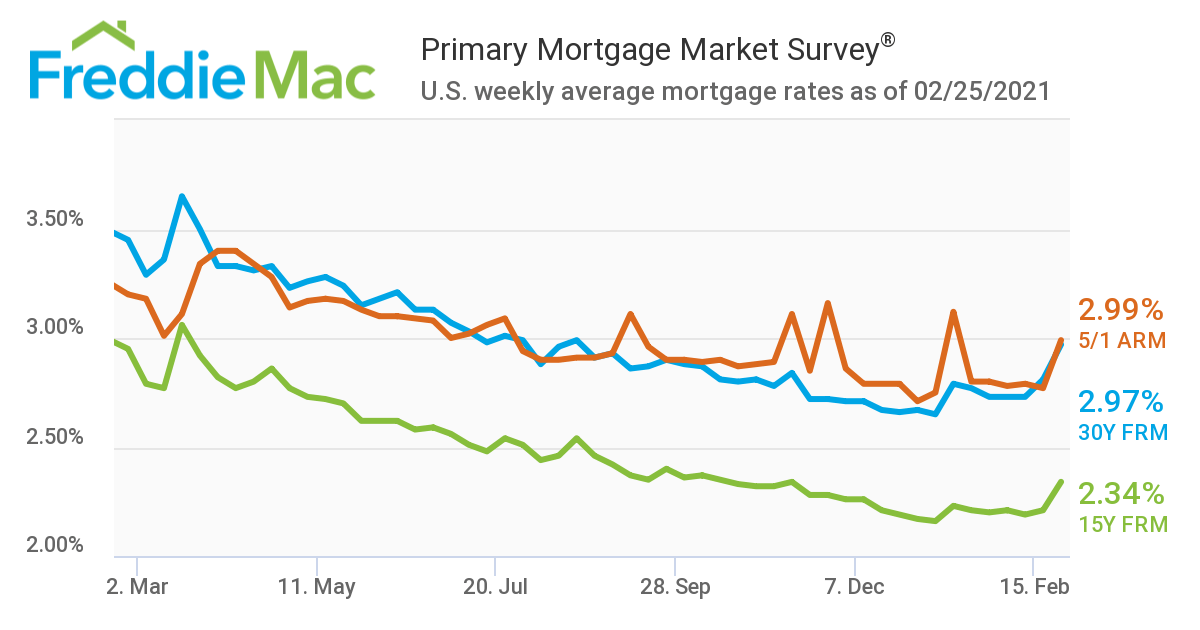
This chart shows the past 6 months of interest rates. The all-time low was reached on 1/4/21.
Sarah Perkins is an award winning account executive and has been in title sales since 2004. As the Director of Industry Research & Senior Account Executive, Sarah’s role is to bring real estate transactions to Navi Title. Sarah supports her clients by helping them navigate the ever-changing real estate space through thorough research and understanding of current trends impacting today’s home buyers and sellers.
In this 9 minute video, Amber Kovarik and I discuss the latest in real estate, lending, and the economy. The biggest topics continue to revolve around shrinking inventory, sly-rocketing prices, and low-interest rates. Here is the latest:
One – Inventory:
Nationwide and locally our low levels of inventory continue to be a challenge. Nationwide we have fewer than 390,000 single-family properties available. Here locally we have less than 5400 active listings. According to the Cromford Report, we are 73% below where we should be for inventory to support our population. Demand remains over 28% above normal.
“This is what we call the homeowner prisoner’s dilemma. There’s nothing to buy because nobody is selling, but nobody is selling because there’s nothing to buy.”
Mark Fleming, First American
Two – Appreciation:
The classic supply and demand imbalance continues to push prices up quickly. Nationwide we had appreciation of 13% in 2020 and nearly 17% here in greater Phoenix. Nationwide, the seller’s market actually started in 2012 and here in Phoenix it started in 2014, the crash hit Phoenix extra hard. The 6 years leading up to 2020 our markets appreciated 8%-10% in each 2018 and 2019. The market intensity had been growing leading up to 2020.
Three – Affordability & Policy:
The main underlying theme for housing in 2021 is affordability. The speed of today’s appreciation combined with the years of significant appreciation make things really tough on our current buyers. Expect more policy and programs coming out of DC addressing this issue. The latest proposed stimulus includes eviction, foreclosure, and forbearance extensions through September 30, 2021 which above and beyond the recent executive orders extended those programs through the end of March. The proposed stimulus includes another $30 billion for rental assistance to help landlords.
Four – Zillow News:
Zillow is officially a brokerage with agent-employees who will represent Zillow for its acquisitions and sales through its iBuyer program, Zillow Homes. This changes a few things for consumers. The Zestimate will now be far more accurate as Zillow now as a direct IDX feed connected to the MLS versus negotiated feeds set up with brokers, companies, and MLS’s. Buyer agents will now be called “personal guides” and will be showcased separately from the listing agent for each listing on the site. Also, Zillow is no longer offering free rental listings. In order to post rental listings the agent either pays $9.99 a week or their brokerage has a contract through a Feed Connection Program.
Five – The Economy:
Many economists are bracing for a rough winter. Consumer sentiment may take a hit. There are struggles with continued lockdowns leading to continued layoffs and high unemployment. But as the vaccine continues its rollout and the economy reopens these economists expect a strong recovery in Q2 or Q3 of this year. Businesses will open back up, people will go back to work, people will spend money on entertainment again. Since it was not an economic event that stopped the machine, they expect it to start right back up again and go straight back into a bullish economy.
Six – Lending:
Borrowers continue to struggle when writing offers when they need down payment assistance or ask for closing costs. Nearly no one with closing cost requests are getting them. Finding other options outside of down payment assistance programs is best for getting offers accepted.
At the beginning of the year rates went up after the Georgia election and rose more several days in a row before retreating again. Rates are now 1/8 point lower than they were last week.
The Federal Reserve meets Wednesday. They are expected to vote to continue buying mortgage-backed securities at a rate of $40 billion a month. Their goal is to keep rates low to continue the buyer demand.
Sarah Perkins is an award winning account executive and has been in title sales since 2004. As the Director of Industry Research & Senior Account Executive, Sarah’s role is to bring real estate transactions to Navi Title. Sarah supports her clients by helping them navigate the ever-changing real estate space through thorough research and understanding of current trends impacting today’s home buyers and sellers.
In this 12 minute video, Amber Kovarik and I discuss the latest in lending and real estate. We cover political implications and what that means for interest rates, inventory, headlines, and demographics. There was a lot of movement in the past 7 days.
One – Politics:
With the Georgia run-off results, we no longer have a split Congress, what does that mean for real estate?
Real estate responds to policy, not to the controlling party. However, given that Congress and the White House will all be on the same side of the aisle, it will be easier for President-elect Biden to push through his proposed policies. While this is the case, both the house and the Senate majorities have TINY majorities. In the house, in order to have the majority, a party needs to have at least 218 seats. Currently, House Democrats have 222 seats, the smallest majority in over 20 years. The Senate is 50/50 plus the Vice President’s deciding vote. Since all of Congress is nearly evenly split it is unlikely super progressive policy will pass. Experts hope that this will lead to centrist voting.
One thing that does bode well for housing is that it is very bi-partisan, both sides of the aisle support housing initiatives.
As part of his campaign promises, President-elect Biden has two proposed policies that directly impact real estate.
The first is getting rid of 1031 exchanges altogether. The 2017 Tax Cuts and Jobs Act eliminated all 1031 exchanges outside of real estate. Previously you could do a 1031 on anything from airplanes to artwork. Now the proposal is to cut the 100-year-old tax law completely. The additional tax revenue would then be slated for free pre-kindergarten and senior care. This impacts both commercial and residential real estate. This is very unpopular in commercial real estate. Experts are afraid that it will significantly decrease the number of transactions each year. NAR opposes this.
The second proposed policy is a $15,000 first time home buyer tax credit that buyers will be able to use as part of their down payment. Lawmakers and politicians are trying to help first-time homebuyers compete in quickly appreciating markets but they do not understand real estate enough to know what kind of impact that will have on the markets. Creating more demand in an already tight market will only drive prices up further and faster. NAR supports this.
Two – Headlines:
Headlines continue mentioning month over month sales declines at the end of 2020 while they exclude the 26% year over year sales increase in existing home sales through November. Inventory shortages are the primary culprit. Buyers cannot buy houses that are not for sale. (NAR)
Nationwide, available single-family homes dropped down to 419,000 as of Monday. That is 60% below normal. (Altos)
In Greater Phoenix, we are running 70% below normal for inventory. Right now, in Maricopa and Pinal Counties we have fewer than 5300 active listings. Inventory continues to drop while demand remains at 30% above normal. A year ago demand was 2.4% above normal and it was a strong market.
Three – Housing Demographics:
Logan Mohtashami of HousingWire explains economics as housing demographics and the recent years have set the stage for an incredibly strong housing market from 2020 through 2024 due to the roughly 32 million Millennials aged 27-33; prime home-buying age. Not only is the Millennial generation the largest, but it is also the most highly educated generation. Not all 32 million will be buyers but First American estimates that 15 million of them will buy homes in the next 10 years. These are what Mohtashami calls replacement buyers, keeping the demand high and inventory low for years to come.
He warns that the biggest problem facing this housing demographic is runaway prices and increasing mortgage interest rates.
Four – Interest Rates:
They are going up now and there is definitely a new sense of urgency.
Amber shared, “The stock markets were down in all three major indices this morning as the markets continue to digest the implications of a Democrat controlled government to the U.S. economy. Goldman Sachs announced today that they have updated their forecasts as a result of the Georgia elections and they are predicting greater fiscal spending, faster GDP growth, more inflation, and higher interest rates.
Mortgage backed securities prices have consistently trended down every day since January 4. (MBS prices trending downward causes mortgage rates to rise). The markets had expected that Republicans would win at least one race in the Georgia Senate runoff elections, and a divided government scenario would continue. In a divided government scenario, it would have been difficult for Democrats to do larger future stimulus packages and substantial increases in personal and corporate tax rates. The daily drop in MBS prices, and the daily increase in the yield on the 10-year U.S. Treasury bond are a reflection of the markets adjusting to the new perceived landscape for the next 24 months until the next mid-term elections would occur.
Many people are wondering if mortgage backed security prices will rebound after a week of consecutive daily drops (MBS price drops, means higher interest rates). It is very possible that lower MBS prices are the new normal for the market.
Some people have asked if the Federal Reserve would increase their daily MBS purchase levels to try to offset the impact of the Georgia elections on the bond markets. The Fed has never previously communicated that they had a specific targeted mortgage rate in their stimulus strategy, so there appears to be a low probability that the Fed would be increasing the level of their stimulus efforts in the near term. The Fed is being very transparent to clearly signal the markets in advance on what their daily MBS purchase levels will be.
There have been no Fed communications that indicate the Fed is considering increasing the daily levels. The Fed communications so far have continued on the theme that they will hold to their current levels until they have clear signs that the economy is beginning to recover at which point they will allow rates to rise.”
Sarah Perkins is an award winning account executive and has been in title sales since 2004. As the Director of Industry Research & Senior Account Executive, Sarah’s role is to bring real estate transactions to Navi Title. Sarah supports her clients by helping them navigate the ever-changing real estate space through thorough research and understanding of current trends impacting today’s home buyers and sellers.
In this 10 minute video, Amber Kovarik and I discuss the latest in lending and real estate. We cover inventory, demographics, population growth, interest rates, and appraisals.
One – Inventory:
As always, be mindful of the headlines. Yes, we did just have 3 months in a row with decreasing numbers going into escrow. There are two reasons. One, seasonality, it is good to have some semblance of seasonality coming into our market. It is a sign of normalization and normal is stable and stable is good for housing.
The other reason is the low inventory. I know, it is like beating a dead horse. There are very, very few listings on the market. There are like 6100 properties for sale in greater Phoenix and, as of last week, there were only 437,000 single-family residences on the market in the whole country! Dr. Lawrence Yun has said several times the decline in listings under contract is due to lack of inventory.
Despite the month-over-month decline, nationwide, through November existing home sales are up nearly 26%!
Two – Housing Demographics:
There is a lot of fear about a bubble. There is a lot of data and there are many moving parts, particularly with eviction and foreclosure moratoriums, it is hard to know what will happen next. There are some economists that say that due to housing demographics and timing, COVID actually slowed down the housing market. What I mean by the demographics is that right now the biggest group of millennials are aged 26-32 which is the time when many are getting married, having kids, and settling down. This is the time when most people buy houses. We are also talking about the largest generation and most well-educated generation. Unemployment has hit people the hardest with a high school education or less. Given that this population is the most well educated in history, it is the largest home-buying generation. This extremely large buyer pool is expected to drive a significant amount of real estate transactions from 2020 through the end of 2024. We just need more inventory!
Three – Census:
The preliminary census numbers are showing that AZ has had about 1 million people move here from 2010-2020. This could entitle us to another seat in Congress. California had its first-ever drop in population. The counties that drive the largest relocation to AZ is LA County and San Diego County.
The full census numbers should be out in March.
Four – Interest Rates:
Rates have been insulated by the Fed buying mortgage-backed securities. The Georgia Senate race could impact rates in that if a new party becomes the controlling party in the Senate, the markets usually move which could push rates. The market likes stability when things change markets shift. This could create volatility.
Increased rates will put pressure on affordability. The current low rates are helping with affordability during a time of double-digit appreciation.
Five – Appraisals:
Appraisals are still coming in low from time to time. It seems to happen more often when the listing agent does not communicate with the appraiser, prepping them with the comps and other information supporting the price. There are some methods that are working when dealing with a low appraisal. Amber has appraisal gap strategies that are helping buyers win offers.
Sarah Perkins is an award winning account executive and has been in title sales since 2004. As the Director of Industry Research & Senior Account Executive, Sarah’s role is to bring real estate transactions to Navi Title. Sarah supports her clients by helping them navigate the ever-changing real estate space through thorough research and understanding of current trends impacting today’s home buyers and sellers.
In this 8 minute video, I cover 4 topics impacting greater Phoenix real estate this week.
One – the Market:
Be mindful of the headlines. Demand remains way above normal but it has fallen slightly below its peak in November. This is causing all kinds of headlines claiming the sky is falling. While our demand is the highest it has been in 9 years, inventory is at the lowest, maybe ever, at least in the past 20 years. Inventory is down 20% just since last month and 51% from a year ago. There are about 6300 available listings. That is it. We could literally use 20,000 more listings in our market, like tomorrow. Nationwide there are fewer than 450,000 single-family residences available.
Also, remember, the market is cyclical, it is normal for activity to slow at the holidays. The best kind of housing market is a stable housing market. For us to move towards more cyclical norms is a good thing.
Existing home sales have declined slightly from November. However, there are still about 25% more pending sales than there were at this time last year.
For new homes, over the past 10 years the average decrease in activity from mid-November to mid-December is 25% and for the same time period, new home sales are up 20% year over year.
The strength of the market is driven by low inventory, high buyer demand, and super-low mortgage rates. This strength is expected to continue into 2021 with, hopefully, an increase in listings.
Two – Population/Migration:
The biggest challenge, that we know of today, is the quickly rising prices, we are up 17% year over year. Increasing supply will slow the price appreciation which will help keep today’s buyers engaged. Over the past 10 years, nationwide, builders have underbuilt for the demand, and it is coming to a head now.
Combine the low inventory with population growth and supply diminishes even faster. The full census numbers come out in March but the preliminary numbers for 2020 are in and Arizona’s population growth is just over 105,000. 2020 actually had slightly fewer people move here than in 2018 and 2019. Over the past 10 years, about 890,000 people moved to Arizona, of which about 80% or 712,000 moved to greater Phoenix.
Further data shows that the mass exodus from big cities has not been what was initially expected. Fewer than 1% of the population left the biggest cities in the country. If you take the homeowners that moved this year in the 50 biggest cities in the country, about 84% stayed in the same city.
Three – Stimulus Bill:
Yesterday, the president signed the $900 billion relief bill into law. There will be a stimulus check, expanded unemployment programs extended through 4/19/2021, additional $300 in weekly benefits extended through 3/14/2021, additional funding for PPP, and an extension to the eviction moratorium through 1/31/2021.
The biggest news for our industry is the $25 billion in rental assistance which allows landlords to apply for funds to cover rents in arrears, utilities, and other housing costs. This is great for landlords as the majority of landlords are mom & pop investors.
Forbearance timelines are not addressed in this stimulus bill. Although last week, FHA announced a 2-month extension on both the foreclosure moratorium and forbearance initiation. This means struggling borrowers who have FHA loans can get started on their initial forbearance plan through 2/28/2021.
Only FHA has extended these, any other struggling borrower who needs to get started on a forbearance plan must call their servicer by the end of the day Thursday.
Four – News:
Last week, another commission based class action lawsuit was filed. This one did not name NAR but did name the local MLS and industry giants like Realogy, Keller Williams, and RE/MAX.
Luxury builder, Camelot Homes will now allow you to take a house for a test drive so to speak, they just announced their “Stay and Play” experience for a new community in Desert Mountain in north Scottsdale.
2021 is expected to be another big year for mergers and acquisitions also, we should expect more IPOs and SPACs for businesses going public.
Sarah Perkins is an award winning account executive and has been in title sales since 2004. As the Director of Industry Research & Senior Account Executive, Sarah’s role is to bring real estate transactions to Navi Title. Sarah supports her clients by helping them navigate the ever-changing real estate space through thorough research and understanding of current trends impacting today’s home buyers and sellers.