Tag: #azforbearanceupdate

  • AZ Forbearance Update 10/20/2021

    In this 21 minute video, Lydia Wietsma and I discuss the latest in forbearance, foreclosures, loan servicing, Zillow, and the market.

    Forbearance:

    80% of the forbearance exits have stayed in their homes. With over 3 million borrowers having stayed in their homes after exiting their plan, the forbearance program has been very successful. There are 1.1 million borrowers still in forbearance, if 80% of those stay in their homes which is 880,000 homeowners, then we may see as many as 220,000 new properties come to market, nationwide. That breaks down to 4400 per state. And that would be overtime. There is no flood of listings that will come as borrowers exit forbearance.

    Foreclosures:

    Foreclosure filings are up. There are always foreclosures. Even during normal times there are foreclosures. On average, there are about 40,000 per month nationwide. There is a backlog of foreclosures due to the moratorium so expect increases but when you look at the chart shown, even with the current increase in pre-foreclosures, we are still way below 2019 numbers. In 2019 we never talked about foreclosures having an impact on the market.

    Zillow:

    On Monday, Zillow announced that its iBuyer will pause all purchases through the end of the year. While yes, this does impact our market, the move does not define our market, nor will it cause sweeping changes. Given that the iBuyer market share is around 8% we will likely see a drop in demand. Zillow was the last iBuyer to rein in its purchases as the market shifts.

    Final Thoughts:

    Loan servicers are shifting back towards BPOs from iBuyer inspections. Sellers cannot expect the market of March and April. Buyers are educated and they see more and more homes coming to market and staying. Inventory is up and days on market have gone from 5 in April to 11 now. This is good for buyers. As the market slowly moves towards seasonality and balance, it will feel strange, and after being used to a market frenzy, a normal market will seem very slow. Everyone will benefit from a slow and steady market, whenever it arrives.

  • Greater Phoenix Real Estate Update 9/24/2021

    At some point, nearly everyone who was in the real estate business in 2008 says, “I wish I bought one/some/many houses when they went on sale from 2009-2011.” Then they go on and say, “Next time, I will be ready.” This sentiment is why prices won’t crash.

    1. We will buy the houses (demand for the supply).
    2. We can buy the houses (today’s market is very liquid, wages are up, savings are up, people have more money).
    3. There is someone to live in the houses (population growth is greater than the housing stock growth).

    Forbearance, Delinquencies, and Foreclosures:

    In order to recognize why we will not see a market crash; we need to understand the extent of the distressed situation. Lydia Wietsma and I regularly discuss forbearance, delinquencies, foreclosures, equity, and loan servicing. Check out our 30-minute conversation and/or see my notes below for the content.

    Forbearance Numbers:

    Since 8/23/21, the number of borrowers in forbearance declined by 8.3% which means that about 100,000 borrowers exited their plan. Now about 3% of loans are in forbearance which translates to roughly 1.5 million borrowers.

    “The share of loans in forbearance decreased by 8 basis points last week, as forbearance exits remained elevated, and new forbearance requests and re-entries were unchanged. 20% of loans in forbearance are either new forbearance requests or re-entries. At this point, borrowers in forbearance extensions are exiting at a faster rate as they near – or reach – the expiration of their maximum forbearance term.”  

    -MIKE FRATANTONI, MBA’S SENIOR VICE PRESIDENT AND CHIEF ECONOMIST

    Forbearance by Stage:

    • 11.3% of total loans in forbearance are in the initial stage, which is a 13% increase over the past month.
    • 80.2% are on extension, a 2.6% decrease in a month.
    • 8.5% are re-entries, an increase of just over 10% since August 23.

    Forbearance Exits from June 1, 2020 through September 12, 2021:

    42% of borrowers continued making their payments (21.9%), got caught up upon exiting (12.7%), or paid off the loan with a refinance or sale (7.4%).

    The segment to be most concerned for is the one that exited their forbearance plan, still behind on their payments, and without a loss mitigation plan in place. This group increased to 16.4% up nearly 2% from last month.

    If forbearance ended today and 16.4% of the 1.5 million borrowers exited their plan at the same time, we are looking at 246,000 borrowers nationwide. Divide that up evenly across all 50 states and we are looking at 4,920 per state. If we had 4,920 new listings hit the market tomorrow, they would all be absorbed quickly.

    Equity:

    In Greater Phoenix, home values have appreciated by 35% since March 2020. This appreciation rate gives many options to struggling borrowers. The vast majority of borrowers have at least 10% equity in their home, enough to sell through a normal sale.

    “In just the last year, increasing home prices have translated into a substantial wealth gain of $45,000 for a typical homeowner. These gains are expected to moderate to around $10,000 to $20,000 over the next year.”

    -DR. LAWRENCE YUN, NAR’S CHIEF ECONOMIST

    Depending on the extent of the deferment, equity levels may decrease. Borrowers may include escrow shortages in their loss mitigation plans.

    Seven percent of 1.5M is 105,000 total borrowers that may not have 10% equity. That breaks down to 2,100 per state.

    Delinquencies:

    The national delinquency rate declined to 4% in August. This is the lowest it has been since the onset of the pandemic.

    Serious delinquencies, those 90 days or more behind, dropped by 108,000 from July to August and is over 1 million fewer than a year ago. There are still about 930,000 more seriously delinquent borrowers than there were in February 2020.

    Foreclosures:

    Be very mindful of scary foreclosure headlines. I just saw one that stated, “Foreclosures are Up 49%” While that is the truth, it is only because there have been so few. With the expiration of the foreclosure moratorium at the end of July, August brought about 7,100 foreclosure starts. The majority of these foreclosure starts were on properties that had started the foreclosure process right before the moratorium was put in place. It is also 80% below August 2019 foreclosure starts.

    For context, from 2017 to 2019, there was an average of about 24,200 foreclosures a month, nationwide.

    Jobs:

    Greater Phoenix has recovered all of the jobs lost due to the pandemic and now has an unemployment rate of 4.8%. The entire state of Arizona has only 9,600 jobs to make up to reach February 2020 employment numbers. There are 10.9 million job openings nationwide.

    Additional Items Discussed:

    • Servicing, everyone is asking about when the fire-sale of homes is coming. Drive by inspections for iBuyers have dropped off a cliff. Drive by BPOs are way up.
    • iBuyer purchases and slowing appreciation rate. Prices are not declining, they are not appreciating as quickly as they were.
    • iBuyer service fees are increasing.
    • Corporate buyers purchasing homes to rent. Removing the property from regular inventory. Rental rate increases.
    • Stock market shifts based on the news, fears of potential Evergrande, a giant Chinese real estate developer, defaults moved the markets earlier this week.

    Final Thoughts:

    While we do not know what the future may bring and there are many moving parts that impact housing, it is unlikely that we will have any form of a market crash. We will see prices continue to moderate and the 2022 appreciation rates will look nothing like 2021’s, and that is a good thing.

    Copyright 2021 Sarah Perkins

  • AZ Forbearance Update 8/25/2021

    In this 13 minute video, Lydia Wietsma and I discuss the latest in forbearance, delinquencies, jobs, BPOs, and inspections. We have had a lot of positive news lately which helps both homeowners and buyers.

    Employment:

    In Greater Phoenix, through July, has recovered 99% of jobs lost due to the pandemic and only needs 2,500 more jobs to match February 2020’s employment rate. Arizona has recovered 93.7% of the jobs lost.

    Housing:

    Housing inventory is slowly increasing, giving more options to our exhausted buyers. With the inventory gains, appreciation has started to slow which is also good for the overall health of the market.

    Delinquencies:

    Delinquency rates continue to decline as more and more renters and borrowers are getting caught back up on their payments. The 30-day delinquency rate and 60-day delinquency rates are at the lowest levels in the history of the Mortgage Bankers Survey. The 90+ day delinquency rate remains elevated above pre-pandemic levels.

    Deadlines:

    Forbearance: If your loan is backed by HUD/FHA, USDA, or VA, the deadline for requesting an initial forbearance is September 30th, 2021.

    If your loan is backed by Fannie Mae or Freddie Mac, there is not currently a deadline for requesting an initial forbearance.

    Click here to find your servicer or to see who backs your loan.

    Foreclosures: The foreclosure ban has been lifted. The CFPB has specific criteria that a lender or servicer must abide by when going through the foreclosure process. This will delay many, but not all foreclosure proceedings until the end of the year. For more information click here.

    Evictions: The CDC extended the eviction ban which covers about 90% of renters through October 3. This is hotly debated with strong opinions on both sides. Despite calls that the ban is unconstitutional experts recommend against moving forward with any evictions until the ban is lifted. The FHFA has banned evictions on all of its foreclosed properties with renters living in them.

    Click here and here for renter advocacy information.

    Forbearance Numbers:

    Since our last video, the number of borrowers in forbearance declined by 100,000. We are now down to 3.26% of borrowers or 1.6 million borrowers are in a forbearance plan. Despite the low number in a plan, this was the slowest decline in over a year.

    Forbearance by Stage:

    • 10% of total loans in forbearance are in the initial stage.
    • 82.3% are on extension.
    • 7.7% are re-entries.

    Forbearance Exits from June 1, 2020 through August 15, 2021:

    42.7% of borrowers continued making their payments (22.6%), got caught up upon exiting (13.1%), or paid off the loan with a refinance or sale (7.4%).

    The percentage of exits for the group to be most concerned about, borrowers who exited their forbearance plan still behind and without a loss mitigation plan in place increased to 16.1% from 15.7% two weeks ago.

    Inspections & BPOs:

    Requests have slowed down and scaled back to normal levels. The tax lien notices have declined significantly.

    Most of her BPOs lately have been for fourplexes. They seem to all be investors who are needing to sell. We are seeing elevated investor transactions both for corporate buy and hold or iBuyers.

    Copyright 2021 Sarah Perkins

  • AZ Forbearance Update 8/11/2021

    In this 15 minute video, Lydia Wietsma and I discuss the latest in policy, forbearance, foreclosures, and inspections.

    Policy:

    There is a lot of confusion with all of the info coming out of Washington DC. There are proposals, bills, executive orders, extensions, approvals, and appointments announced every day. The Biden administration is proposing a lot of bills that impact housing.

    Here is a brief update on several of the policies coming out of DC:

    • The $1 trillion proposed infrastructure bill passed the Senate and is now in the House for negotiations.
    • A new $3.5 trillion social infrastructure bill has been proposed in the Senate which includes down payment assistance options along with other housing aid.
    • Eviction ban was extended through 10/3. This extension has created quite a buzz among the real estate industry. I expect many more lawsuits in the coming weeks.

    Lifted Foreclosure Ban:

    This did not create a foreclosure frenzy as the CFPB implemented a strict foreclosure process for lenders and servicers. It is likely that we will not see many foreclosures until later in the year after borrowers have exhausted their loss mitigation options.

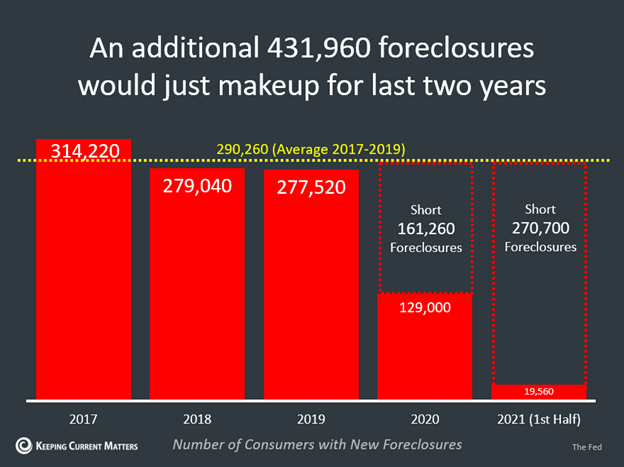
    Keep in mind that in any year there are foreclosures. The ban that lasted nearly 18 months created a backlog that will have to be worked through. From 2017-2019 there was an average of just over 290,000 foreclosures nationwide which gives us a shortage of about 432,000 foreclosures.

    Given that nationally homes have appreciated about 17% year over year and here locally about 27% year over year, most borrowers in foreclosure will be able to do a normal sale rather than having to go through foreclosure.

    Nationwide, it is estimated that about 4% of borrowers are upside down on their homes by 25% or more. This number has decreased from 6% last year.

    The report went on to say, “Equity gains in Arizona were particularly extreme. In the first quarter of the year, 16 percent of mortgaged homes in this state were considered equity-rich by Attom’s definition. In the second quarter of 2021, that number rose to nearly 40 percent.”

    Forbearance Numbers:

    The total number of loans in forbearance continues to decline. We are down to 3.4% of loans which is about 1.7 million borrowers.

    Forbearance by Stage:

    • 9.7% of total loans in forbearance are in the initial forbearance plan stage.
    • 82.9% are in a forbearance plan extension.
    • 7.4% are forbearance re-entries.

    Forbearance Exits from June 1, 2020 through August 1, 2021

    43.7% of borrowers continued making their payments (22.9%), got caught up upon exiting (13.3%), or paid off the loan with a refinance or sale (7.5%).

    The percentage of exits for the group to be most concerned about, borrowers who exited their forbearance plan still behind and without a loss mitigation plan in place remained flat at 15.7%.

    Future Forbearance Exits:

    According to Black Knight data services, next month is anticipated to have the largest number of forbearance plan exits this year.

    Missed Payments:

    While mortgage delinquencies are easier to track, missed rental payments are not. Based on my research, I think the MBA’s recent update stating that Q2 2021 saw a big improvement in missed housing payments and the total number for both borrowers and renters is below 5 million nationwide is fairly accurate. The data shows that there are about 2.86 million rental households behind on their payments and 2.19 million borrowers behind on their mortgage payments.

    Servicers & Inspections:

    Inspections are way up. Many more for corporate buyers, not just iBuyers but also buy and rent companies also. The servicers have gone quiet on the future of foreclosures but continue to prepare for the coming months of uncertainty.

    Be mindful of the information out there. Be sure that it is current and from a reputable source. And remind borrowers and renters there are still options available. Discuss exit strategies.

    Options:

    Forbearance and foreclosure assistance: https://www.consumerfinance.gov/coronavirus/mortgage-and-housing-assistance/help-for-homeowners/avoid-foreclosure/

    AZ Eviction Help: https://azevictionhelp.org/

  • AZ Forbearance Update 7/28/2021

    In this 16 minute video, Lydia Wietsma and I discuss the latest in forbearance, delinquencies, foreclosures, and loan servicing.

    Forbearance Numbers:

    The forbearance numbers have improved a lot in the past month. We are down to 3.48% of borrowers or roughly 1.74 million borrowers are now in a forbearance plan. This is huge progress. Think about where we were in May of 2020 with nearly 4.76 million loans in forbearance which is over 9% of borrowers!

    The declines have been slowing. In April we had a 12% drop in homeowners in forbearance. In the past 30 days, we have had a 5% drop. Since there is a limit on how long an owner can be in forbearance, it is expected that about 900,000 borrowers will exit the program in Q3 and Q4 this year.

    About 7.25 million borrowers have been in a forbearance plan at one time or another throughout the pandemic, which is about 14% of all homeowners nationwide.

    I have been asked a lot for forbearance info by state and I came across this chart from Matthew Gardner, Windermere’s chief economist. It is older, the data is from March, so today’s numbers are much lower but it is a nice view to see the state differences. In March in Arizona, there were about 4.2% of borrowers were in forbearance.

    Forbearance by Stage:

    • 9.8% of total loans in forbearance are in the initial forbearance plan stage.
    • 83.2% are in a forbearance extension.
    • The remaining 7.0% are forbearance re-entries.

    Forbearance Exits from June 1, 2020 through July 18, 2021

    44% of borrowers continued making their payments, got caught up upon exit, or paid off the loan with a refinance or sale upon exit.

    15.7% of borrowers exited their forbearance plan still behind on their payments and without a loss mitigation plan in place.

    Delinquencies:

    Remember borrowers who are behind on their payments and in forbearance are also counted in the total delinquency numbers. Total delinquency rates in June dropped to 4.37%, the lowest since the start of the pandemic. There are about 2.32 million borrowers behind on at least one payment and about 1.5 million that are 90+ days behind on their payments. This number has been the slowest to move and remains much higher than pre-pandemic numbers.

    Foreclosures:

    In an effort to keep foreclosures down, HUD, USDA, and the VA now offer the option for borrowers to extend the length of their loan to reduce monthly payments.

    The foreclosure moratorium expires on Saturday but that doesn’t mean that lenders will start the foreclosure process immediately. The CFPB has put in place very specific rules and processes for lenders and servicers to adhere to which helps enable struggling borrowers to modify their current loans.

    The properties which can be foreclosed on immediately will be vacant, abandoned properties, and the owners are not reachable.

    Do not expect to see a flood of foreclosures as the moratorium is lifted. The median equity of a borrower in forbearance is $100,000! Another way to look at it is 96% of homeowners in forbearance have at least 10% equity in their houses. If they have to sell, they will be normal sales.

    Based on these numbers the total amount of homes that could go into foreclosure could be about 200,000-300,000 homes nationwide. For comparison, the 2008 crash led to about 10 million foreclosures nationwide. Big difference. And if we divide 300,000 by 50 states, each state could see about 6,000 foreclosures each. However, each state and each market is different so it will not be evenly distributed like this.

    Ivy Zelman said, “The likelihood of us having a foreclosure crisis again is about zero percent.” Dr. Lawrence Yun agrees and he expects that the homes will be absorbed quickly and will not lead to any price declines.

    Inspections:

    Three weeks ago, Lydia did not have any inspections. Then in the past two weeks she has had 15-20 inspections a day! The type of inspection varies. She has done many for iBuyers, tax liens, BPOs, and others.

    Servicers are requiring confirmation regarding occupancy. If the property is abandoned the lender is able to foreclose right away, per CFPB’s rules.

    For more information on CFPB’s foreclosure ruling visit https://www.consumerfinance.gov/rules-policy/final-rules/protections-for-borrowers-affected-by-covid-19-under-respa/

  • AZ Forbearance Update 6/30/2021

    In this 19 minute video, Lydia Wietsma and I discuss the latest in forbearance, extensions, and tax liens. We share this information to help provide guidance for real estate professionals and struggling borrowers.

    Deadline & Extensions:

    There is a lot of news around forbearance right now. Today is the final day to get started on a forbearance plan. At the end of the day, no new forbearance plans will be created.

    Do not confuse the end of forbearance with the other moratoriums that were extended last week. Both the eviction and foreclosure moratoriums were extended for one more final month. Those moratoriums will expire at the end of July.

    Forbearance Numbers:

    The forbearance numbers continue to decline. About 3.93% of mortgages or roughly 2 million borrowers remain in a plan after 17 weeks of declines.

    Forbearance by Stage:

    • 10.7% of borrowers are in the initial stage. Initial requests this week dropped to their lowest rate since forbearance plans started 15 months ago. According to Mike Fratantoni, MBA’s senior vice president and chief economist, the pace of new forbearance requests remained at an acutely low level of 4 basis points or 0.04% of borrowers.
    • 83.1% of borrowers are on extension, down from recent weeks.
    • 6.2% of borrowers are re-entries, up from recent weeks also.

    Forbearance Exits from June 1, 2020 through June 20, 2021

    45.2% of borrowers continued making their payments, got caught up upon exit, or paid off the loan with a refinance or sale upon exit. This number continues to decline slightly each week.

    15.2% of borrowers exited their forbearance plan still behind on their payments and without a loss mitigation plan in place.

    Even with the end of forbearance, borrowers still have options. Black Knight estimated that of the loans in forbearance, 96% have at least 10% equity in their homes – typically enough to sell through traditional real estate channels to avoid a default or short sale.

    CFBP:

    On Tuesday, the Consumer Financial Protection Bureau (CFPB) extensive mortgage servicing regulations it hopes will prevent “unwelcome surprises” for borrowers exiting forbearance.

    The CFPB outlined the rules for mortgage servicers to follow in the coming months and them, “Unprepared is unacceptable.”

    Servicers may initiate foreclosure proceedings only after the borrower has submitted a loss mitigation application, and either isn’t eligible for, breaks or rejects the loss mitigation plan. If the borrower was already six months past due by March 2020 or if the property is abandoned, the loan servicer is exempt from those requirements.

    The CFPB rule also outlines escrow shortages which can be included in the loss mitigation option. There are limits on how much servicers require borrowers to deposit in an escrow account over the next year.

    Lenders and servicers may offer streamlined loan modifications, as long as the modification does not increase the monthly payments, or increase the mortgage term beyond 40 years. Servicers may not charge extra fees for the loan modification, and if a borrower accepts a loan modification, the servicer must waive any late fees.

    The CFPB wants servicers to be proactive about communicating with borrowers about their options, especially if they are not in a forbearance plan.

    If borrowers are still delinquent, servicers must contact them ahead of the end of their forbearance period to give them the option to complete a loss mitigation plan.

    Finally, the rule adds clarity to the definition of financial hardship to mean any hardship that the pandemic brought on, either indirectly or directly, from March 2020 to February 2021.

    The rule will take effect at the end of August.

    To learn more about the CFPB, submit a complaint, or better understand borrower protections visit https://www.consumerfinance.gov/

    Servicers, BPOs, and Tax Liens:

    BPO requests are up. 15 new ones last week and 16 so far this week. Lydia is not only giving a statement of value but is also checking the exterior condition and whether or not the property is vacant.

    In addition to the regular BPO visits, she is also being asked to deliver tax lien letters to homeowners that do not have a mortgage but are behind on their property tax payments. Tax lien foreclosures have also been suspended and will resume when the moratorium is lifted.

    Buyers and sellers need to let their Realtor know if they have done a forbearance on any property in the country. It is not something that can be just swept under the rug and it is not something to be ashamed of. As inventory grows strategies change. Forbearance was created to keep people in their homes and has been successful at doing so.

  • AZ Forbearance Update 6/2/2021

    In this 14 minute video, Lydia Wietsma and I discuss the latest in forbearance, delinquencies, and loan servicing. Scroll down for the summary.

    Forbearance Numbers:

    This week was week number 13 of continued improvement in the forbearance numbers and are now down to 4.18% of loans in forbearance or about 2.1 million borrowers. This is fewer than half the total amount of borrowers who were initially in a forbearance plan in May 2020 which was about 8.47% of borrowers which was way below the predicted 30% of borrowers who were expected to go into forbearance. The chart below represents last week’s data but a powerful illustration nonetheless.

    Forbearance By Stage:

    • 11.6% of borrowers are in the initial stage of forbearance and new requests dropped down to their lowest level since March 2020.
    • 82.8% of borrowers are on extension, down from previous weeks. Well over 50% of borrowers on extension have been in forbearance for over 12 months. This means that a large number of forbearance plans will be expiring soon.
    • 5.6% of borrowers are re-entries, also up from previous weeks.

    Forbearance Exits from June 1, 2020 through May 23, 2021:

    46.3% of borrowers continued making their payments, got caught up upon exit, or paid off the loan with a refinance or sale upon exit. This number has declined slightly in recent weeks.

    15% of borrowers exited their plan, still behind on their payments and without a loss mitigation plan in place. It is critical for struggling borrowers who are nearing the end of their forbearance plan to call their lender or loan servicer to discuss the options. There are options.

    Based on this info, if 15% of the 2.1 million borrowers exit forbearance who are still behind on their payments and without a loss mitigation plan, means that nationwide there would be about 315,000 borrowers who would need help upon exit. Divided by 50 states, each state would have about 6,300 borrowers without a loss mitigation plan. These are the ones who need to know their options so they do not lose their homes. And 315,000 is a far cry from the 10 million foreclosures we had nationwide during the crash.

    Delinquencies:

    In April, the national delinquency rate dropped to 4.66%. A borrower who is in forbearance and not making payments is counted in these numbers. 900,000 borrowers have gotten caught up in the past 12 months. At 1.768 million, the seriously delinquent rate remains 4x the rate from February 2020.

    Black Knight data services, which supplies much of the data we discuss, is predicting that delinquency rates will normalize to pre-pandemic levels by the end of this year.

    Please note the 1.8 million borrowers are I mentioned in the video are not the total number of borrowers delinquent but a rounded number of the total borrowers that are 90+ days late.

    Deadline – June 30, 2021:

    The deadline to enter into a forbearance plan is June 30, 2021. Time is of the essence and struggling borrowers must reach out to their lender or mortgage servicer to get started. Check out the available resources below.

    The ban on rental evictions and the foreclosure moratorium also expire on June 30, 2021. It is possible that any of these programs may be extended at any time without any warning. The CFPB proposed a foreclosure moratorium through the end of 2021, which is still being discussed.

    Servicing:

    Requests for inspections are up! Lydia received 17 inspection requests in 2 days and not all are iBuyer owned. Sometimes it is to deliver letters encouraging borrowers to call their servicers to find out about their options. A large lender is offering 0% interest on second loans for the deferred amount. The servicing companies are hiring more staff to prepare the June 30 expirations. There is a backlog of pending foreclosures due to the moratorium so we will see an increase in notices of trustee sale.

    The Market:

    Do not overprice listings. Despite a 32% year-over-year appreciation rate, the market is starting to slow a bit. Some listings are lasting days rather than hours on the market.

    Resources:

  • AZ Forbearance Update 5/19/2021

    In this 17 minute video, Lydia Wietsma and I discuss the latest in forbearance, delinquencies, employment, and loan servicing.

    Forbearance Numbers:

    We had another week of improvement in the forbearance numbers. There are now only 2.1 million borrowers or 4.22% of mortgages are in a forbearance plan. This is down from last week’s 4.36%.

    Forbearance by Stage:

    • 11.9% of borrowers are in the initial stage of forbearance and new requests dropped down to their lowest level since March of 2020.
    • 83% of borrowers are on extension, up from previous weeks. Over 50% of borrowers on extension have been in forbearance for over 12 months.
    • 5.1% of borrowers are re-entries, also up from previous weeks.

    Forbearance Exits from June 1, 2020 through May 9, 2021:

    46.5% of borrowers continued making their payments, got caught up upon exit, or paid off the loan with a refinance or sale upon exit. This number has declined slightly in recent weeks.

    15% of borrowers exited their plan, still behind on their payments and without a loss mitigation plan in place. It is critical for struggling borrowers who are nearing the end of their forbearance plan to call their lender or loan servicer to discuss the options. There are options.

    Delinquencies:

    Remember in December when there were roughly 10 million Americans behind on either rent or mortgage payments? By March that number dropped to 5 million!

    Single Family Rentals:

    Two of the country’s largest single-family rental REITs upped their rates on vacant homes in April by a lot. American Homes 4 Rent increased 11% and Invitation Homes increased by 10%.

    Housing Shortage:

    From 1959 to 2006 builders built an average of just over 1.1M single-family homes a year. From 2007 to 2020 they built an average of just over 700,000 homes a year. This has created a 5.5M home shortfall nationwide. In 2020; 990,500 homes were started, still below the average prior to 2006. Based on this math, if builders build 2M houses a year, it will take 6 years to make up for the shortfall.

    Another way to look at it for all residential building:

    Employment:

    • ASU’s WP Carey School of Business predicts that Arizona will add nearly 117,000 jobs this year putting us ahead of our pre-pandemic numbers; a significant feat considering in April of 2020 Arizona lost over 331,000 jobs.
    • Today we have roughly 7,367,000 job openings, which is about 5.5 million more than we had at the lowest point of the great recession.

    April’s employment numbers were so disappointing that the U.S Chamber of Commerce, the nation’s largest lobbying group, urged Congress to end the $300-a-week federal unemployment benefits, claiming that people being paid not to work were keeping consumers from returning to the labor force.

    Employers are having to offer higher wages to get people to come back to work. When wages increase quickly, it drives even more inflation which would put further pressure on mortgage rates which would add to the affordability challenges in housing.

    Today, locally, our median appreciation rate is at 30%!!! It is due to the supply/demand imbalance as our supply is still over 76% below normal while our demand is over 7% above normal. This extreme appreciation rate is expected to fall as inventory continues to grow, it is increasing at an almost imperceptible rate, and as demand continues to decline.

    Elliot Eisenberg’s Scary Scenario. On Tuesday, the economist wrote:

    “Aside of a bad Covid recurrence, here’s how a recession could occur. Due to supply chain problems and labor shortages, consumer prices and wage inflation rise quickly, spooking markets. Powell resists raising rates, but the pressure is too great and he caves. In response, equities, bonds, commodities, and other assets decline. This also pushes leveraged firms into bankruptcy, hurts emerging economies, and we accidentally end up in a mild recession.”

    Lydia Discussed:

    Retro BPO, or a historic BPO looks at the valuation of a home and the comparables at a specific timeframe in the past. They are often used when potential fraud is suspected.

    Servicers do not believe there will be any further extensions for the foreclosure or eviction moratoriums and no further forbearance extensions. There is also a continued increase in inspection requests.

  • AZ Forbearance Update 4/28/2021

    In this 10 minute video, Lydia Wietsma and I discuss the latest in forbearance, delinquencies, and loan servicing.

    Consumer Finance Protection Bureau (CFPB)

    The CFPB has put loan servicing companies under a microscope. It is watching the servicers to ensure that borrowers in forbearance have been handled properly.

    “I think the math speaks for itself how well the forbearance program has worked, and it’s one of the few times in my career that I have seen a government-initiated program adopted as well and executed as well by the industry as this one,” said Rick Sharga, executive vice president of RealtyTrac.

    Forbearance Numbers:

    After 2 weeks of large drops, we had a small drop in total loans in forbearance. As of April 18, about 4.49% of loans were in forbearance, a slight decline from 4.50%. This is a decline of nearly 5,000 borrowers to about 2.25 million.

    Forbearance by Stage:

    • 12.9% of loans in forbearance are in the initial stage, down from the previous week’s 13.1%
    • 82.4% are on extension, up from last week’s 82.1%. More than 40% of borrowers on extension have now been in a forbearance plan for over 12 months.
    • The remaining 4.7% are re-entries, down from last week’s 4.8%.

    Forbearance exits from June 1, 2020 through April 18, 2021

    47.3% of borrowers continued making their payments throughout the forbearance plan, got caught up upon exit, or paid off the loan with a refinance or sale.

    14.6% of borrowers exited their plan, still behind on their payments and without a loss mitigation plan in place. This number remained flat from last week.

    Delinquencies:

    • Over the past 20 years, delinquencies have fallen by nearly 10% on average in March due to tax return and other seasonal funds being used by homeowners to pay down past-due mortgage debt
    • Despite March’s strong performance, some 1.9 million mortgage-holders – including those in active forbearance that are behind on their payments – are at least 90 days past due on payments
    • There are 1.5 million more such serious delinquencies than at the onset of the pandemic, nearly five times pre-pandemic levels

    New Low-Income Refinance Option:

    This morning FHFA announced a new refinance option for low income borrowers.

    To qualify for this option, beyond owning a GSE-backed mortgage, a borrower must have an income at or below 80% of the area’s median income and have been current of their payments for the last six-months, with no more than one payment missed in the last 12. Borrowers must also not have a mortgage with an LTV ratio greater than 97% and a DTI no higher than 65%. Lastly, borrowers must have a FICO score no lower than 620.

    Now, the FHFA said the new refi option could save borrowers an average of between $100 and $250 a month. 

    Under the new refi option, lenders must ensure that the borrower saves at least $50 a month in their mortgage payments while simultaneously dropping their interest rate by at least ½ of a percent or 50 basis points. This could potentially knock an already historically great rate such as 3.5% down to 3% with the new product.

    Loan Servicing:

    Lydia’s servicing company has added another local iBuyer to its list of clients they are doing inspections for. Opendoor has been hiring this company since July for its inspections.

    Inspections have been consistent.

    While foreclosures remain at a standstill, servicing companies are doing more inspections on properties that were inspected 12 months ago.

  • AZ Forbearance Update 4/21/2021

    In this 13 minute video, Lydia Wietsma and I discuss the latest in the economy, forbearance, and borrower options.

    The most important takeaway from today’s video is that struggling borrowers have options and many people who entered a forbearance plan do not understand what forbearance is. If a borrower has questions about their situation, they need to call their mortgage servicer to discuss options. Time is of the essence.

    The CFPB created this page full of information for struggling homeowners and renters.

    Economy:

    Economically speaking, we are in very good shape. Things are improving across the board and residential real estate remains the strongest sector. The market is just beginning to show signs of normalcy, which is very good. Demand, while still strong, is calming down. Fatigued buyers are just now getting a few more options.

    The pandemic created involuntary savings. People simply couldn’t spend the way they used to so all of a sudden they had money for a down payment or that down payment they were saving for reached the target amount. This enabled super strong demand. As the economy opens up and people are able to spend their money on more services like concerts, eating out, and traveling the buyer demand is likely to subside some. This will also help bring us back to closer to normal sales cycles. Despite movement towards normal, sales prices and appreciation continue to grow. While yes, inventory has increased, it remains over 77% below normal and demand has decreased it is still over 8% above normal. This supply-demand imbalance is so severe, it will take years to correct which is why sales prices continue increasing around 18% year over year.

    Unemployment is improving. When all kids go back to school next fall, provided that happens, the unemployment rate will get even better. There are over 11 million students K-12 in the US. A lot of parents had to choose between their kid and their job.

    Forbearance Numbers:

    Two weeks ago, we had a big drop in total loans in forbearance, and last week we had another large drop. We are now down to 4.50% of loans or 2.3 million homeowners in a forbearance plan. Two weeks ago, it was 4.9% of loans.

    Forbearance by Stage:

    • 13.1% of loans in forbearance are in the initial stage, down from two weeks ago when it was 13.7%.

    • 82.1% are on extension, down from two weeks ago when it was 84.1%. More than 36% of borrowers on extension have now been in a forbearance plan for over 12 months.

    • 4.8% are re-entries, up from two weeks ago when it was 2.2%.

    Forbearance exits from June 1, 2020, through April 11, 2021:

    • 40.1% of borrowers either continued making their payments throughout their forbearance plan or got caught up upon exit. This is down from two weeks ago when it was 41.2%.

    • 14.6% of borrowers exited their plan, still behind on their payments and without a loss mitigation plan in place. This is an increase from two weeks ago when it was 13.9%.

    There are other methods for exiting forbearance such as loan modification, refinance, sale, loan deferral, etc. Mike Fratantoni, MBA’s Senior Vice President and Chief Economist said this about the exits:

    “In terms of performance, more than 88 percent of homeowners who have exited into deferral plans, modifications, or repayment plans were current on their loans at the end of March, compared to 92 percent of all homeowners. The accelerating economic recovery in March helped more homeowners recover and become current on their mortgages, in addition to helping other homeowners with more stable financial situations exit forbearance.”

    BPOs are increasing a lot.

    A borrower did not realize that forbearance was a loan modification. He did not know that he had options. He thought he had a year of not making his payments and didn’t think he had to pay it back.

    The biggest unknown is the lack of information. The lenders are not necessarily charging late fees, but they are charging penalties. Each month the lenders and servicers are paying the impounds which are the taxes and insurance to keep the property protected and prevents tax liens. There has been no moratorium on taxes.