Category: National Real Estate

  • AZ Forbearance Update 5/19/2021

    In this 17 minute video, Lydia Wietsma and I discuss the latest in forbearance, delinquencies, employment, and loan servicing.

    Forbearance Numbers:

    We had another week of improvement in the forbearance numbers. There are now only 2.1 million borrowers or 4.22% of mortgages are in a forbearance plan. This is down from last week’s 4.36%.

    Forbearance by Stage:

    • 11.9% of borrowers are in the initial stage of forbearance and new requests dropped down to their lowest level since March of 2020.
    • 83% of borrowers are on extension, up from previous weeks. Over 50% of borrowers on extension have been in forbearance for over 12 months.
    • 5.1% of borrowers are re-entries, also up from previous weeks.

    Forbearance Exits from June 1, 2020 through May 9, 2021:

    46.5% of borrowers continued making their payments, got caught up upon exit, or paid off the loan with a refinance or sale upon exit. This number has declined slightly in recent weeks.

    15% of borrowers exited their plan, still behind on their payments and without a loss mitigation plan in place. It is critical for struggling borrowers who are nearing the end of their forbearance plan to call their lender or loan servicer to discuss the options. There are options.

    Delinquencies:

    Remember in December when there were roughly 10 million Americans behind on either rent or mortgage payments? By March that number dropped to 5 million!

    Single Family Rentals:

    Two of the country’s largest single-family rental REITs upped their rates on vacant homes in April by a lot. American Homes 4 Rent increased 11% and Invitation Homes increased by 10%.

    Housing Shortage:

    From 1959 to 2006 builders built an average of just over 1.1M single-family homes a year. From 2007 to 2020 they built an average of just over 700,000 homes a year. This has created a 5.5M home shortfall nationwide. In 2020; 990,500 homes were started, still below the average prior to 2006. Based on this math, if builders build 2M houses a year, it will take 6 years to make up for the shortfall.

    Another way to look at it for all residential building:

    Employment:

    • ASU’s WP Carey School of Business predicts that Arizona will add nearly 117,000 jobs this year putting us ahead of our pre-pandemic numbers; a significant feat considering in April of 2020 Arizona lost over 331,000 jobs.
    • Today we have roughly 7,367,000 job openings, which is about 5.5 million more than we had at the lowest point of the great recession.

    April’s employment numbers were so disappointing that the U.S Chamber of Commerce, the nation’s largest lobbying group, urged Congress to end the $300-a-week federal unemployment benefits, claiming that people being paid not to work were keeping consumers from returning to the labor force.

    Employers are having to offer higher wages to get people to come back to work. When wages increase quickly, it drives even more inflation which would put further pressure on mortgage rates which would add to the affordability challenges in housing.

    Today, locally, our median appreciation rate is at 30%!!! It is due to the supply/demand imbalance as our supply is still over 76% below normal while our demand is over 7% above normal. This extreme appreciation rate is expected to fall as inventory continues to grow, it is increasing at an almost imperceptible rate, and as demand continues to decline.

    Elliot Eisenberg’s Scary Scenario. On Tuesday, the economist wrote:

    “Aside of a bad Covid recurrence, here’s how a recession could occur. Due to supply chain problems and labor shortages, consumer prices and wage inflation rise quickly, spooking markets. Powell resists raising rates, but the pressure is too great and he caves. In response, equities, bonds, commodities, and other assets decline. This also pushes leveraged firms into bankruptcy, hurts emerging economies, and we accidentally end up in a mild recession.”

    Lydia Discussed:

    Retro BPO, or a historic BPO looks at the valuation of a home and the comparables at a specific timeframe in the past. They are often used when potential fraud is suspected.

    Servicers do not believe there will be any further extensions for the foreclosure or eviction moratoriums and no further forbearance extensions. There is also a continued increase in inspection requests.

  • This Week in Real Estate 5/10/2021

    In this 10 minute video, Amber Kovarik and I discuss the latest in real estate and lending.

    Real Estate Headlines:

    Many of you may read Inman News and last week they ran a series entitled “Bubble Trouble.” While the headlines are to get our attention, the articles really aren’t about the market crashing. If anyone wants to see any of them, let me know and I will send you the info. Don’t let the headlines scare you or your clients. The market is starting to get more normal, it is not crashing. Demand continues to exceed supply. Here in Phoenix, in March we had 10 buyers for each listing, today we have 5 buyers for each listing, prices are still going up. The decline in demand is allowing some buyers to actually get a contract accepted, which is good. While houses are selling quickly, buyers are educated, now is not the time to push the market. Overpriced listings are sitting and we are seeing more price reductions. This is healthy and good. The roughly 24% year over year appreciation is way too much and unsustainable.

    In economics, it all comes down to supply and demand. In real estate, it is about supply, demand, and equity. In 2005 we had a lack of supply, high demand, and no equity. Today, we have even lower inventory, solid demand, and tons of equity. Supply has started increasing slowly, but we are still about 77% below normal. Demand remains nearly 8% above normal.

    Eviction Ban Lifted? Nope.

    On Wednesday a federal judge lifted that the CDC’s eviction ban, which is set to expire on June 30, after a 7-month lawsuit filed by the Alabama and Georgia Association of Realtors. Within hours the DOJ filed an emergency appeal on the case and issued a stay effectively prohibiting any evictions until the appeals process is over. Legal housing experts are recommending against any evictions prior to June 30th.  FTC and CFPB issued a statement to landlords stating they would be held accountable for moving forward with any evictions.

    Too Interesting Not to Share:

    Loans that originated from 2005-2008 make up only 2% of existing loans but those loans make up 5x the seriously delinquent rate when compared to loans that originated since 2009. Those loans are still haunting us!

    Lending:

    Interest rates increased quickly earlier this year and then came back down quickly. They remain right around 3%.

  • Greater Phoenix Real Estate Update 4/30/2021

    Yesterday one of my clients excitedly called to tell me she had accepted an offer on her home for $1.2M more than she paid for it about two years ago. She then said, “Now what do we do? Rent, buy, flip?” I paused, gathered my thoughts, considered the numbers, and answered, “Don’t rent. Buy.”

    Logan Mohtashami recently wrote about why we are not in a housing bubble, “These Americans who are outbidding others and getting the home are doing very well financially. I am not talking about cash buyers or investors. I am talking about primary resident mortgage homebuyers. They have enough home-buying power to win the house. The market is unhealthy because we shouldn’t be having this much competition for shelter, but it’s not speculation demand at all.”

    Economy:

    Yesterday, Elliot Eisenberg wrote, “GDP grew at a pleasantly fast 6.4% annualized rate in 21Q1 and is now just 0.9% below its inflation-adjusted level on 12/31/19. It will surpass that level in mid-May 2021. By contrast, it took more than three years for real GDP to fully recover in the last recession. 21Q2 and 21Q3 GDP should easily exceed 21Q1’s 6.4%, and GDP growth in 2021 will, baring disaster, be the best since 1984.”

    Lending:

    With forbearance and delinquencies declining, 16.4% of homeowners got caught up on their mortgage in March, lessening the severity of the ultimate impact of these programs. There are still about 1.5M 90+ day late borrowers, which is not insignificant, however many are in forbearance and are protected for the time being. Over 47% of the borrowers exiting their forbearance plan never missed a payment, were caught up upon exit, or paid off the loan with a refinance or sale. For more info, check out my forbearance update from Wednesday.

    Purchase mortgage applications, a leading indicator, decreased 4% week over week, last week. This is the result of frenzied demand normalizing, low inventory, and significant home-price growth.

    “The purchase market’s recent slide comes despite a strengthening economy and labor market. Activity is still above year-ago levels, but accelerating home-price growth and low inventory has led to a decline in purchase applications in four of the last five weeks.”

    Joel Kan, MBA’s Associate Vice President of Economic and Industry Forecasting

    National Real Estate:

    After two months of declines, pending home sales increased by 1.9% from February to March. NAR projects a 10% year over year increase of existing home sales in 2021 with prices increasing by 9%.

    “Low inventory has been a consistent problem, but more inventory will show up as new home construction intensifies in the coming months, as well as from a steady wind-down of the mortgage forbearance program. Although these moves won’t immediately replenish low supply, they will be a step forward.”

    Dr. Lawrence Yun, NAR’s Chief Economist

    After new home sales declined by 18.2% from January to February, they increased by 20.7% from February to March and were up 66.8% year over year, the highest rate since 2006.

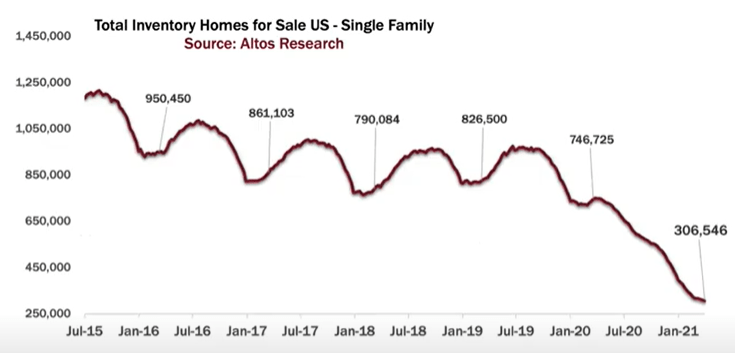
    Last week we had our first teaser with a slight inventory increase, this week available single-family listings declined by 2,000 down to 310,039. The steep decline in inventory is leveling out. Inventory is expected to grow for the next few months.

    The chart below doesn’t show the roughly 100,000 new listings that hit the market each week. About 28,000 went under contract in less than 24 hours and another 42,000 went under contract in less than a week. Sales are expected to remain at an elevated pace through June.

    The AZ Market:

    Inventory levels remain at historic lows but it stopped dropping. It is down 76% from two years ago and 69% from last year. Monthly sales are 11% above where they were two years ago and 29% above where they were last year.

    New Construction: The median new home price in greater Phoenix is now up to $403,000, according to Zonda. That is a 16% year over year price increase and sales are up 17% year over year. Lately, prices of new homes have been increasing 3% a month. While it seems like new homes are going up everywhere, there are actually 100 fewer active new subdivisions this year than there were last year. There is a total of 427 active subdivisions in Maricopa and Pinal Counties, the lowest in seven years.

    Case-Shiller Index: February’s Case-Shiller Index (the report that many large builders, Wall Street, and the US Census to track appreciation) shows that greater Phoenix continues to lead the pack with the highest year over year appreciation rate in the country at 17.4%. The national year over year appreciation was 12%, the highest year over year gain since February of 2006. Phoenix’s month-over-month gain was 2.03% while the national average was 1.05%. Tucson just barely beat Phoenix for the top spot for the largest year-over-year single-family rental appreciation at 11.2% and 11.1%, respectively.

    Policy:

    American Families Plan: On Wednesday, President Biden announced his proposed policy to provide free pre-Kindergarten and community college. The funding would come from taxing capital gains and inherited properties as well as eliminating the 1031 exchange program. This plan most significantly impacts real estate investors to the tune of $41B over the course of four years. Read more here. The proposal will likely evolve as it goes through Congress.

    First-Time Homebuyer Act: Congressmen from CA and OR introduced a bill that provides a tax credit for first-time homebuyers of up to 10% of the purchase price or $15,000. Buyers may not have owned a home in the past three years and make no more than 160% of the median income for the area.

    Zillow Browsing:

    A recent study shows that Zillow, like many social media platforms, can be addictive. According to the study: 53% of people looked up their boss’s house, 30% browse to daydream about houses they can’t afford, 62% checked out the value of their neighbor’s house, and 27% said they browse Zillow to relax. Additionally, browsers admitted to:

    Real Estate News:

    • Asset management companies, Altas Real Estate and DivcoWest have created a joint venture for single-family rentals and will spend $1B “acquiring and renovating homes in high-growth states including Colorado, Arizona, Idaho, Nevada, and Utah,” according to a press release.
    • Lumber prices increased again, now triple what they were 12 months ago, adding an estimated $36,000 to the average price of a new construction single family home.

    Final Thoughts:

    Elliott Pollack & Company wrote on Monday, “Housing will continue to make headlines for the foreseeable future. This level of activity and interest has not been seen since the mid-2000s. It is difficult not to compare these two periods. We went through our first recession since the Great Recession and the effects of that recession are still fresh in our minds. Yet, this is different. Measures were taken to keep people afloat and avoid a large number of foreclosures so far. Job growth has been steady and has made a significant recovery since last year. The number of listings is at a decade low and demand is outpacing supply, causing upward pressure on prices. Mortgage rates remain at historical lows and have allowed buyers to buy more and maintain affordability (Greater Phoenix and Greater Tucson) to a certain extent. And housing does not appear to be slowing down yet. We have seen an increase in permitting activity across the country and in Arizona, especially in its biggest metro areas.”

    Copyright 2021 Sarah Perkins

  • AZ Forbearance Update 4/28/2021

    In this 10 minute video, Lydia Wietsma and I discuss the latest in forbearance, delinquencies, and loan servicing.

    Consumer Finance Protection Bureau (CFPB)

    The CFPB has put loan servicing companies under a microscope. It is watching the servicers to ensure that borrowers in forbearance have been handled properly.

    “I think the math speaks for itself how well the forbearance program has worked, and it’s one of the few times in my career that I have seen a government-initiated program adopted as well and executed as well by the industry as this one,” said Rick Sharga, executive vice president of RealtyTrac.

    Forbearance Numbers:

    After 2 weeks of large drops, we had a small drop in total loans in forbearance. As of April 18, about 4.49% of loans were in forbearance, a slight decline from 4.50%. This is a decline of nearly 5,000 borrowers to about 2.25 million.

    Forbearance by Stage:

    • 12.9% of loans in forbearance are in the initial stage, down from the previous week’s 13.1%
    • 82.4% are on extension, up from last week’s 82.1%. More than 40% of borrowers on extension have now been in a forbearance plan for over 12 months.
    • The remaining 4.7% are re-entries, down from last week’s 4.8%.

    Forbearance exits from June 1, 2020 through April 18, 2021

    47.3% of borrowers continued making their payments throughout the forbearance plan, got caught up upon exit, or paid off the loan with a refinance or sale.

    14.6% of borrowers exited their plan, still behind on their payments and without a loss mitigation plan in place. This number remained flat from last week.

    Delinquencies:

    • Over the past 20 years, delinquencies have fallen by nearly 10% on average in March due to tax return and other seasonal funds being used by homeowners to pay down past-due mortgage debt
    • Despite March’s strong performance, some 1.9 million mortgage-holders – including those in active forbearance that are behind on their payments – are at least 90 days past due on payments
    • There are 1.5 million more such serious delinquencies than at the onset of the pandemic, nearly five times pre-pandemic levels

    New Low-Income Refinance Option:

    This morning FHFA announced a new refinance option for low income borrowers.

    To qualify for this option, beyond owning a GSE-backed mortgage, a borrower must have an income at or below 80% of the area’s median income and have been current of their payments for the last six-months, with no more than one payment missed in the last 12. Borrowers must also not have a mortgage with an LTV ratio greater than 97% and a DTI no higher than 65%. Lastly, borrowers must have a FICO score no lower than 620.

    Now, the FHFA said the new refi option could save borrowers an average of between $100 and $250 a month. 

    Under the new refi option, lenders must ensure that the borrower saves at least $50 a month in their mortgage payments while simultaneously dropping their interest rate by at least ½ of a percent or 50 basis points. This could potentially knock an already historically great rate such as 3.5% down to 3% with the new product.

    Loan Servicing:

    Lydia’s servicing company has added another local iBuyer to its list of clients they are doing inspections for. Opendoor has been hiring this company since July for its inspections.

    Inspections have been consistent.

    While foreclosures remain at a standstill, servicing companies are doing more inspections on properties that were inspected 12 months ago.

  • Greater Phoenix Real Estate Update 4/23/2021

    The pandemic created involuntary savings. People simply couldn’t spend the way they had in the past, and all of a sudden they had money for a down payment. Along with historic low mortgage rates and the ability to work remotely; the extra savings enabled super strong demand. As the economy opens up and people are able to spend their money on more services like concerts, eating out, and traveling the buyer demand is likely to subside modestly. Today’s ideal demographics (see last week’s post for details) will keep replacement buyers steady through 2024. As the demand fades to slightly elevated from crazy hot, the market will return to normal sales cycles.

    Despite movement towards normal, sales prices continue to grow. While yes, inventory has increased, locally it remains over 77% below normal and demand has decreased, it is still over 8% above normal. This supply/demand imbalance is so severe, it will take years to correct, and is why sales prices continue increasing at an appreciation rate of nearly 22%, year over year.

    Bull versus Bubble:

    There is a difference between a bull market and a bubble market. Real estate experts agree, we are currently in a bull market. Here are some basic indicators to illustrate the differences:

    • Is it true or false demand? Are the properties occupied by either renters or owners? True demand is when people are living in the property. False demand is when investors park money in the asset with no plans of using the property. Today homes are lived in.
    • Are rents increasing with sales prices? Rents, like sales prices, increase with greater demand and less supply and decrease with less demand and increased supply. Rental rates decreased during 2004-2006 and today they are increasing faster than sales prices in greater Phoenix. There are some markets, like San Francisco, where rents are falling while sales prices are increasing indicating the market is overvalued.
    • Huge increases of speculative buying on credit (bubble) versus cash buyers and down-payment buyers (bull).
    • What are the fraud levels? The higher the fraud levels, the higher the likelihood of a bubble market. If you were in the business during 2004-2006, chances are good you know someone in prison. Today, there are exhausted buyers and sellers who are unsure where they will go; the price appreciation is based on supply and demand, not collusion.

    National Real Estate:

    Existing homes sales declined by 3.7% from February to March, a smaller decline than the 6.6% decline from January to February. Both declines are attributed to the low inventory levels.

    “Consumers are facing much higher home prices, rising mortgage rates, and falling affordability, however, buyers are still actively in the market. The sales for March would have been measurably higher, had there been more inventory. Days-on-market are swift, multiple offers are prevalent, and buyer confidence is rising.”

    -Dr. Lawrence Yun, NAR’s Chief Economist

    It happened – for the first time in 52 weeks – not only did inventory not drop last week, it increased by 5,000 listings so now we are up to 312,000 available single family listings nationwide, which is an increase of 1.6%.

    Demand remains high; immediate sales also increased, up 3,000 from last week to 26,000 new single-family listings hit the market and went under contract in less than 24 hours.

    The high demand delayed the normal season cycle by about a month, normally by mid-March inventory starts climbing for peak buying season, which is normally March – June. In housing, normal is ideal.

    In addition to buyers having more options, an increase in available listings allows more time for appraisals.  So appraisers can get caught up and increases the likelihood of homes coming in at value.

    This week, the national median sales price increased by $5,000 week over week to $380,000 and the median asking price of new listings increased by $10,000 week over week to $360,000. Sales prices will keep climbing until about June 30th. Then they start to slow because cheaper homes tend to sell more in the 2nd half of the year.

    Homeownership Rates:

    In 2020, homeownership grew by 2.6% or by 3.9M new homeowners to 67.4% and the majority of that gain took place during Q2 2020 and Q3 2020.

    From 3Q 2019 to Q3 2020, Arizona’s homeownership rate increased by 4.1%, up to 71%. Arkansas had the biggest gain at a 7.1% increase, while New Jersey’s homeownership rate declined by 4.4%. West Virginia has the highest homeownership rate at 78.6%.

    The AZ Market:

    According to Redfin, nationwide luxury home sales increased by 41.6% in Q1 2021, year over year. In greater Phoenix, luxury home sales prices are up 25% in Q1 2021, year over year.

    New Construction:

    Nationwide, single-family permits increased from February to March by 4.6%. Single-family completions increased from February to March by 5.3%.

    Housing starts, considered an economic leading indicator, increased by 37% in March, year over year, and increased by 19.4% from February to March, though February’s level was lower than expected due to the winter storms.

    “In nearly every market, 20% more inventory means 20% more home sales. Today’s news on the new home construction surge is, therefore, highly welcomed, especially in light of major challenges on material costs and soaring lumber prices.”

    -Dr. Lawrence Yun, NAR’s Chief Economist

    According to Freddie Mac, builders need to build 3.8 million single-family homes just to meet current demand levels. The lag of new construction over the past decade has contributed to today’s low inventory.

    In 2020 builders built about 65,000 entry-level homes while 2.38 million renters became first-time homeowners.

    “As we navigate our way through the year and get beyond the pandemic, we expect the housing supply shortage to continue to be one of the largest obstacles to inclusive economic growth in the U.S. Simply put, we must build more single-family entry-level housing to address this shortage, which has strong implications for the wealth, health and stability of American communities.”

    -Sam Khater, Freddie Mac’s Chief Economist

    Commercial Real Estate:

    • The local office market has suffered four straight months of increased vacancies putting the vacancy rate at the end of Q1 2021 at 19.1%!

    “A year-plus of forced acceptance of remote services in every sector has carved permanent change into our behavior. And, few sectors have seen a more radical transformation than office work.”

    -Scott Galloway, Author & NYU Business Professor
    • Many major companies are making plans to reduce their commercial real estate footprint. JP Morgan Chase is planning to significantly reduce its commercial space as 10% of its employees will work from home permanently. CEO Jamie Dimon said, “Remote work will change how we manage our real estate.”
    • Office rents are expected to decline by 15% nationwide.

    Lending:

    • Purchase mortgage applications increased by 7% last week from the previous week and are up 57% year over year. We still have a few more weeks of year over year data comparing last year’s lockdown market to this year’s high demand/low inventory market.
    • Despite expectations of interest rates reaching 3.7% this year, the Mortgage Bankers Association is forecasting a 16.4% year over year increase in purchase mortgage volume which would set a new record at $1.67 trillion.

    “The housing market is incredibly strong this year, with robust housing demand in nearly every part of the country, driven by the improving economy, households seeking more indoor and outdoor space, millennials reaching their prime homebuying years, and still low mortgage rates. A lack of supply is the biggest hurdle to an even larger increase in home sales. The widening imbalance of supply and demand is driving up home-price growth and eroding affordability – especially for entry-level buyers.”  

    -Mike Fratantoni, MBA’s Chief Economist and Senior Vice President

    Real Estate News:

    • According to a recent Harvard report, due to last year’s lockdowns about 76% of homeowners completed at least one home remodeling project. The complexity and scope of the projects are increasing as homeowners are willing to spend more as home values rise. It is expected that in 2022 homeowners will spend $370 billion on home improvements.
    • iBuyer acquisitions are nearing their Q1 2020 numbers. While Phoenix remains the national leader in iBuyer activity, the margin of that lead is shrinking and Atlanta is catching up. Meanwhile, the two cities have significant leads ahead of the four remaining largest iBuyer markets in the country: Dallas, Charlotte, Las Vegas, and Raleigh.

    Final Thoughts:

    As one of my favorite housing economists, Logan Mohtashami with HousingWire recently wrote, “The nature of yellow journalism in our society is that fear and loathing sell. Impending doom is somehow sexy and gets many eyeballs and clicks, whereas the standard economic truth does not. People like myself who spend their time yammering on about demographics, prime-age employment to population levels, and how much shelter inflation can move Core CPI, are pleasant to listen to when the double martini doesn’t do the job of putting you to sleep. I get it. Stick to the facts, don’t get sidelined by the sideshow, and we will all be better off.”

    Copyright 2021 Sarah Perkins

  • AZ Forbearance Update 4/21/2021

    In this 13 minute video, Lydia Wietsma and I discuss the latest in the economy, forbearance, and borrower options.

    The most important takeaway from today’s video is that struggling borrowers have options and many people who entered a forbearance plan do not understand what forbearance is. If a borrower has questions about their situation, they need to call their mortgage servicer to discuss options. Time is of the essence.

    The CFPB created this page full of information for struggling homeowners and renters.

    Economy:

    Economically speaking, we are in very good shape. Things are improving across the board and residential real estate remains the strongest sector. The market is just beginning to show signs of normalcy, which is very good. Demand, while still strong, is calming down. Fatigued buyers are just now getting a few more options.

    The pandemic created involuntary savings. People simply couldn’t spend the way they used to so all of a sudden they had money for a down payment or that down payment they were saving for reached the target amount. This enabled super strong demand. As the economy opens up and people are able to spend their money on more services like concerts, eating out, and traveling the buyer demand is likely to subside some. This will also help bring us back to closer to normal sales cycles. Despite movement towards normal, sales prices and appreciation continue to grow. While yes, inventory has increased, it remains over 77% below normal and demand has decreased it is still over 8% above normal. This supply-demand imbalance is so severe, it will take years to correct which is why sales prices continue increasing around 18% year over year.

    Unemployment is improving. When all kids go back to school next fall, provided that happens, the unemployment rate will get even better. There are over 11 million students K-12 in the US. A lot of parents had to choose between their kid and their job.

    Forbearance Numbers:

    Two weeks ago, we had a big drop in total loans in forbearance, and last week we had another large drop. We are now down to 4.50% of loans or 2.3 million homeowners in a forbearance plan. Two weeks ago, it was 4.9% of loans.

    Forbearance by Stage:

    • 13.1% of loans in forbearance are in the initial stage, down from two weeks ago when it was 13.7%.

    • 82.1% are on extension, down from two weeks ago when it was 84.1%. More than 36% of borrowers on extension have now been in a forbearance plan for over 12 months.

    • 4.8% are re-entries, up from two weeks ago when it was 2.2%.

    Forbearance exits from June 1, 2020, through April 11, 2021:

    • 40.1% of borrowers either continued making their payments throughout their forbearance plan or got caught up upon exit. This is down from two weeks ago when it was 41.2%.

    • 14.6% of borrowers exited their plan, still behind on their payments and without a loss mitigation plan in place. This is an increase from two weeks ago when it was 13.9%.

    There are other methods for exiting forbearance such as loan modification, refinance, sale, loan deferral, etc. Mike Fratantoni, MBA’s Senior Vice President and Chief Economist said this about the exits:

    “In terms of performance, more than 88 percent of homeowners who have exited into deferral plans, modifications, or repayment plans were current on their loans at the end of March, compared to 92 percent of all homeowners. The accelerating economic recovery in March helped more homeowners recover and become current on their mortgages, in addition to helping other homeowners with more stable financial situations exit forbearance.”

    BPOs are increasing a lot.

    A borrower did not realize that forbearance was a loan modification. He did not know that he had options. He thought he had a year of not making his payments and didn’t think he had to pay it back.

    The biggest unknown is the lack of information. The lenders are not necessarily charging late fees, but they are charging penalties. Each month the lenders and servicers are paying the impounds which are the taxes and insurance to keep the property protected and prevents tax liens. There has been no moratorium on taxes.

  • This Week in (Greater Phoenix) Real Estate 4/19/21

    In this 12 minute video, Amber Kovarik and I discuss the latest in real estate trends and lending from the past week.

    It is almost daily I hear people talking about how they will get into the market when prices go back down. And they do not like my follow-up question asking why they think the market will go down. They don’t like my question because they cannot give me an answer. They tell me they are afraid things are like they were in the 2005 bubble.

    Today’s market is nothing like the 2005 bubble. We have real demand. We have real appreciation due to people actually wanting to move here and live in houses here. Economic cycles are based on supply and demand.

    Our market peaked on March 14th. What does that mean? It means that demand is falling faster than supply. What does that mean? It means that we are moving towards a more balanced, healthy market. Balance and healthy are good. Demand remains slightly elevated, at about 9% above normal. Supply is rising, so we are now only below normal by 77.4%!!! That is an increase from 78% below normal. Demand needs to fall below supply in order for prices to drop. That is not happening anytime soon.

    When you combine basic supply and demand it is important to think about where demand comes from. There are more than 32,400,000 Americans aged 27-33. This is the largest group, in the largest generation and this is the prime time for getting married, having babies, and buying houses. This demand is expected through 2024.

    Even with increasing prices and increased interest rates, there are still enough replacement buyers for the listings even if some buyers are removed from the market.

    Another fear I hear about is overbuilding. Builders are not overbuilding, they are attempting to pick up from the underbuilding that has taken place for the past decade. Builders learned a very tough lesson in the 2008 crash and they shifted their business models and will not overbuild. Business is good for builders right now.

    Institutional investors are another reason we have tight supply. Since the end of the Great Recession, institutional investors have purchased over 7M single-family homes to keep as rentals. These buyers are home rental firms, like Invitation Homes which owns about 80,000 houses in 16 markets, private equity, pension funds, sovereign wealth funds, etc.

    According to John Burns Real Estate Consulting, institutional investors are currently purchasing about 20% of all single-family homes in the US. Due to the continuously climbing rental rates in Phoenix, these buyers are purchasing about 30% of the single-family supply. They pay cash and will go over the asking price in order to secure the property; something many buyers simply can’t compete with. Additionally, these properties are held longer than a typical owner stays, meaning these properties are being completely removed from the market.

    With forbearance numbers improving, we’re down to about 2.3 million borrowers in forbearance and Mike Fratantoni Senior Vice President of the MBA said, “In terms of performance, more than 88 percent of homeowners who have exited into deferral plans, modifications or repayment plans were current on their loans at the end of March, compared to 92 percent of all homeowners.” 

    A recent article shared insight into Google search queries. People asking, “When is the housing market going to crash?” increased by 2,450% in the past 30 days.

    The market is actually starting to normalize and a semblance of seasonality is starting to emerge. These are good things. If you or your clients have questions on where the market indicators are pointing, let’s talk. Recoveries are fragile and misinformation is toxic.

    There are a lot of strategies available for buyers who are looking to make strong, over asking offers.

  • Greater Phoenix Real Estate Update 4/16/2021

    Despite our fear of change, humans are quite resilient and are far more flexible than we realize. Quite often, change is good. Demand is declining and seasonality is beginning to emerge in the market. I am hearing stories about an FHA buyer who finally had a contract accepted and a seller who agreed to a few concessions. This is good news for our exhausted buyers; they need some wins too. This is how the machine is supposed to work.

    Demographics:

    The post-2008 market crash recovery was the weakest recovery in real estate history. Nationally we have been in a seller’s market since 2012, here in AZ it has been since 2014 (we had a deeper hole to climb out of than most of the country). From 2017-2020 resale closings ranged from 5,340,000 (2018) to 5,640,000 (2020); that is not a huge variation.

    There are more than 32,400,000 Americans aged 27-33. This is the largest group, in the largest generation and this is the prime time for getting married, having babies, and buying houses. Logan Mohtashami, senior economist at HousingWire says, “This is when people date, mate, and buy real estate.”

    The demand wasn’t here 10 years ago but it is here now and likely to stay elevated through the end of 2024. The combination of high demand and low inventory indicates we will stay in a strong seller’s market for years to come. The biggest problem buyers face today is declining affordability.

    New Construction:

    Builders have been underbuilding since 2009 due to the extremely slow recovery. The baselines for months of inventory for new homes is different from resale. At 6.5 months, builders stop building. At 4.4-6.4 months builders are ok as long as sales are consistent. Under 4.3 months builders are happy and building as fast as possible. Nationwide there is a 3.3 month supply of new homes. The building frenzy is warranted.

    While many are looking to builders to solve our inventory crisis and therefore aid in slowing this massive appreciation, builders will not overbuild. Builders are sellers, they want to maximize profits too. Like many of us, they too remember the pain of the crash and adjusted their business models accordingly.

    Lumber costs are the most notable, having nearly tripled in the past 12 months, but other material costs have increased also. Combine that with the labor shortages and huge demand, costs continue to rise for builders, who then push the additional costs to the buyers.

    Institutional Investors:

    Since the end of the Great Recession, institutional investors have purchased over 7M single-family homes to keep as rentals. These buyers are home rental firms, like Invitation Homes which owns about 80,000 houses in 16 markets, private equity, pension funds, sovereign wealth funds, etc.

    According to John Burns Real Estate Consulting, institutional investors are currently purchasing about 20% of all single-family homes in the US. Due to the continuously climbing rental rates in Phoenix, these buyers are purchasing about 30% of the single family supply. They pay cash and will go over the asking price in order to secure the property; something many buyers simply can’t compete with. Additionally, these properties are held longer than a typical owner stays, meaning these properties are being completely removed from the market.

    National Real Estate:

    Many industry experts predict that 2021 will have more sales than 2020 despite the low inventory. NAR predicts 6.5M resale closings, which is significantly up from 2020’s 5.64M resale closings. We do have strong demand and the market is, very slowly inching towards thinking about maybe trying to get closer to being normal, demand is not booming, which makes me doubt that 6.5M sales projection.

    Single-family active listings declined by another 3,000 listings this week so we are now down to 306,546. We may have another week or two of declines and by May, it is likely we will start to see an increase in inventory. Inventory levels are expected to stay low for years but not at these low historically low levels.

    Prices have stabilized, for the past 3 weeks, the median new listing asking price has remained at $350,000. Expect this to fall as we get later into the year. During normal cycles, more expensive homes are listed in the first half of the year.

    While prices and inventory have started to stabilize, the speed of homes going under contract has not. 38% of single-family homes went under contract within hours of listing and 70% sold in less than a week on the market.

    The AZ Market:

    The Case-Shiller Index measures residential values using a very specific set of data and guidelines and runs a couple of months behind the current market. Many large institutions, including the US Census, use it to gauge appreciation. The most recent data is from January and it shows, for 20 months straight, that Greater Phoenix has the highest appreciation rate in the country. January came in at 15.8%. More info on Case-Shiller click here and here.

    Demand is dropping, as of yesterday, it is 9.2% above normal. And inventory is increasing, it now only 77.7% below normal. Active listing supply is down over 70% from last year (during lockdown protocols). The median sales price is up over 18% year over year to $360,000.

    Remember in January 2020, when Tina Tamboer with the Cromford Report told us to expect a 10% appreciation in 2020 and it was shocking? I do. A lot has changed since then.

    Lending:

    • Many experts believe that despite rising interest rates (with the exception of the past 2 weeks) buyer demand will not dampen. In a press release from March, Fannie Mae stated that while some buyers are being pushed out of the market, an ample amount of buyers remain.
    • For the second week in a row, 30 year fixed mortgage rates declined. Despite the drop Freddie Mac expects rates to rise slowly throughout 2021.
    • While interest rate increases often make people nervous, remember the largest home purchase year in history was 2005 and rates were about 7.5%.

    Forbearance:

    The forbearance numbers saw one of their largest improvements this past week, dropping down to about 2.3 million borrowers or 4.66% of loans. That is down from 4.9% the previous week.

    “Almost 32 percent of borrowers in forbearance extensions have now exceeded the 12-month mark. In terms of performance, more than 88 percent of homeowners who have exited into deferral plans, modifications or repayment plans were current on their loans at the end of March, compared to 92 percent of all homeowners. The accelerating economic recovery in March helped more homeowners recover and become current on their mortgages, in addition to helping other homeowners with more stable financial situations exit forbearance.”

    Mike Fratantoni , MBA senior vice president and chief economist

    Policy:

    President Biden’s first-time homebuyer tax credit has evolved and was submitted to Congress on Wednesday. In the current iteration of the legislation, it is less of a tax credit and more of a down payment assistance program offering up to $25,000. Eligibility requirements include but are not limited to buyers who have not owned a house in the past 3 years, none of the borrowers’ parents may have owned a house unless they lost it due to foreclosure or short sale, income limits, and additional funds are available to groups recognized as socially disadvantaged. For more information click here.

    Real Estate News:

    • After multiple failed attempts to acquire CoreLogic, CoStar, which is heavily involved in commercial real estate, plans to acquire Homes.com for $156M as it continues to enter the residential space.
    • California Regional MLS, the country’s largest MLS with 104,000 members, has declared Saturday a business day. Some suspect it is to prevent a loophole in the Clear Cooperation Policy.
    • The SEC is warning investors about an increase in “lawsuits alleging inadequate disclosure by SPACs.” Going public via SPAC has been perceived as a cheaper, easier process than via IPO. However, in November, Harvard published a study showing that SPACs are more expensive than an IPO and investors are paying those added costs, for now.

    Final Thoughts:

    Today’s market is nothing like that of 2005 but the intensity of it feels very similar. As the market begins to cool, fear will rise, the 2008 crash wasn’t THAT long ago, right? A lot has happened in 13 years.

    That hasn’t stopped the housing fear Googling though. Searches asking, “When is the housing market going to crash?” increased by 2,450% in the past 30 days. Searches asking, “Why is the market so hot?” doubled in the past week. And searches asking “How much over asking price should I offer on a home 2021?” increased by 350% in the past week.

    Let’s spread the word, housing is, hopefully, starting to normalize which is good for everyone. Prices will continue to rise but at a slower rate.

    Copyright 2021 Sarah Perkins

  • Greater Phoenix Real Estate Update 4/9/2021

    Now, this is a headline that says it all, “Who’s Lying About The Housing Market? The housing market is heating and cooling at the same time, depending on the data in question. Who’s telling the truth?  Actually, maybe everyone…” Author, Matthew Graham explains that prices are appreciating faster than they have in 15 years, homes are selling in minutes, and bidding wars are commonplace all while demand is actually falling. Demand was THAT high and remains above normal.

    National Real Estate:

    • 36% of newly pending sales were immediate, meaning they went pending either before they hit the market or within 24 hours of going active.
    • 64% of newly pending sales were on the market for one week or less.
    • Nationwide there are only 309,883 active single-family listings available. The decline in inventory has slowed over the past 4 weeks.
    • As the market moves towards typical seasonality, it is likely that inventory will increase towards the end of April. Anything moving towards “normal” is good.
    • The supply/demand imbalance drove the 15% year over year appreciation leading to 58% of all households, or about 71.1 million, could not afford to buy the median-priced new home.
    • The median sales price last week increased to $374,000, a new all-time high. As typical seasonal cycles emerge, prices are expected to keep rising through June. More sales usually happen in the first half of the year which is why October through December 2020 had record-breaking sales.
    • The newly listed cohort asking price is flattening at $350,000 and will continue to flatten as more listings come to market and there is more competition. This is also normal for this time of year, again seasonality is good.

    The AZ Market:

    For one week only – from April 10 through April 17 – local home builder, Fulton Homes, is allowing buyers under contract to cancel and receive a full refund. They did this because of the 1 to 6+ month building delays due to supply chain shortages, lumber costs, labor shortages, etc. While yes, this benefits buyers with specific timelines but the builder is also benefitting. This will lead to more spec homes to sell allowing the builder to capitalize on the 1-3% of monthly appreciation our market is experiencing.

    The Greater Phoenix housing market and the overall economy have been a top performer throughout the pandemic. The affordable housing we have enjoyed for many years has brought much business to Arizona from more expensive cities. However, now after many months of having the highest rental appreciation in the country and among the highest sale appreciation, we are not so affordable anymore.

    On Monday, Elliott Pollack & Company wrote, “So while the local economy is performing better than any other in the country at the current time, demand for housing is pushing costs beyond the reach of some, even with low-interest rates. Housing cost is something to watch over the next couple of years with the hopes it does not detract from our competitive advantages.”

    With 5 buyers for every available listing and 18-20% year over year appreciation, this concern is very real. While demand is declining – we no longer have 8 buyers for every listing – prices continue to increase and will continue increasing for the foreseeable future.

    Lending:

    • The Data has yet to show that rising interest rates are hurting buyer demand. The current closings are with buyers who locked in at a lower rate; we may see the impact in the coming weeks. The segment to watch is the second home market because those loans just got a lot more expensive.
    • Purchase applications decreased by 4% last week from the week before. They are up 51% year over year; keep in mind that one year ago we were in the middle of the 8-week downturn in the market.
    • Sam Khater, Freddie Mac Chief Economist said, “After moving up for seven consecutive weeks, mortgage rates have dropped due to the recent, modest decline of U.S. Treasury yields. As the economy recovers, it should experience a strong rebound in the labor market. Combined, these positive signals will continue to bolster purchase demand.”

    The Economy & Employment:

    • Yesterday, economist Elliot Eisenberg wrote, “The economy continues to roar back to life. The Institute for Supply Management’s services index rose to a record high of 63.7 in March, and in the process blew away the previous high of 60.9 of 10/18. This is great news as the recovery in services has, for obvious reasons, lagged well behind the manufacturing renaissance, and that index hit 64.7 in March, its best reading in nearly 40 years!”
    • The Fannie Mae Home Price Sentiment Index reached 81.7 in March, nearly exceeding pre-pandemic numbers for the first time in a year. It is up 0.9 points year over year and up 5.2 points from February.
    • Between decreasing unemployment, increased vaccine distribution, and the latest round of stimulus checks consumers are optimistic about the economy. Doug Duncan, Fannie Mae senior vice president, and chief economist said. “Home-selling sentiment experienced positive momentum across most consumer segments – nearly reaching pre-pandemic levels and generally indicative of a strong seller’s market.”
    • About 62% of jobs lost last year have been recovered. Today, there are still about 4 million more people unemployed than in February 2020.
    • The real estate industry added 10,000 jobs in March which was a huge improvement after losing 4,500 jobs in February.

    “There’s a seismic shift going on in the U.S. economy. Fear is subsiding, and American households are sitting on a lot of cash from saved stimulus checks and other money people would normally spend on travel or going out. That’s going to support spending, especially in the services sector.”

    Beth Ann Bovino, a Ph.D. economist at S&P Global, told the Wall Street Journal.

    CFPB Proposal:

    On Monday, the CFPB proposed a ban on foreclosure starts through the end of 2021. This means that lenders and servicers could not even start the foreclosure process until January 1, 2022. Different states have different timelines for the foreclosure process. Here in AZ, the process takes 90 days so we would not see any properties go to auction until about April 2022.

    The CFPB’s foreclosure rules state that a borrower needs to be at least 120 days delinquent before the foreclosure process can start. They extended timelines because they are concerned that borrowers in forbearance will exit forbearance and then immediately go into foreclosure.

    Of the roughly 2.5 million borrowers in a forbearance plan, about 2.1 million are on a plan extension, meaning they have been in forbearance for at least three months (timelines depend on loan type and/or servicer). The CFPB’s proposal does not take into consideration that about 41% of forbearance plan exits are current on their payments at the time of exiting. For more forbearance data, check out my AZ Forbearance Update from Wednesday.

    A number of industry leaders are questioning the proposal stating that the CFPB is violating legal contracts and agreements that are currently in place.

    “I was surprised we went all the way to the end game. Candidly, I’m not sure the CFPB has the legal standing to disrupt a contract law across the country, especially as some of these are private loans and there is a contract made between the borrower and lender. This is the first time the CFPB has really tried to interject itself in this dramatic manner. So I do suspect if they come out with this ruling, we might see legal challenges to it by somebody in the industry.”

    -Rick Sharga, RealtyTrac

    The proposal is open for public comments through May 11. To comment, email: 2021-NPRM-COVID-Mortgage-Servicing@cfpb.gov. Include Docket No. CFPB-2021-0006 in the subject line of the message.

    Real Estate News:

    • For 1.5% of the sales price, Offerpad will allow sellers to stay in the property up to 60 days after close of escrow.
    • Announced Monday, Redfin finalized its $608 million acquisition of RentPath, the parent company of ApartmentGuide.com, Rent.com, and Rentals.com. Rental listings will be available on Redfin by 2022.
    • Eight new real estate executives joined the ranks of the roughly 200 real estate executives on this year’s Forbes Billionaire List. Zillow co-founders Rich Barton and Lloyd Frink and eXp founder Glenn Sanford are now among the 2,755 richest people in the world.
    • Last summer New York City reached its highest vacancy rate in 14 years. Sales in Q1 2021 in New York City increased by 58% year over year and reached the highest total first-quarter sales in 14 years.
    • According to a Zillow survey released on Tuesday, 11% of Americans moved during the pandemic accelerating the trend which began in 2018 of people moving to smaller, less expensive cities in the Sun Belt. From January through November 2020 Phoenix, Charlotte, and Austin had the highest inbound moves from expensive, high-tax cities.
    Zillow

    Final Thoughts:

    Residential real estate is indeed heating and cooling at the same time. Homeowners have gained serious equity, savings rates are high, and economists are optimistic. 2020 created more billionaire real estate executives while 9.7 million people remain unemployed.

    Copywrite 2021 Sarah Perkins

  • AZ Forbearance Update 4/7/2021

    In this 15 minute video, Lydia Wietsma and I discuss forbearance, evictions, delinquencies, extensions, and appreciation.

    Forbearance Numbers:

    The number of loans in a forbearance plan dropped for the fifth straight week. This week we decreased to 4.90% from 4.96% of all loans are in forbearance. The number of borrowers remains right around 2.5 million.

    Forbearance by Stage:

    • 13.7% are in the initial stage, down from last week’s 13.8%.
    • 84.1% are on extension, up from last week’s 83.4%. Over 21% of these borrowers have been on a forbearance plan for over 12 months.
    • 2.2% are re-entries, down from last week’s 2.8%.

    Forbearance exits from June 1, 2020 through March 28, 2021:

    • 41.2% of borrowers either continued making their payments throughout their forbearance plan or got caught up upon exit. This is down from last week’s 41.7%.
    • 13.9% of borrowers exited their plan, still behind on their payments and without a loss mitigation plan in place. This is a decrease from last week’s 14.1%.

    Of the total exits in March 2021, 21% received a loan modification due to income declines.

    Logan Mohtashami, the lead housing economist for HousingWire believes that the increased employment numbers may end forbearance sooner than expected.

    Evictions:

    For the third time, the CDC extended its eviction moratorium. This time through June 30th otherwise it would have expired at the end of March.

    Based on US Census surveys (not the big one) renters owe an estimated $60 billion in back rent payments and other housing costs.

    Landlords who either cannot continue with the financial obligations of the investment or who are tired of owning it are starting to list and sell the properties with the non-paying renter included. There are investors who want properties and are willing to take on non-paying renters in order to acquire the property. The amount owed to the current landlord is often made up in the sales price.

    This is a good option for struggling landlords.

    Delinquencies:

    In February delinquencies ticked up slightly from January. Experts believe this is mostly due to the short month. We will know when we see March’s numbers.

    Despite the increase, 30-day lates are 19% below pre-pandemic numbers. There are still 5 times more 90+ day lates before the pandemic. That is about 1.7 million more than there were a year ago. This number includes those in a forbearance plan.

    Foreclosures:

    On Monday, the CFPB proposed furthering the ban on foreclosures through the end of 2021. Under current CFPB foreclosure rules, a borrower must be 120 days delinquent before the foreclosure process can start. I am not sure what the timelines are for those who were in the foreclosure process last year when the moratoriums were put in place. The services want to start where they left off, but will they be able to? It sounds like the CFPB does not agree though. The 120 days is to protect those who exiting their forbearance plan more than 90 days late from immediate foreclosure.

    Servicers:

    Servicers are hiring and preparing for more REOs and foreclosures. They are at the mercy of federal policy but they are preparing nonetheless.

    Appreciation:

    It is very difficult to make predictions in this current environment. Policy is changing regularly. We do know one thing that is helping all homeowners, struggling or not, it is the sky-high appreciation. Nationwide it is nearly 16% and here locally it is 19%. This gives homeowners options, whether or not they are struggling to make payments.