In this 10 minute video, Amber Kovarik and I discuss the Federal Reserve’s September 22nd announcement stating the start of the bond and mortgage backed security purchase tapering will likely start this year and the expected impact it will have on mortgage interest rates. Click to watch or read my notes below.
This is an urgent message for any buyer that is on the fence about a refinance or purchase. Mortgage rates are going up, SOON.
Affordability is already being challenged. Rents are increasing, sales prices are increasing, and soon, without the benefit of low interest rates, homes will get even more expensive.
Rents are expected to continue increasing. Greater Phoenix rental occupancy is at its highest rate in over 40 years! Occupancy rates are 97.1%, the highest since 1978.
The $120 billion spent monthly on BMS and bond purchases have grown the Federal Reserve’s debt holdings up to nearly $8 trillion.
When interest rates rise, inflation slows. The Fed may be attempting to slow the rate of appreciation, which has slowed some over the past few months. The supply chain challenges continue to put pressure on the existing supply and thus increasing prices.
Despite inventory being up 42% from its lows in April, it is still incredibly low and demand continues to exceed supply.
Ivy Zelman said that 54% of American borrowers have a rate at or below 3.75%. If rates exceed 3.75% we could see more people opting to stay in their current property, which would only continue the low inventory challenges of today’s market.
Sarah Perkins is an award winning account executive and has been in title sales since 2004. As the Director of Industry Research & Senior Account Executive, Sarah’s role is to bring real estate transactions to Navi Title. Sarah supports her clients by helping them navigate the ever-changing real estate space through thorough research and understanding of current trends impacting today’s home buyers and sellers.
In this 10 minute video, Amber Kovarik and I discuss the latest in real estate and lending.
Supply, Demand, and Appreciation:
It is incredible what a human can get used to. Some people are afraid of moving into a more normal, more balanced market. We got used to operating under extreme pressure due to high demand and low inventory. That market isn’t healthy and it peaked in March. Now, we are, very slowly, moving towards a healthier market and it is a good thing.
In the past 3 weeks, inventory has increased by 13%, while that is a large increase we still only have 5800 active listings. Demand is about 7% above normal, which means that demand is solid but is continuing to decline, more slowly than inventory is increasing. Even with these increases, it will take years to get to normal supply levels.
The Greater Phoenix appreciation rate is over 30%. 18 months ago, the idea of 10% appreciation seemed excessively high. The relationship between supply and demand dictates appreciation. In 2005 it was the extremely high demand from the speculative buyers that pushed prices up so significantly. Today it is the extremely low inventory levels and more/less regular demand that is pushing up the prices. Today’s buyers are qualified buyers looking to live in these houses.
As more and more sellers are willing to list their properties, the increased competition will slow appreciation and allow for more buyers to enter the market, which is a good thing. It will not put us in negative appreciation. We are seeing an increase in price reductions. Now is not the time to overprice listings. Buyers are doing their homework.
Equity:
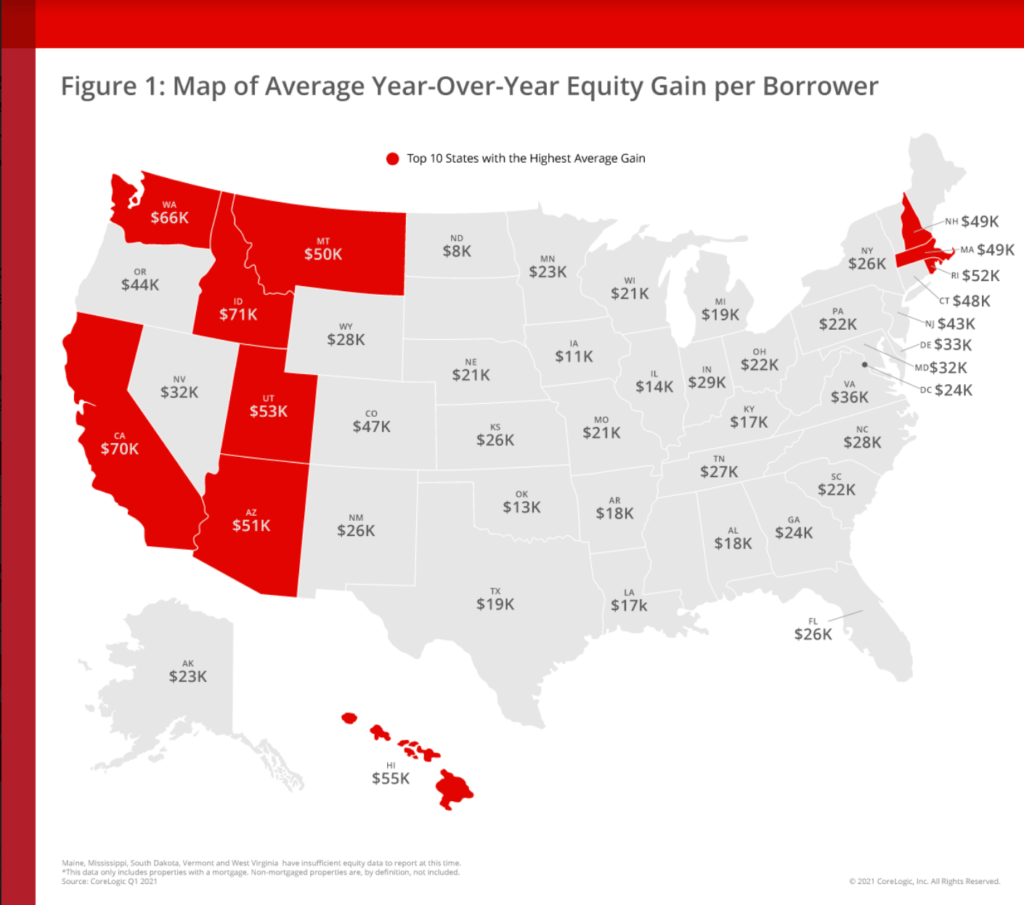
A recent report from CoreLogic states that homeowners gained $1.9 trillion in equity in Q1 2021, which is a year-over-year increase of 19.6%. Going deeper that breaks down to an increase of $33,400 in equity per homeowner and is the highest gain in over 10 years. Arizona’s year-over-year average equity increase is $51,000!
Housing Shortage:
According to a recent NAR report, construction declines and housing demolition over the past 30 years, has created a 6.8 million unit housing shortage nationwide. NAR is calling for a “major national commitment” for more building of all housing types, especially for more affordable housing units. To close the gap, builders will have to build 2 million homes a year for the next 10 years. The challenge here is that builders build to make money and when demand declines, they stop building, which means to reach the building levels NAR calls for, government assistance will be necessary.
3D Printed House:
Habitat for Humanity is building its first 3D printed house in Tempe. The goal is to expedite the building process while reducing labor and construction costs. About 70% of the building will be printed and the remaining 30% will be built through traditional construction. The selected family will move into the 1,600 square foot, 3 bedroom, 2 bathroom home this fall.
Federal Reserve:
Last week’s Fed meeting announcements moved the markets significantly, inflation increased a lot more than expected. Some analysts believe inflation has peaked. Rates are up. All eyes will be on next month’s inflation report as it could be very telling about the future.
FHA Announcement:
On Friday we got some good news from FHA regarding guidelines on student payment loans. Currently, regardless of the payment status, we have to hit the borrower for the greater of:
1 percent of the outstanding balance on the loan; or
The monthly payment reported on the borrowers credit report; or
The actual documented payment; provided the payment will fully amortize the loan over its term
The NEW guidelines state we must use:
the payment amount reported on the credit report or the actual documented payment, when the payment amount is above zero; or
0.5 percent of the outstanding loan balance, when the monthly payment reported on the borrower’s credit report is zero
This new guideline is effective for all case numbers on or after August 16th.
Sarah Perkins is an award winning account executive and has been in title sales since 2004. As the Director of Industry Research & Senior Account Executive, Sarah’s role is to bring real estate transactions to Navi Title. Sarah supports her clients by helping them navigate the ever-changing real estate space through thorough research and understanding of current trends impacting today’s home buyers and sellers.
In this 9 minute video, Amber Kovarik and I discuss the latest in real estate, lending, and the economy. The biggest topics continue to revolve around shrinking inventory, sly-rocketing prices, and low-interest rates. Here is the latest:
One – Inventory:
Nationwide and locally our low levels of inventory continue to be a challenge. Nationwide we have fewer than 390,000 single-family properties available. Here locally we have less than 5400 active listings. According to the Cromford Report, we are 73% below where we should be for inventory to support our population. Demand remains over 28% above normal.
“This is what we call the homeowner prisoner’s dilemma. There’s nothing to buy because nobody is selling, but nobody is selling because there’s nothing to buy.”
Mark Fleming, First American
Two – Appreciation:
The classic supply and demand imbalance continues to push prices up quickly. Nationwide we had appreciation of 13% in 2020 and nearly 17% here in greater Phoenix. Nationwide, the seller’s market actually started in 2012 and here in Phoenix it started in 2014, the crash hit Phoenix extra hard. The 6 years leading up to 2020 our markets appreciated 8%-10% in each 2018 and 2019. The market intensity had been growing leading up to 2020.
Three – Affordability & Policy:
The main underlying theme for housing in 2021 is affordability. The speed of today’s appreciation combined with the years of significant appreciation make things really tough on our current buyers. Expect more policy and programs coming out of DC addressing this issue. The latest proposed stimulus includes eviction, foreclosure, and forbearance extensions through September 30, 2021 which above and beyond the recent executive orders extended those programs through the end of March. The proposed stimulus includes another $30 billion for rental assistance to help landlords.
Four – Zillow News:
Zillow is officially a brokerage with agent-employees who will represent Zillow for its acquisitions and sales through its iBuyer program, Zillow Homes. This changes a few things for consumers. The Zestimate will now be far more accurate as Zillow now as a direct IDX feed connected to the MLS versus negotiated feeds set up with brokers, companies, and MLS’s. Buyer agents will now be called “personal guides” and will be showcased separately from the listing agent for each listing on the site. Also, Zillow is no longer offering free rental listings. In order to post rental listings the agent either pays $9.99 a week or their brokerage has a contract through a Feed Connection Program.
Five – The Economy:
Many economists are bracing for a rough winter. Consumer sentiment may take a hit. There are struggles with continued lockdowns leading to continued layoffs and high unemployment. But as the vaccine continues its rollout and the economy reopens these economists expect a strong recovery in Q2 or Q3 of this year. Businesses will open back up, people will go back to work, people will spend money on entertainment again. Since it was not an economic event that stopped the machine, they expect it to start right back up again and go straight back into a bullish economy.
Six – Lending:
Borrowers continue to struggle when writing offers when they need down payment assistance or ask for closing costs. Nearly no one with closing cost requests are getting them. Finding other options outside of down payment assistance programs is best for getting offers accepted.
At the beginning of the year rates went up after the Georgia election and rose more several days in a row before retreating again. Rates are now 1/8 point lower than they were last week.
The Federal Reserve meets Wednesday. They are expected to vote to continue buying mortgage-backed securities at a rate of $40 billion a month. Their goal is to keep rates low to continue the buyer demand.
Sarah Perkins is an award winning account executive and has been in title sales since 2004. As the Director of Industry Research & Senior Account Executive, Sarah’s role is to bring real estate transactions to Navi Title. Sarah supports her clients by helping them navigate the ever-changing real estate space through thorough research and understanding of current trends impacting today’s home buyers and sellers.
In this 12 minute video Amber Kovarik and I talk about what is happening this week in real estate.
Today’s Takeaways.
Right now there are a lot of headlines about how the housing market is softening, that we are turning into a buyers market. That is not the case. What is the case is that there was a slight decrease in contract signings from September to October, a 1.1% decrease. That doesn’t mention that there was still a 20% year over year increase. Seasonality could be coming into play now, in that it does get a little quieter around the holidays. What the bigger factor is lack of inventory. A buyer cannot write an offer on a property that is not for sale.
To put it in perspective, in the US there are about 140 million housing units. Of those, about 84 million are single family homes. (Greater Phoenix has about 2 million housing units and just over 1.4 million single family homes) Last week, for the first time in history, the number of single family homes for sale nationwide dropped to just below 500,000.
Greater Phoenix has about 4 buyers for every available listing. In order for the Phoenix market to be balanced we would need 25,000-35,000 active listings, we have 7,300. Aside from New York and San Francisco all other major metros are in similar situations. There are some areas in the country that have sufficient inventory for the demand giving us a national average of about 3 buyers for every listing nationwide.
Interesting Facts.
Demand for primary homes is up 50% and for second homes is up 100%, year over year (Redfin)
19% of buyers paid cash in 2019 and 2020. (HousingWire)
For the fourth time, FHFA extended the foreclosure and eviction moratoriums to January 31, 2021. (HousingWire)
Mortgage interest rates have hit all-time lows 14 times this year. (MBA)
Every time we get news that is not favorable for the economy interest rates have gone down. There is so much uncertainty that the fed has just keeps buying more and more mortgage-backed securities. It likely will not go much lower.
Appraisal delays continue. 45 day escrow periods can help make things go more smoothly. Bring on the harmony to a real estate transaction!
With the new conforming loan limits a buyer can now purchase a property for $577,000 with 5% down without having to get a jumbo loan.
With the new FHA limits a buyer can now buy a property for $381,000 with 3.5% down.
Sarah Perkins is an award winning account executive and has been in title sales since 2004. As the Director of Industry Research & Senior Account Executive, Sarah’s role is to bring real estate transactions to Navi Title. Sarah supports her clients by helping them navigate the ever-changing real estate space through thorough research and understanding of current trends impacting today’s home buyers and sellers.
Every Monday afternoon Amber Kovarik and I spend 15 minutes discussing the economy, real estate, and lending.
Today’s Takeaways:
Amber explains what the latest changes made by the Federal Reserve Board mean for interest rates.
Appraisals are taking longer and longer and costing more and more.
Mortgage interest rates have a greater impact on the economy than a recession.
Many economists and real estate experts are changing their real estate projections.
There are 160 million employed Americans who are looking at their home as their castle. Now home is the focus, more so than ever before. And 11% of those 160 million American workers have at least one child in school.
Sarah Perkins is an award winning account executive and has been in title sales since 2004. As the Director of Industry Research & Senior Account Executive, Sarah’s role is to bring real estate transactions to Navi Title. Sarah supports her clients by helping them navigate the ever-changing real estate space through thorough research and understanding of current trends impacting today’s home buyers and sellers.
Every Monday afternoon Amber Kovarik and I talk about what happened this week in our local and national real estate market in 15 minutes or less.
Today’s Takeaways:
Many economists are calling this a K shaped recovery. That means that some are having a positive recovery or are fully recovered while for others the struggle continues to worsen. Economist and real estate consultant, Elliott Pollack calls it the “have and have not economy.” Those with jobs have saved money and are in good financial standing. Those who have lost their jobs, who are usually not homeowners, are finding themselves with fewer job prospects and, with the expiration of the CARES Act, significantly smaller unemployment checks.
Economy:
Retail spending is up. National retail spending increased by 1.2% from June to July, increased 1.7% from February to July, and increased by 2.7% from July 2019. (Elliott Pollack & Company)
AZ retail spending increased by 4% in June and was up 13.7% over June 2019. (Elliott Pollack & Company)
People are buying stuff though, not services. Many young couples who had $30,000 saved for their weddings are now canceling their weddings and using that money for a down payment.
Small businesses are struggling. 97% of businesses in AZ are considered small businesses.
Unemployment:
Initial unemployment claims in the US increased last week by 1.1 million, 135,000 more than the previous week. Continuing unemployment claims dropped by 636,000 to just over 14.8 million. (US Department of Labor)
Phoenix has the best performing job market in the country. It is not that more jobs were added, it is that fewer jobs were lost. (Elliott Pollack & Company)
Amazon announced it is bringing 3,500 new jobs to the valley, including a 500 employee tech hub in Tempe and a 150,000 square foot fulfillment center at Falcon Field in Mesa. (Arizona Republic)
Mortgage:
For the ninth week in a row mortgages in forbearance decreased. It dropped from 7.44% to 7.21% or to roughly 3.6 million loans. Yes, we have a long way to go but an improvement is still an improvement. (MBA)
Mortgage loan applications declined 3.3% week over week. (MBA)
Schools:
Buyer trends are shifting, they want home offices, Zoom rooms, and home-schooling rooms. This week there was an article in Inman that said, “buyers are much less interested in things that used to be important: proximity to offices, shopping and urban centers, high-quality public schools, and even the prestige of neighborhoods.”
Real Estate:
Commercial real estate is struggling. The biggest thing we have to watch is what happens with rentals given the unemployment challenges.
About 22% of single-family homes in the Phoenix metro area are rentals. (Elliott Pollack & Company)
96% of rental owners are small Mom and Pop businesses.
Residential real estate is the shining star and what is pulling us in the right direction. Without the good things happening in real estate the entire country would be in far worse shape.
Supply: The available inventory continues to stabilize. Inventory remains low but is not dropping at incredible rates.
Demand: Pending sales up 16% year over year. This is significant given the low inventory. Our demand is over 21% above normal. The demand continues to rise but at a slowing rate.
Sales & Prices: Phoenix metro area closed sales are up 5% month over month and up 15% year over year. The median sales price is $320,000, up over 14% year over year. Healthy appreciation is 3% annually.
The National Association of Homebuilders/Wells Fargo Housing Market Index, which shows builder confidence, increased to 78, the highest reading since 1998.
Appraisals are getting trickier. They are taking longer to come in. Waiving the appraisal contingency is not working as well as it used to. Many appraisals are not coming in at value.
Sarah Perkins is an award winning account executive and has been in title sales since 2004. As the Director of Industry Research & Senior Account Executive, Sarah’s role is to bring real estate transactions to Navi Title. Sarah supports her clients by helping them navigate the ever-changing real estate space through thorough research and understanding of current trends impacting today’s home buyers and sellers.
Every Monday afternoon Amber Kovarik and I talk about what happened this week in our local and national real estate market in 15 minutes or less.
Today’s Takeaways:
Second Quarter Earnings:
In the second quarter of 2020, the total number of closed residential real estate transactions was down 17.8% year over year. This is because April and May were very low contract writing months. June was up. July even more so. (NAR) The drop in transactions is reflected in the Q2 2020 earnings reports from the major publicly traded real estate firms. Only three had year over year revenue gains.
Zillow: year over year revenue increased by 28%.
Hit a site-traffic record of 2.5 Billion visits.
iBuyer acquisitions dropped to the lowest levels since Q2 2018.
eXp World Holdings: year over year revenue increased by 33%.
Much of the growth is credited to headcount growth.
Redfin: year over year revenue increased by 8%.
RE/MAX: year over year revenue dropped by 24.2%.
News Corp, parent company of Move Inc which owns Realtor.com: year over year revenue declined by 6%.
Realogy, parent company of Coldwell Banker, ERA, Sotheby’s, Century 21, and Better Homes & Garden: year over year revenue decline of 27%.
Keller Williams: closed transactions were down 15.4% and sales volume was down 15%. (Privately owned company and shares limited data)
Softbank Vision Fund, the primary source of funding for companies like Opendoor and Compass Real Estate posted profits in Q1 2020 after three-quarters of billion-dollar losses.
Unemployment:
New unemployment claims dropped below 1M for the first time since the onset of the pandemic in March. 963,000 new claims were filed last week.
Continuing unemployment claims decreased by 604,000 to just under 15.5M
During July 1.8M new jobs were added bringing us down to a 10.2% unemployment rate.
The jobs added were mostly in leisure and hospitality, government, and retail (US Department of Labor)
The average American homeowner has $177,000 in equity. (KCM) This means that a financially burdened homeowner does not have to go through a foreclosure or short sale in order to sell the property.
Housing:
Sales & Prices: Phoenix metro area closed sales are up over 10% month over month and up 15% year over year. The median sales price is $319,490, up 3% month over month, and 12.5% year over year. Healthy appreciation is 3% annually.
Lending:
Fannie Mae and Freddie Mac instituted a 0.5% refi fee for FHA and VA refinances. Adding on average of $1500 to the borrower’s closing costs for $300,000 refinances.
Rates are up slightly but still locking in people under 3%.
Appraisals are coming in low. Be sure to have the conversations with the appraisers. Give them the comps and ask questions.
Sarah Perkins is an award winning account executive and has been in title sales since 2004. As the Director of Industry Research & Senior Account Executive, Sarah’s role is to bring real estate transactions to Navi Title. Sarah supports her clients by helping them navigate the ever-changing real estate space through thorough research and understanding of current trends impacting today’s home buyers and sellers.
Every Monday afternoon Amber Kovarik and I talk about what happened this week in our local and national real estate market in 15 minutes or less.
Today’s Takeaways:
Schools:
Before there are trends there is consumer sentiment. The conversations about “what do we do next?”
Private school and move?
Quit job and move?
What happens to the top performing school districts when the families move away?
Schools are a big part of location, location, location. If they are closed does the demand for a top-notch school district go down?
With kids at home, parents cannot go back to work or look for a new job; which will keep the unemployment numbers high.
Parents that are working from home are now also simultaneously teaching from home.
85% of college students want to return to campus. Colleges and universities want to reopen but how? Some economists question whether major universities will be able to weather this storm. What would Tempe look like without ASU? (Chronicles of Higher Education)
Big 10 voted today to cancel the entire 2020 football season. This will be the first year since 1869 with no college football.
Jobs:
In July 1.8 million new jobs were created.
Total filings are 55 million, continuing unemployment is at 16.1 million.
Nationally week over week filings decreased after 2 weeks of increases, those were the first increases since March. Hopefully we do not see more increases.
Arizona’s new unemployment filings continues to fall. We have not had any week over week increases since the beginning and Phoenix remains the strongest job market in the country.
Forbearance:
Mortgages in forbearance declined for the seventh week in a row, down to 7.67% of all mortgages or roughly 3.8 million loans. (MBA)
With the expiration of the CARES Act, some foreclosure protections have ended and mortgage services are chomping at the bit to get the ball rolling on foreclosures. Remember these services are contractually obligated to make these loans whole, having to pay the difference to the lienholder in the secondary market.
77% of loans in forbearance have at least 20% equity.
Many borrowers have no idea about options. This is a very important conversation to be having with your contacts.
Real Estate:
Nationwide we are struggling with low inventory. The Phoenix listing market seems to have stabilized, just at an extremely low level. We are 63% below where we should be. Instead of 8,400 active listings we should have at least 24,000! Demand continues to outpace supply pushing prices higher. Right now we are running at an 11% appreciation rate. In years passed we were shocked that we hit 8%! And remember healthy appreciation is 3%.
1031 Exchanges may be on the chopping block again. Getting rid of the nearly 100-year-old tax program to fund Joe Biden’s childcare and elder-care proposal. What does that mean for real estate? (Inman)
Sarah Perkins is an award winning account executive and has been in title sales since 2004. As the Director of Industry Research & Senior Account Executive, Sarah’s role is to bring real estate transactions to Navi Title. Sarah supports her clients by helping them navigate the ever-changing real estate space through thorough research and understanding of current trends impacting today’s home buyers and sellers.
Every Monday afternoon Amber Kovarik and I talk about what happened this week in our local and national real estate market in 15 minutes or less.
Today’s Takeaways:
Communication with your clients is key. Be sure to share what is going on in real estate. The real estate industry is the driving force in our economic recovery. Things are happening quickly, demand is high, inventory is low, prices are increasing. This is a great time to be a seller and get top dollar. It is also a great time to buy with mortgage interest rates at historic lows.
Lending:
Usually, there are about $2.5 trillion in loans being pushed through the pipeline, today it is $10 trillion. Four times more volume than usual!
Mortgages in forbearance declined again for the sixth week in a row. 7.74% of mortgages are in forbearance which is roughly 3.9 million loans. (MBA)
About 1.8 million loans in forbearance are seriously delinquent on their mortgage payments. (KCM)
77% of the past due owners have at least 20% equity and 90% have at least 10% equity. (KCM)
The AZ Market:
Cromford Market Index (CMI): The CMI is the best leading indicator available (balance is 100, above 100 is a seller’s market, below 100 is a buyer’s market, prices rise at 110, and drop at 90). Yesterday it was 312.9 (matching the CMI’s record high from the spring of 2005), higher than the pre-COVID peak of 241, and more than double bottom we hit on May 15 of 145.2. Despite the over 15 point increase in the past week, the increase is slowing, slightly, which is good.
Supply: The available inventory continues to stabilize; it just happens to be at an extremely low level. As of yesterday, our inventory is 62.5% below normal. Active listings excluding under contract accepting backups (UCB) are down 42% year over year and 11% month over month.
Typically, the second half of the year sells less than the first half. Starting in July we tend to see an increase in available listings and that increase remains through November. It is too early to tell if 2020 will fit the pattern.
Demand: Pending sales are up 17% year over year, which is significant given how much lower our inventory is today. Our demand is 17.2% above normal and continues to increase.
Sarah Perkins is an award winning account executive and has been in title sales since 2004. As the Director of Industry Research & Senior Account Executive, Sarah’s role is to bring real estate transactions to Navi Title. Sarah supports her clients by helping them navigate the ever-changing real estate space through thorough research and understanding of current trends impacting today’s home buyers and sellers.
Every Monday Amber Kovarik with Guild Mortgage and I spend 15 minutes (or less) talking about what is currently happening in the real estate market, title, and lending. We give a few key points to share without taking up too much time.
Today’s Big Takeaways:
May’s job report was way better than predicted. Rather than losing 8 million jobs, the United States created 2.5 million jobs!
Demand has grown 7% in the past 3 weeks and it is increasing daily. It has increased to only 20% below normal.
Inventory is decreasing daily and we are now nearly 49% below normal.
With demand being higher than inventory, prices are pushing upwards.
Many listings are seeing multiple offers. One of Amber’s clients had a new listing that had 70 showing requests this past weekend.
Lending guidelines are clearer now. New options available including self employed loan options and jumbos.
It is very important to get pre-qualified early on as houses are moving so quickly right now.
Sarah Perkins is an award winning account executive and has been in title sales since 2004. As the Director of Industry Research & Senior Account Executive, Sarah’s role is to bring real estate transactions to Navi Title. Sarah supports her clients by helping them navigate the ever-changing real estate space through thorough research and understanding of current trends impacting today’s home buyers and sellers.