Sensationalism in the news media hurts consumer sentiment. Consumer sentiment has the greatest impact on the market and the economy as a whole. As much as we value our individualism and our ability to think for ourselves, we are heavily influenced by the decisions and actions of others.
When consumers see other consumers pull back, they question, “What do they know that I don’t?” Unfortunately, it is not unusual for groups of people to make drastic choices based on nothing.
This is why it is so important to share accurate and timely information with our home buyers and sellers. Be wary of clickbait and remember, sometimes it is the last sentence in the article that sheds the most amount of light on the topic.
Yes, there are headwinds. Yes, this year will not be like last year and that is ok. The 2021 housing market was unsustainable. And besides, no two years are ever exactly the same. That would be boring.
Fannie Mae’s January Housing Survey:
In March 2021, 53% of Americans thought it was a good time to buy a house. Today 70% said it is a bad time to buy. Consumer sentiment has changed. Prices are higher, rates are higher, there are fewer listings available, and the competition is fierce. The counterintuitive piece is that declining demand will allow inventory to grow and will slow appreciation which will ultimately bring that consumer confidence back up because then the buyers have more options to choose from.
“Younger consumers — more so than other groups — expect home prices to rise even further, and they also reported a greater sense of macroeconomic pessimism. Additionally, while the younger respondents are typically the most optimistic about their future finances, this month their sense of optimism around their personal financial situation declined. All of this points back to the current lack of affordable housing stock, as younger generations appear to be feeling it particularly acutely and, absent an uptick in supply, may have their homeownership aspirations delayed.”
“Homebuyers in the last quarter saw little relief as home prices continued to climb, albeit not as fast as earlier in the year. The increasing prices are indicative of a seller’s market, with an abundance of eager buyers and very limited supply.”
-Dr. Lawrence Yun, NAR Chief Economist
Available national single family inventory hit another new all time low, dropping by nearly 6% this week to 256,000. Down 17% below the record low on April 30, 2021. In normal markets, mid-January is the low point of inventory for the year.
In 2021 we saw an average of 100,000 new listings each week. So far this year we are seeing about 80,000 new listings a week. Last week 31% of homes sold immediately, within one day. Last year it was about 25% sold in one day.
Despite the volatile stock market and rising mortgage rates, demand remains solid, declining some but still at elevated levels. Prior to now, the most recent rate hike took place at the end of 2018. Nationally demand declined and inventory grew by about 6% (not in Greater Phoenix).
There may be a pull back on purchases but do not expect an increase in defaults and foreclosures. The typical American mortgaged homeowner has $185,000 in equity.
Usually, interest rates increasing deters second home buyers and investors before demand declines for primary homes. According to Redfin, January’s second home demand was 87% higher than pre-pandemic, only September of 2020 was higher at 90%. Primary home demand is up 42% from pre-pandemic numbers.
The AZ Market:
Join us on Wednesday, February 16 for our next Cromford Market Update with Tina Tamboer. She will spend an hour doing a deep dive into the Greater Phoenix real estate market. For details and registration, click here.
Following in the footsteps of Minnesota, California, and Oregon; Arizona’s lawmakers have proposed a bill that allows the state to override local zoning ordinances and enable developers to build higher density and multi-family in areas that previously only allowed for single family homes. NIMBYism (not in my backyard) has long prevented local zoning changes. The entire proposal can be found here.
In 2021, Greater Phoenix was the most popular city for relocation bringing 85,000 new residents. Dallas came in second with 56,000 new residents and Orlando came in third with 53,000 new residents.
In ten years, the median sales price increased by about 300%. Today homes under $200,000 are nearly non-existent and in 2011 the majority of our market was under $200,000.
New Construction:
I recently had the privilege of attending the AZ Dealmakers event on January 27, 2022. It is an event that includes industry leaders in the residential new construction arena. The presenters included economists, housing analysts, builders, lenders, and more. The conversation was all about the future of new home development in Arizona. My notes and takeaways from the event are here.
Real Estate News:
In 2021, the most popular ‘how to become’ search on Google was for ‘real estate agent’ followed by flight attendant and notary.
In 2021, publicly traded residential prop-tech companies lost 65% to 75% of their value including Zillow, Redfin, Compass, eXp, Opendoor, and Offerpad. That is $90 billion in shareholder value gone in a year. This year all eyes will be on these companies to see if they can become profitable.
Final Thoughts:
Clickbait headlines like “75% of homebuyers acknowledge some regret over recent home buy” lead to incorrect conclusions. If you read through the full article, it explains that 75% of buyers that purchased in the past two years have at least one regret about their home purchase. It is probably fair to say that most people have one regret about their new house, regardless of when it was purchased, there are always woulda, coulda, and shoulda’s.
In order to be confident, consumers need reliable information that helps them make choices based on their specific needs. If consumer confidence is waning, remember real estate moves slowly, albeit currently, it is moving faster than ever before, there is plenty of time to plan and pivot accordingly.
Sarah Perkins is an award winning account executive and has been in title sales since 2004. As the Director of Industry Research & Senior Account Executive, Sarah’s role is to bring real estate transactions to Navi Title. Sarah supports her clients by helping them navigate the ever-changing real estate space through thorough research and understanding of current trends impacting today’s home buyers and sellers.
I recently had the privilege of attending the AZ Dealmakers event on January 27, 2022. It is an event that includes industry leaders in the residential new construction arena. The presenters included economists, housing analysts, builders, lenders, and more. The conversation was all about the future of new home development in Arizona. These are my notes and takeaways from the event.
State of the Housing Market and the Wider Economy, presented by Ali Wolf, Zonda Chief Economist:
Labor market: surprisingly tight
Nationwide still down 3.6 million jobs from February 2020
Greater phoenix has 70% more jobs
Wages are up 4-7% depending on source
Inflation is up so real wages are flat
Inflation: highest in 40 years, why would inflation increase/decrease?
Could go to 7.5%? Why?
labor shortage
Wage price spiral
Supply chain issues
Demand stays strong
Fed is cautious on rate hikes
Could be 2.7% why?
Fed raises rates 4-5 times (announced 3?)
Demand stays strong but is more evenly spread
Supply chain eases
Higher wages bring back more workers
Federal Reserve: accelerating policy timeline
Mortgage rates: about 3.5%
Lumber prices: more than doubled since November
Supply chain: disrupting product availability
Covid: evolving
Home sales and supply:
The national average new home sales rate:
2018: 1.7 (average per month sales rate per community)
2019: 2.1
2020: 2.9
2021: 2.8
Sales Strategy:
Entry level builds used to be the primary type of home sold. Its lead over the other types is decreasing.
90% of builders are slowing the build times because it is too hard to keep up with supply and labor chain issues. National it is a big problem and locally it is even bigger.
Mortgage rate urgency has pushed the typical spring selling season started earlier in 2022. (it was already starting in January for the past few years)
Community count is trending down. Still searching for the bottom.
Inventory is down 50% from two years ago and is still dropping.
Pricing & Affordability:
50% of all activity was around $200-300K and now it is 5% of the market and the past 2 years saw a big change.
Price increases in response to demand and costs.
90% of builders are raising prices nationally
Locally all of the buidlers are raising prices
One builder raised prices by $25,000 just to cover costs
Builder reported buyer hesitancy peaked and then it started to trend down. 48% hesitancy in September 2021 and248% in January 2022.
Equities and equity:
Why has the growth been so dramatic? How has wealth changed?
The average equity gain, per Corelogic, in AZ in 2021 was $92K. #1 was CA at $112K. AZ is #4 in increases. (AZ has more growth than CA)
Most active shoppers in Phoenix:
Move up
Entry level
Relocation
36% of shoppers are coming from outside AZ.
In some markets in FL it is 80%
Policy is trying to keep up. New FHA loan limits. AZ saw a $75K increase. FHA is trying to catch up, not trying to keep up.
It is easier to get an FHA offer accepted on a new build than with a seller on a resale home.
Forecasts and final thoughts:
Mostly positive growth but concerns remain. Zonda forecasts a 5.1% in additional growth for single family starts in 2022, nationally.
Entering 2022 with the same challenges at the start of 2021. As reported by the builders:
Sales are dependent on supply, sales, caps, and affordability.
New home sales are down by 6.6% in 2021 year over year. Zonda forecasts a 10% increase in sales in 2022. The decline in sales is mostly due to slow completions.
Mortgage rates:
Consumers weighing higher wages and increases savings against higher IRs and home prices.
A 0.5% change in interest rate translates to 6.5% in home price.
A 1% change in interest rate translates to 13.2% in home price.
Zonda is calling for an annual average of 3.6%
Depending on what rates do, it will impact buying trends. New homes are more susceptible to fluctuations in rates.
Zonda believes that the appreciation rate will be closer to 12% mostly due to:
Low inventory
Buyers showing little resistance to higher prices
Interest rates plateau around today’s levels or decline
Builder costs increases main high and get passed to consumers
Demographics continue to drive supply and demand imbalance
These levels of appreciation are not sustainable.
Steven Hensley: Phoenix housing market overview:
Economy:
Rosy employment outlook. Greater Phoenix has more jobs today than in Feb 2020. Only a few states are fully recovered. Lots of jobs coming here, lots of job openings.
120,000 new jobs in AZ Moody’s forecasts in Phoenix in 2022.
Strong household growth and household formation expected.
48,000 new household formations each year over the next 5 years. We need roughly 50,000 new units to support this growth.
Demand:
Contract sales are lower in 2021 than 2020
Closings are down in 2021 from 2020.
Starts are way up, highest since 2007
Run up in demand that led to historic level of starts in 2021.
2019: sales contracts 22,050
2020: 27,399 (levels not seen since 2005-2006)
2021: 24,215
Demand took a step back for a few months, then heading into 2021 demand shot up and then the supply chain issues surged seemingly overnight.
This summer we had a considerable pullback and then in October demand picked right back up to 2019 levels. Demand was down 12% in 2021 from 2020 but up 10% from 2019.
Sales rates back to “normal”
3-4 sales per month in 2019
5 sales per month in 2020
2021 it was 8.5 in the spring and the year ended around 4.5 sales per month.
Huge peaks and followed some normalization.
Pinal always outbuilds and outsells Maricopa. It is newer and has more land to build on.
Affordability still drives this market. Under $300K saw 6.5 sales per month. Healthy demand in all price points.
Supply:
Existing inventory is down 52% since 2019 and 2% since 2021.
New home supply, active community counts are down 5% year over year and 15% from 2 years ago.
We had 100 fewer communities active in 2021
Same number in December as March 2021
Low vacant developed lot count, there are 28,000 vacant developed lots that are ready to go, lowest levels since 2003.
Lot development is up 13% year over year through Q4 2021.
Supply is on the way and should have more coming to market this year.
Plateaued on sales but starts are way up. Labor is the biggest struggle. Over a 12 month build time for a regular house, way up.
New home price appreciation is softening, slightly. Median base home price $450K, 26% higher year over year. 51% up from January 2019. Slight leveling off. Lots of price increases this month. Some increasing $15K to $20K per home and builders are pushing costs to consumers, not adding to profit.
Median resale prices reached $425K in 2021. (pending sales median is currently $450,000 – I have friends in high places 😊)
Home affordability ratio:
The median sales price of new homes compared to a 30-year fixed and household income* affordability ratio has dropped *data issues on wages. Affordability is under a lot of pressure.
Final Thoughts:
Lots of homebuilders are going towards the freeways
Home sales are limited due to lack of capacity to develop
Strong migration trends
Zonda forecast, new homes sales will be similar to 2020
Lot counts are up
New home appreciation 6-7% expected this year
Stable sales per month
Fewer building permits
Record number of starts last year
Should we be worried? Why?
Interest rates could rise too quickly. Watch the 10 year yield, rates go high then it could put pressure on the buyers.
Land prices are significantly higher.
Could have a bit more inventory but not much, this year.
Trends & Predictions by Nicollette Chapman, Zonda’s chief mortgage analyst:
Affordability and interest rates are buyers’ biggest challenges.
Rates are 3.5%, up 0.75% year over year.
Are we nearing a potential bubble? Watch the 10 year treasury yield.
Lender Q & A
Mortgage applications are a leading indicator.
2020 $4.1T, 2021 $3.9T, 2022 expected $2.1T(f). Market is built for $4T. Expecting a 65% decline in refis this year. Lots of refi shops, are going to attempt to move to new home lending. Refis are super different than new home lending (homeowners financial). Seeing lots of shifts in the lending market already happening. Have seen lots of announcements of layoffs from national lenders. Believes rates could reach 4% – 4.5% in the next 6 months.
A way to address increased rates, look at the overall budget, figure out how to make other adjustments to handle house payments. Shelter is a bigger need than an extra car. Or look at what can be cut out. Lifestyles are forever changed. Maybe re-addressing options for how people use their own homes.
Home has evolved. Work at home, work out at home, hopefully not teach at home anymore.
(Ryan Sandal things rates may reach 4% in the next 6 months)
Wells Fargo said north of 4% for rates in 6 months from now.
Austin Bates with Fairway:
Thoughts on the increased upfront fees for high balance and second home sold to Fannie and Freddie?
He said that it supports the fundamentals that has helped the market so it is easier for owner occupied buyers and buyers without a ton of money to have more options because second homebuyers pull back due to the extra cost.
Maricopa county is not considered a high cost county, yet but probably will. A lot of CA counties are and that is why so many people are moving here.
Mike Sturgis with Loan Depot
50% of buyers are millennials
Educational and marketing is how you get in front of buyers today
Expects 4%-4.5% rates in 6 months
The Future of Build to Rent:
Darin Rowe national president BFR Taylor Morrison and Tim Sullivan Zonda and George Maravilla senior vice president Tower Capital (land development and DMB, lots of funding for BFR):
Build to Rent Market Is it the foundation of affordable housing?
BFR is it a one size fits all? Not really. It depends on the cost.
Phoenix is ground zero for the movement.
Struggle to find rents that are high enough to make it make sense to buy the land. Land is expensive so if the numbers don’t make sense it is much harder to make it happen. Depends on the cost of the land. CA is too much. If there isn’t traditional multifamily it is hard to comp out the BFR to gauge pricing and demand.
2 types:
Traditional separate lots, divided and stand alone, can be sold individually.
Single property is bigger here than in other markets, easier to develop
Traditional appeals to different renter types and different price points
All one property, like an apartment, horizontal apartment complexes (Christopher Todd)
Taylor Morrison is the owner/builder and Christopher Todd is the franchisor. Idea was to team up. Wants to build this across the country, 2 years in Phoenix. Targeting markets where Taylor Morrison has communities. Are working on about 10 markets nationwide. Phoenix is a successful market.
Different markets have different demographics and different demand.
Any cities struggling? Smile states are doing the best (sunbelt states) the migration patterns are where the strengths are. CA has been a challenge and will always be and will likely be one of the later states for BFR. Most will not consider CA for BFR.
Massive Flood of capital coming into this space. Pre-covid lots of capital, then as covid hit everyone was chasing the capital.
Covid stopped many asset classes except for:
Residential
Industrial
Life sciences
BFR
Capital has gotten cheaper because so much capital is available for bfr development. Huge drops in interest rates.
November 2021 dropped to 3.5% from 4.1% rates, getting more and more aggressive to get capital. Money is cheap right now so it is good on the competitive side.
Each city has different policies for rentals so each area is carefully selected. Need to know who the target audience is.
Each market is different but about 80% of development can be the same across the board. Many are 1 and 2 bedrooms. Finding more people are moving units than expected. 2 people in a 1 bed, or 3-4 in a 2 bed, even families.
Hybrid projects, some rentals and some for sale. Like having a for sale project near the rental projects.
Talked about modular, off-site builds. No one has done it successfully.
BFR and SFR fight over land. Will land get too high for the single family builder? George said yes. Math is skewed towards the for rent and policy will likely come to limit that so SFR still comes first.
BFR asset class is in its infancy, expect a lot of growth here. Right now there is so much capital in the space, best time to get in but it is harder than it looks.
Housing Builder Panel:
6% appreciation by the end of Q1 2022.
Everything is costing more. Not seeing people who will pull back due to cost growth, at least at this point. Expecting a good year.
The backlogs are not scaring the builders. Expect a great first half and then demand pull back the second half and inventory rises.
Timelines are increasing significantly. Labor issues is bigger than supply chain issues. Not feeling the improvement in new jobs. Still needs a lot more. AZ is not immigration friendly, trades are not growing, expect to see continued labor issues.
Build side:
Very similar to 2004-2005 demand
A lot that feels like 2004-2005
The fundamentals are very different
Potential to overbuild but it will take years because such a lack of supply now.
Appreciation forecasts are 6-8%, 10%, 10% by March 31.
If we see 10% increase and a 4%+ interest rate could pressure demand.
Potential Challenges:
Continued high inflation
Declining job growth, no economy with no job growth
NIMBYism AKA not in my backyard (an issue in Levine)
Migration impacts demographics
Biggest takeaway: adapt.
Notes by Sarah Perkins, Director of Strategic Accounts, Clear Title Agency of Arizona
Sarah Perkins is an award winning account executive and has been in title sales since 2004. As the Director of Industry Research & Senior Account Executive, Sarah’s role is to bring real estate transactions to Navi Title. Sarah supports her clients by helping them navigate the ever-changing real estate space through thorough research and understanding of current trends impacting today’s home buyers and sellers.
Inventory is still declining, demand remains consistent, and prices are still increasing. There is no relief in sight. The anticipated January inventory increase never materialized. The expected foreclosure boom didn’t come. The builders are constrained as ever. Mortgage rates are up. Something has to give, but what and when? Our buyers are exhausted and potential sellers don’t know where they will go when they sell.
National Real Estate:
Available national single family inventory hit another new all time low this week at 272,000. Down 1.9% from last week and 11.4% below the record low on April 30, 2021. In normal markets, early to mid-January is the low point of inventory for the year. By February, inventory has already started climbing. Inventory hasn’t slowed its weekly decline yet. Like last year, it may not be until the end of April before we start to get a little inventory increase for the year.
It is too soon to see the impact of the financial corrections on housing. It will take a couple of months to show its impact. Home buying is more driven by life events (married/divorced/babies/empty nest) than it is by financial events. Second homes and vacation rentals are more impacted by the market volatility. This has the potential to create opportunities for first time home buyers.
First time home buyers gained some ground in 2021, making up 34% of the year’s buyers, up from 32% in 2020. Prior to the market crash in 2008, first time buyers made up 40% of the market. With the largest group of the largest generation aged 28-34, this number is expected to rise. Affordability and lack of available homes will likely dampen growth though.
Despite expectations, foreclosure filings declined in December making 2021 the all time low for foreclosure filings. The forecasted increase did not materialize and bring additional inventory to market.
Fannie Mae expects existing home sales will decline in 2022 by 3.2% due to increased mortgage interest rates creating affordability challenges. Fannie also predicts that 2022 will be the second biggest resale year in the past 15 years only behind 2021.
Source: Fannie Mae Economic and Housing Outlook, January 2022.
Prices increased so much nationwide that the value of our housing market grew by $6 trillion in one year!
The AZ Market:
Join us on February 16 for our next Cromford Market Update with Tina Tamboer. She will spend an hour doing a deep dive into the Greater Phoenix real estate market. For details and registration, click here.
To see my notes on our recent deep dive with Tina, please click here.
According to the Marcus & Millichap annual US Multifamily Index, Phoenix ranks number five in top investment markets due to the job growth and household formation rates.
Tom Ruff with the Information Market summed up 2021 and the challenges we face in 2022 beautifully. He wrote:
“What we do know, we begin 2022 with the lowest number of active listings at year’s end on record. And, while we all know the 28% year-over-year increase in the median sales price last year is unsustainable, there is nothing holding back continued price gains in the short term. We know a change is coming, but there are two questions I can’t answer: When will our market moderate? Where will the increase in supply come from? We do know, it isn’t going to moderate tomorrow. New construction and distressed sales will not increase our supply as new construction did in 2004 and 2005, and distressed properties did in 2009, 2010 and 2011.
It’s time for your year in review records:
• Highest year-end sales units: 104,850
• Highest year-end average sales price: $528,940
• Highest year-end gross dollar sales volume: $51.763 Billion
• Highest year-end median sales price: $427,000
• 11 consecutive years with year-end gain in the median sales price
• The number of new builds sold in Maricopa County declined this year after increasing 6 straight years”
New Construction:
Recently I attended an event that discussed the future of land development and building. There were multiple national and local builders who all believe we will see new builds appreciate 10% in the next 6 months. They anticipate increased delivery of backlogged product later this year. Labor is the number one struggle for builders and is why a regular house now often takes over 12 months to complete. Supply chain issues are a close second. Builders expect to see an increase in completions during the second half of the year, but it will be sometime before the low inventory struggles improve.
Nationally, a record high of 34.1% of homes on the market in December were new construction, up from 25.4% a year ago.
According to Ivy Zelman of Zelman & Associates, about 70% of mortgage holders are locked into a mortgage interest rate at or below 4%. That is a big disincentive to move as rates incrase. Zelman thinks that the rate increases will hurt the primary buyer but not the investor who is paying cash and buying and holding.
Before covid each year about 2.3 million renters converted into homeowners. By the end of 2020 and Q1 2021 that number increased to 2.8 million and has since moderated to about 2.4 million. The increased demand we are seeing now is from the investors who were 20-21% of the market and now are 26% of the market. A substantial amount of the surge in prices has been from corporate buyers. Second home buyers have also been a big part of the market and pushing up prices.
Inventory is coming from the new builds. A ton of product is coming. Backlogged single family inventory is at 2007 levels. The pipeline is massive in the mountain west. Tons of options coming both for build for sale and build for rent.
Real Estate News:
AIG is not renewing 9,000 homeowner insurance policies for high end homes in CA due to future flood and fire risks. Backup insurance is offered with premiums of upwards of $40,000 a year for a $10 million house, or $100,000 a year for a $30 million home. This could have a significant impact on CA home values.
With the goal to reduce inflation, the Federal Reserve announced it will begin raising rates on 3/16/22 after it completes the bond and mortgage backed security purchase tapering.
In an effort to boost homeownership, a quasi-governmental group in Cincinnati out-bid 12 other investors to purchase nearly 200 homes. The properties will be renovated and sold to local residents.
42% of homeowners with a loan are equity rich, which means their home’s value is at least double the loan amount. The top three states are 1. Idaho, 2. Washington, 3. Arizona.
Final Thoughts:
For years, the simple rule of thumb has been if a city has a solid job market and a growing population to handle those jobs then the city would have a healthy real estate market. That seems easy enough. But what happens when you have a growing job market and growing population of over 5 million with ever declining resale options and new homes are taking 12 months to build? I do not know but we will find out soon enough.
Sarah Perkins is an award winning account executive and has been in title sales since 2004. As the Director of Industry Research & Senior Account Executive, Sarah’s role is to bring real estate transactions to Navi Title. Sarah supports her clients by helping them navigate the ever-changing real estate space through thorough research and understanding of current trends impacting today’s home buyers and sellers.
“Buy land, they’re not making it anymore.” ~Mark Twain
On June 19, 2020 I wrote, “Econ 101 taught us about supply and demand. To measure the health of the real estate market we look at new listings AKA supply, and new pendings AKA demand. When demand out paces supply, prices go up. This has been good news for a lot of sellers over the past several weeks. However, we are moving closer and closer to running out of houses to sell.”
When I wrote that there were 8900 active listings in Greater Phoenix. Yesterday there were fewer than 5300 active listings. That is a 40% decline in 18 months. We haven’t run out yet, but this is the closest we have gotten.
Despite many real estate experts believing that things will normalize in 2022, the numbers are telling a very different story. Demand continues to outpace supply.
National Real Estate:
Inventory: 2022 started with record-low supply. There are only 294,000 available single family homes in the country, which is a 10% drop in the last week and a 33% drop from this year’s peak in early September.
If demand drops off, we are still at a record low supply. Forbearance will/did not bring any inventory relief. That was a very successful program that kept many people in their homes when they may have otherwise had to sell. There is no foreclosure wave coming and the new builds are being absorbed as quickly as they are being released.
Typically, inventory grows early in the year. In January and February, 2020 supply started increasing before it started falling and we didn’t see any increase in supply until May 2021. Homes were coming to market and selling immediately so supply could not increase.
We do not know if supply will hit the normal low in January (essentially now) or if demand will keep things moving until April or May again. Does the hot market entice sellers to take advantage of their equity? Will the assumption of mortgage rates increasing drive owners to sell sooner? The question is, will inventory bottom out at 300,000 in January or decline to 200,000 in April? We will know the answer soon.
Inventory has been falling for a decade and mortgage rates are low. It has been a really good time to be a homeowner. And with rates this low, many sellers are keeping their previous home as a rental. This is a big reason for the continuously falling inventory levels.
“Investors accounted for more than 18% of U.S. home purchases, a record. Low interest rates and a persistent shortage of affordable properties have pushed investors to stomach higher prices as they bank on rent growth and price appreciation.”
-Patrick Clark, Bloomberg
In an inflationary economy, assets are more valuable than cash due to an assets ability to appreciate while cash depreciates. Inflation of this magnitude hasn’t been seen in 40 years. This implies 2022 will face new lows in available inventory.
The best way to track the level of demand is with immediate sales. Since June about 25% of new listings sold within the first 24 hours of going active. Two weeks ago, it actually increased to 33%. About 60,000 new listings hit the market two weeks ago and over 18,000 went pending in less than 24 hours. The data is not showing any signals of slowing.
Experts are still hoping for a calmer, slower 2022 but there are no indications of that at this point.
Buyer demand increased in December and was 84% higher than normal pre-pandemic December demand, nationally and locally in Phoenix.
A recent headline reads, “Home Inventory Hits All Time Low: Fewer homes were available in November than in any period on record, driving prices 15% higher than last year, Redfin reports”
There were about 15 million refinances closed in 2020 and 2021. Low rates often keep owners in homes.
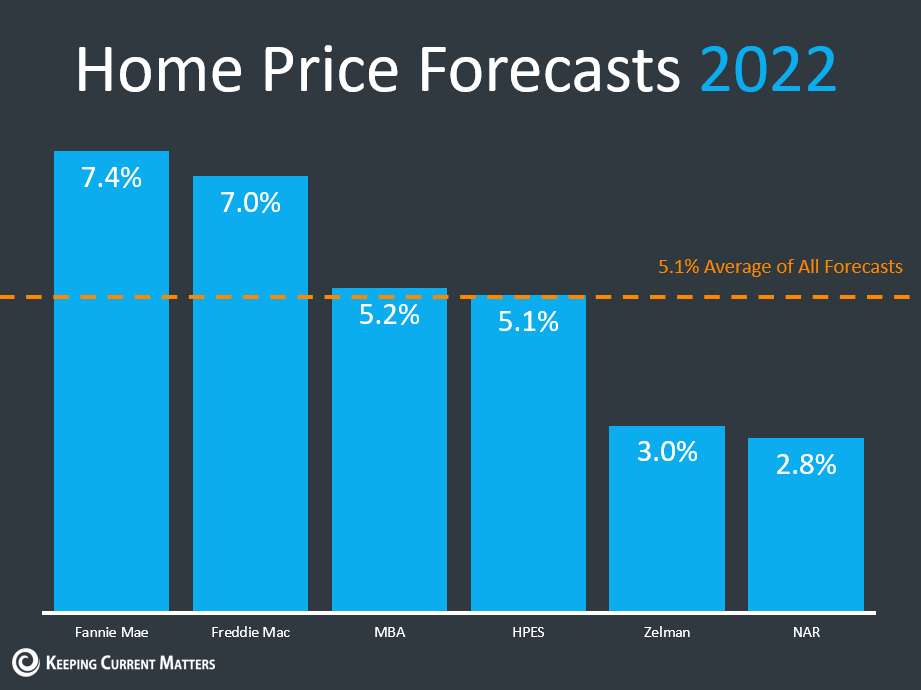
Yet despite the evidence, forecasted home price appreciation for 2022 is oddly low. I expect these numbers to be revised up:
The AZ Market:
Join us next week for a Cromford Market Update with Tina Tamboer. For details and registration, click here.
The median sales price in December reached $425,000. Resale homes appreciated 28% in 2021 and 297% in ten years.
New homes appreciated 26% in 2021.
About 30,000 single family permits were issued in 2021. In 2005 there were about 60,000 issued.
With the 90,000 new jobs created in 2021 and the 120,000 expected in 2022 further growth is anticipated along with consistent demand.
New Construction:
The first phases of Superstition Vistas, the largest community in the east valley, has officially broken ground. The nearly 2,800 acre master-planned community will offer about 10,500 residential properties.
Phoenix is ground zero for the build-to-rent movement with 5,008 units in 32 existing communities and 6,902 units in 34 communities under construction.
In Greater Phoenix, at the end of 2021 there were 424 new home comminutes, down from 480 in 2020, and down 25% from 545 in 2019.
In 2021, six US properties sold for $120 million or more. In 2020, one property sold for over $100 million. In 2019, 25 properties sold for $50 million or more.
Zillow’s plans for ShowingTime includes direct to consumer and new build scheduling.
OnePointOne, a Silicon Valley startup, is planning its first vertical farm in Avondale. Located in an 80,000 square foot warehouse, the idea is to save space and water.
BlueZoo’s “Party Squasher” sensors measure occupancy in homes in real time and can alert owners including short term rental owners of parties or large gatherings in the property. (I am so glad these didn’t exist when I was in high school!)
Greater Phoenix had more resale closings in 2021 than in any other year, beating out 2005. Nationally, it was the biggest selling year since 2006. That happened despite a still raging pandemic, iBuyer sloppiness, political unrest, supply and labor shortages, massive inflation, high (but dropping) unemployment, and virtual learning. That is very impressive and also explains why 2022 will be anything but normal (no matter how desirable that sounds).
Sarah Perkins is an award winning account executive and has been in title sales since 2004. As the Director of Industry Research & Senior Account Executive, Sarah’s role is to bring real estate transactions to Navi Title. Sarah supports her clients by helping them navigate the ever-changing real estate space through thorough research and understanding of current trends impacting today’s home buyers and sellers.
Remember at the beginning of the year we hoped for answers and less political strife? Whether or not those were accomplished remains to be seen but one thing is for sure, 2021 was a year of records. Nationally, median sales prices peaked, for sale inventory bottomed, average days on market bottomed, over-asking price sales peaked, mortgage rates hit all-time lows, and second home demand surged.
I recently lost all of my previous reviews, will you please help me rebuild by leaving me a review here?
National Real Estate:
Yesterday Mike Delprete wrote, “As the Zillow Offers collapse has demonstrated, pricing is a true potential competitive advantage for iBuyers (sellers). Getting it right is a prerequisite for success, while getting it wrong can lead to catastrophic failures.” This applies to all sellers.
The most recent Swanepoel Trends Report created by real estate consulting and research firm T3 Sixty, author of NAR’s Danger Report (published in 2015 detailing the biggest dangers to the residential real estate industry which have all essentially come to pass), states that in 2021 real estate went into “hyperdrive” and is labeling this year the start of the “Great Acceleration” which could last as long as 10 to 15 years. The growth of available capital has enabled an “increasing concentration of production and market share among the nation’s largest real estate companies.”
Last week, available single family inventory declined by 7%, this week it declined by another 3%, we are now down to 339,000 actives. On April 30, we hit the 2021 low of 307,000 listings. Inventory may fall below that by the end of the year.
Experts suspect a cause of the low inventory is due to homeowners keeping their properties to rent out rather than selling when they move. About 16 million or 19% of single family homes are rentals. Of those about 300,000 are owned by institutional investors and 176,000 are owned by the 4 largest corporate investors, Invitation Homes (the largest with 80,000 homes), American Homes 4 Rent, Progress Residential and Cerberus Capital Management.
Each week for the past 6 months, about 25% of new listings sold within 24 hours of going active. This is a leading indicator of demand, when this number shrinks, we will know demand is declining.
The AZ Market:
Inventory is dropping, quickly, again. Inventory is 67% below normal while demand is 23% above normal. The supply-demand imbalance continues, pushing prices ever higher. We may end this year with a 30% year over year appreciation rate. We will have more existing home sales than in 2005! Given that our available inventory levels have been declining for years, we will start 2022 in a robust seller’s market.
The $750 million redevelopment of Metro Center is expected to start in the second half of 2022. The plan includes 2,600 multi-family units, retail, restaurants, bars, parks, and commercial and entertainment venues.
After reaching an increase of 6.8% in year over year inflation, a 39 year high, inflation concerns have replaced unemployment concerns. The Federal Reserve has opted to, starting in January, increase the speed in which it tapers its bond and MBS purchases. With the new schedule the tapering will be completed by March rather than June. Upon completion, the Fed will be ready to implement its first short term rate hike as early as April. By raising the rates, inflation will cool. (Devil’s advocate, they can’t raise rates too much or the Federal government will not be able to make its debt payments because it be able to afford the interest rates.)
Buffini is proud that of the 33 bold predictions he has done (year-end and mid-year), he has gotten it right 31 times.
This fall we experienced a mini-surge in demand, making this fall the second busiest fall in 15 years, behind 2020. The increased demand is unusual for this time of year.
2021 in Review:
In 2019 Realtors had an average of 9 years of experience. In 2020 that numbers dropped to 8 years, the largest one year decline in history.
In 2021 first time home buyers made up 34% of buyers, up from 2020’s 31%.
15% of buyers purchased new homes (it was 29% in 1989).
29% of buyers paid over asking.
90% of homes went under contract within 30 days.
Estimates 6 million existing home sales, up 7% from 2020’s 5.7 million sales.
NAR’s has roughly 1.5 million members, which means that there were 8 transaction sides for every Realtor.
2022 Predictions:
Expects a very busy spring and summer. The cheaper markets will cool first and luxury will remain strong. Asset purchases, particularly real estate purchases are a great hedge against inflation and those who can (buy), will.
2% decline in existing home sales; to 5,880,000 or 7.8 transaction sides per Realtor.
Inventory increases due to new construction completions and the expiration of mortgage forbearance. (I agree with the new home availability, but the mortgage forbearance numbers are too small to make an impact. At the end of October there were 1M borrowers in forbearance and 17% exited still behind on their payments with no loss mitigation plan in place. These exits only add 3,400 listings per state if divided evenly)
By December 2022 interest rates will be at 3.7%. The increased rates slow price appreciation.
Fewer sales over asking.
It will be harder to get business and more market share will go to the highly trained.
After two years of record numbers entering the industry and due to the increased difficulty in obtaining business, not everyone will be successful, more agents will fail than will succeed, likely furthering the decline in years of experience.
Real estate is no longer for hobbyists, it is for the highly trained, skilled, funded agent who runs the business like a business.
Real Estate News:
In an effort to stifle money laundering and other criminal activity, the US Treasury Department is looking to expand reporting requirements for all cash purchases. According to NAR, one-third of home sales are all-cash. (in Greater Phoenix it is closer to 40%)
Since the definition a “safe neighborhood” is subjective and has the potential to reinforce racial biases, Redfin and Realtor.com are removing crime data from their sites and Redfin is encouraging other portals to do the same.
As we look to 2022. We are watching the leading indicators, ready to pivot upon market instruction. I remain cautiously optimistic. Remember last year residential real estate pulled us out of the shortest recession in history. This year it broke all of the records. What will real estate do in 2022? I look forward to finding out!
Sarah Perkins is an award winning account executive and has been in title sales since 2004. As the Director of Industry Research & Senior Account Executive, Sarah’s role is to bring real estate transactions to Navi Title. Sarah supports her clients by helping them navigate the ever-changing real estate space through thorough research and understanding of current trends impacting today’s home buyers and sellers.
When you are asked, “How is the market?” what do you say? Is it a great time to buy? Is it a great time to sell? Is it a great time to be a homeowner? I would say yes to all of those. The data supports the continued growth, continued strength, and continued appreciation – just at a slower rate.
Despite that housing still faces continuing challenges; low inventory, rising prices, demand – traditional homeowners versus institutional investors, and negative headlines. The economy as a whole faces supply chain and labor shortages, inflation, and another variant. Muted seasonality is emerging, which is not to be confused with a crash, it is simple – and necessary – moderation.
Ivy Zelman:
Tom Ruff, with the Information Market, compiled this series of Ivy Zelman quotes from a recent presentation. She is the premier Wall Street housing analyst who has received a lot of industry attention lately due to her reports on future household formation and new construction.
“The market has started to show some moderation. It’s still extremely strong, and we expect that we’re going to see that reversion to the mean and normalization come to fruition in 2022, barring no large increase in mortgage rates. One of the primary reasons for the looming cool down is the current situation’s ultimate lack of sustainability. In some regions, mortgage payments on a medium-priced home have gone up in double digits because of an ever-increasing percentage of investors and fix-and-flip buyers hoping to tap into rising home prices. The market then becomes oversaturated to an extent where people who own only the home they live in cannot afford to buy at all, finally bringing down demand for all. You have the people who have real jobs and need a place to shelter their families, and you have non-primary buyers. When you’re competing with cash and investors paying above appraised value, at some point, the music stops. Pricing is not elastic, and affordability matters. Too many homeowners are getting too comfortable in the belief that this situation will last forever. Some are hoping to see their property grow by more, while others are simply worried that, even if they sell well, prices have soared so much that they won’t be able to find another home to move into. The problem with such a market is that it does not work when there are no primary buyers. When only investors can afford properties and everyone else holds off on buying, the market ultimately stagnates for everybody. As a result, agents need to convince homeowners who are on the fence about selling their homes to do it quickly. It’s the incremental buyer that you need to worry about. You, as a Realtor, need to convince the existing prospective seller that now is a good time to sell. If your clients thought they could double what they paid, that opportunity is going to start to compress.”
National Real Estate:
Zelman’s statements make sense. Demand pulled back slightly in mid-summer and inventory rose. Pending home sales declined, seasonality emerged. The iBuyer frenzy with absurd purchase prices that ultimately took down Zillow Offers was relatively short-lived.
Yet something doesn’t sit quite right. I can’t seem to put my finger on it either. Why would October have a 7.5% month over month increase in pending sales if sales are moderating? Mortgage applications have hardly declined since the beginning of the year, the trend line shows less than a 1% decline.
United States MBA Mortgage Applications
Available inventory has been dropping since 2014. According to a recent Redfin report, inventory has never been lower. It is 42% below December 2019 and 23% lower than December 2020. Available active single family homes declined by 7% week over week. At this rate, we will start 2022 with fewer homes on the market than at any point in 2021.
Between the consistent demand, low inventory, days on market at half the seasonal average, and increased housing tenure (2008-2021 averaged 10+ years) which further reduces inventory; prices should go up next year, right? In October prices were up 18% year over year, the supply/demand imbalance was extreme earlier this year. While the supply/demand imbalance remains, to a lesser extent, what is causing a forecast of only 2.5%?
The AZ Market:
Inventory has been dropping since 2011 which was also the year property values bottomed out after the crash at $110,000. November’s median sales price is $420,000 and is still rising. That is a 282% increase in 10 years.
As long as the demand remains above supply, there are currently about 4 buyers for each listing, prices will go up. When the mix of buyers is 8% iBuyer, 8% corporate investor, and 18% out of state (YTD) the demand has the potential to shift quickly, leaving Greater Phoenix vulnerable to outside forces.
In Q3 2021, iBuyers paid $1.47 Billion to Greater Phoenix home sellers. This is the first time iBuyer purchases exceeded $1B in a single market. 12.1% of sellers sold to an iBuyer.
“Just because Zillow didn’t get it right doesn’t mean Opendoor and Offerpad are not going to get it right. It doesn’t mean disruption is not going to work. It doesn’t mean billions of dollars of venture capital is not going to continue to flow in and subsidize new businesses and try new things and stress your existing model.”
-Mike DelPrete, iBuyer guru and real estate analyst
The build to rent movement is popular nationwide, but here in Greater Phoenix it is more than just popular, developers are betting big. With a 96.8% occupancy rate for the existing 5,000 units with an average monthly rate of $1,990; another 6,900 units are under construction.
Wall Street and private capital continue to flow into our market and as Zelman said above without traditional buyers, the market stagnates. 66% of our buyers are traditional buyers, which is down from 2020’s 91%. This is the trend to watch.
Final Thoughts:
The bottom line is if there are available jobs and a growing population, the real estate sector grows. Greater Phoenix has created over 14,000 more jobs than existed in February 2020 and people are moving here to fill those jobs. The headlines are often misleading, but I remain cautiously optimistic.
Sarah Perkins is an award winning account executive and has been in title sales since 2004. As the Director of Industry Research & Senior Account Executive, Sarah’s role is to bring real estate transactions to Navi Title. Sarah supports her clients by helping them navigate the ever-changing real estate space through thorough research and understanding of current trends impacting today’s home buyers and sellers.
Yesterday I had lunch with three of Greater Phoenix’s premier real estate analysts. As the conversation moved from appreciation rates to price reductions to data quality to seasonality, the question kept coming up, “What do you think will happen in 2022?” It is forecast season after all. Time to reflect on the year that was and plan for the year ahead.
Before I go further, I am pleased to announce that I recently joined Clear Title. While remaining in the sales arena, I will use my research on the real estate industry to solve specific client challenges. The best way I can support our clients is by understanding their business and the subtle nuances and shifts within the real estate space. Click here for the Phoenix Business Journal announcement. Click here for the Clear Title press release.
“Home sales remain resilient, despite low inventory and increasing affordability challenges. Inflationary pressures, such as fast-rising rents and increasing consumer prices, may have some prospective buyers seeking the protection of a fixed, consistent mortgage payment.”
-Dr. Lawrence Yun, Chief Economist for NAR
Fannie Mae projects that we will see declining sales volumes over the next two years. If 2021 has the most sales in the past 15 years, then it only makes sense that there would be fewer sales in the next two years. Even still, the 2022 and 2023 projections both call for sales volumes greater than every year from 2007 through 2018.
The headlines look bad but the actual numbers show continued growth and stability. Fannie Mae, despite the negative headlines, forecasts favorable markets for the next two years. While yes, Fannie Mae does predict a downturn in 2023, a lot can happen in two years, just look at the past two years. No one predicted any of it. That 2023 prediction is based on seasonal trends going back 60 years. While some elements of seasonality have emerged over the past six months, it is muted and unpredictable. Inventory is declining faster than normal and demand, particularly luxury demand, remains strong, which is also unusual for Q4.
Inventory:
With inventory declining quickly, we may start 2022 with fewer homes on the market than we had at the beginning of 2021. If inventory stays low, prices will continue increasing. If inventory increases, then prices will rise more slowly. There is a lot of speculation that supply will rise, but the question remains, by how much and when?
Appreciation & Inflation:
When we are in a balanced market, homes appreciate at the rate of inflation. Today, that means homes would appreciate at 6.2%. The forecasts that call for appreciation rates under 6% are essentially calling for negative appreciation. In 2022, Realtor.com expects a 3.6% appreciation rate and Forbes expects a 16% appreciation rate. With ranges this wide, how educated are these guesses, I mean forecasts?
The AZ Market:
2021 will likely turn out to be Greater Phoenix’s biggest resale year by units, outpacing even 2005.
In January 2020 all signs pointed to a year with 10-12% appreciation. I was concerned about the lack of sustainability of appreciation rates that high. Little did I know that 2020 would end at 18% appreciation and continue growing. In April we hit 4% month over month appreciation and by June we dropped to only a 1.1% appreciation rate month over month.
In July and August, when the median sales price stayed flat month over month at $405,000, we thought we would see some real normalization. The median sales price in November was $420,000 giving us an appreciation rate of 28%!! Back to back years with appreciation rates this high is unsustainable and unhealthy for the overall market.
Tapering:
The Federal Reserve may speed up its bond and mortgage backed security purchase tapering. The persistently high inflation is not abating meaning that the Fed expects to raise rates sooner than expected. The tapering is currently expected to be complete by June 2022 but the timelines may move up to a March 2022 completion date in order to raise rates as early as April 2022. Some say June was too cautious and others are concerned about demand declines if we have another “tamper tantrum” like in 2013 when sales declined by 10%, appreciation slowed but did not go negative.
Real Estate News:
Several law firms are investigating Zillow for potential securities fraud, which is not uncommon when a company pivots and share prices drop significantly. In only a few weeks Zillow’s market cap has dropped from $21.3 billion to $14 billion.
At the end of 2020 NAR had $50M in reserves. By the end of 2021 NAR expects to have $160M in operating reserves and $91M for advocacy reserves. The increase is to help fund the DOJ lawsuits battles.
People with a net worth of $5M+ own an average of $1M-$5M in real estate. That is a 180% increase from 2019.
Opendoor, Offerpad, Zillow sold 20% of their inventory to investors this year. This week three Senators requested information from Zillow on how many homes the company has sold and plans to sell to Wall Street firms.
The elimination of 1031 exchanges was removed from the recently passed infrastructure bill.
As our lunch ended yesterday, we agreed, that with so many different moving parts – many operating outside of typical seasonal trends – it is extremely difficult to comfortably forecast anything past Q1 2022. We agreed that 28% appreciation is unsustainable, and it is unlikely that we will see appreciation at even half that rate next year. After 2020’s 18% appreciation and 2021’s potential 28%+, an appreciation rate of 8% to 10% for 2022 would be welcomed by buyers and would ultimately put us on a better path towards a healthier real estate market.
Sarah Perkins is an award winning account executive and has been in title sales since 2004. As the Director of Industry Research & Senior Account Executive, Sarah’s role is to bring real estate transactions to Navi Title. Sarah supports her clients by helping them navigate the ever-changing real estate space through thorough research and understanding of current trends impacting today’s home buyers and sellers.