

Projections, forecasts, and predictions are educated guesses and are the only guides we have available today. Navigating uncharted territory without a compass is challenging at best. Nothing about this year’s real estate activity fits into the usual cyclical patterns. Data companies are updating their projections seemingly daily.
Projections are based on trends and it takes at least 3 weeks to see an emerging trend. Before the trends, there is consumer sentiment. Will you please help me gauge consumer sentiment by completing a quick 2-minute survey? If so, here is the link https://theazmarket.com/8-28-2020-consumer-sentiment-survey/
National Real Estate:
Home has never been more important. Today we live, work, play, and teach at home. This is why real estate is the shining star in the midst of so much bad news.
- With a 58% increase in new starts from June to July, multi-family new builds made up the majority of the 22.6% new housing starts in July over June. The new builds are the only thing keeping prices from skyrocketing out of control. (Bisnow)
- In July, single family starts were up 7.4% year over year. (Elliot Eisenberg)
- New single-family sales are were up in July 36.3% year over year. (US Census Bureau & HUD)
- Resale closings in July were up 24.7% from June which were up 20.7% from May. July’s closings were up 8.7% year over year. (NAR)
- After 101 straight months of price increases the national median sales price is $304,100; the highest ever and an 8.5% increase over July 2019. (NAR)
- The median listing price increased 10.1% year over year for week ending August 15. (Realtor.com)
- People are buying larger houses. In July sales of houses with a square footage range of 3,000 – 5,000 are up 21.2%. (Redfin) Reasons for the increased space:
- 21% dedicated office space to work from home.
- 21% outdoor/recreation space.
- 7% home-schooling space.
- During Q2 2020 San Francisco is the only city in the country without an increase in prices. (FHFA house price index)
CoreLogic recently adjusted their future pricing projections significantly. They initially projected a 6.6% value decrease over the next 12 months. Their revised projections are’ a 1% value decrease and are now much closer to the other real estate pricing projections.

“Although housing prices have consistently moved higher when the favorable mortgage rates are factored in, an overall home purchase was more affordable in 2020’s second quarter compared to one year ago.”
Dr. Lawrence Yun, Chief Economist for NAR
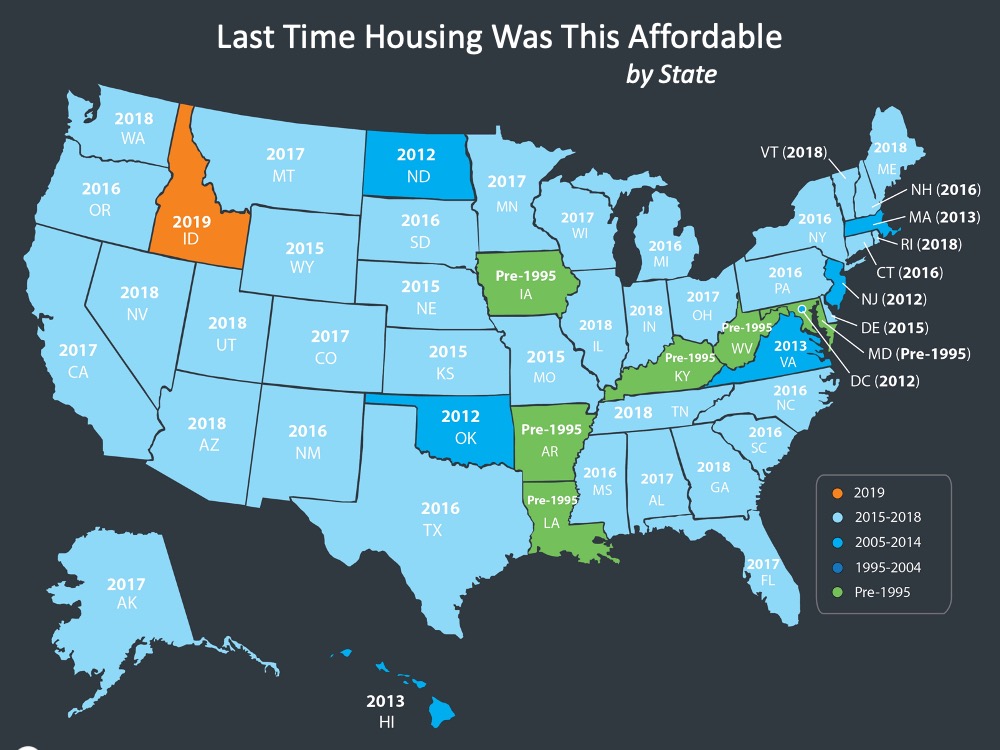
This chart from KCM shows, by state, the last time homes were at the same affordability level as today. For many states it has been 25+ years!
The AZ Market:
Local economist Elliott Pollack believes that the Phoenix metro housing market will remain strong. Between the strength of our job market, affordable prices, stability, and good weather people will continue to move here from other parts of the country.
Cromford Market Index (CMI): Is the best leading indicator available (balance is 100, above 100 is a seller’s market, below 100 is a buyer’s market, prices rise at 110, and drop at 90). Yesterday it was 341.1, MORE THAN 100 POINTS above the pre-COVID peak of 241 and nearly 200 points above the 145.2 we hit on May 15.
Supply: Inventory remains low but is not dropping at incredible rates. As of yesterday, our inventory is 64.4% below normal. Active listings excluding under contract accepting backups (UCB) are at 8,000 (we should have 25,000) down 40% year over year and down over 4% month over month.
Southeast Valley New Listings: This a bi-weekly comparison of new listings in 2019 and 2020 for Tempe, Mesa, Chandler, Gilbert, Apache Junction, and Queen Creek. 2019 followed the typical annual cycle showing more activity in the first half of the year. 2020 is not following any typical patterns. Which makes it impossible to know what the orange line will do next.

Demand: Pending sales up 16% year over year. This is significant given the low inventory. Our demand is nearly 22% above normal. The demand continues to rise but at a slow rate.
Sales & Prices: Phoenix metro area closed sales are up 3.2% month over month and up 15% year over year. The median sales price is $320,500, up 14.5% year over year. Healthy appreciation is 3% annually.
Southeast Valley New Listings, Pendings, and Closings: This week over week comparison for Tempe, Mesa, Chandler, Gilbert, Apache Junction, and Queen Creek since March 15 shows the listing progress we have made. It remains to be seen whether or not last week’s dip in new listings is a trend or an anomaly. Demand continues to increase slightly, absorbing the new listings quickly.

Commercial Real Estate:
- With office buildings only at 10-15% capacity, commercial office owners are implementing expensive upgrades to make the tenants more comfortable working at the offices again. (Bisnow)
- Delinquencies for hotel commercial mortgage-backed securities hit an all-time high in July at 23.45% or $20.6 billion in loan volume. (Trepp Analytics)
- According to Joe Blackbourn, CEO of Everest Holdings, there are about 13.5 million square feet in planned or in-development industrial and warehouse building in greater Phoenix.
- Temporary furloughs are becoming permanent layoffs in many New York City hotels. This trend is expected to become the norm for hotels across the country. It is also expected that it will take years for the hotel industry to recover. (Bisnow)
Mortgage & Forbearance:
- Mortgage applications are down 6.5% week over week, mostly due to a 10% decrease in refinance applications, likely due to the recent slight increase in rates. (MBA)
- Purchase mortgage applications are up 33% year over year. (MBA)
- VA loan originations we up 113% in Q2 2020 from Q2 2019. (Department of Veterans Affairs)
- Fannie Mae and Freddie Mac are delaying the implementation of the 0.5% fee added to refinances from September to December. (FHFA)
- The fee will not be charged on refinances with balances under $125,000.
- When the additional fee was announced it was met with significant opposition from MBA and NAR.
- Christina Hughes Babb, a DC News Reporter said, “More than 1 million households in forbearance are still paying their mortgage. Both MBA and Black Knight show that about a quarter of households in active forbearance plans are still making their mortgage payments.”
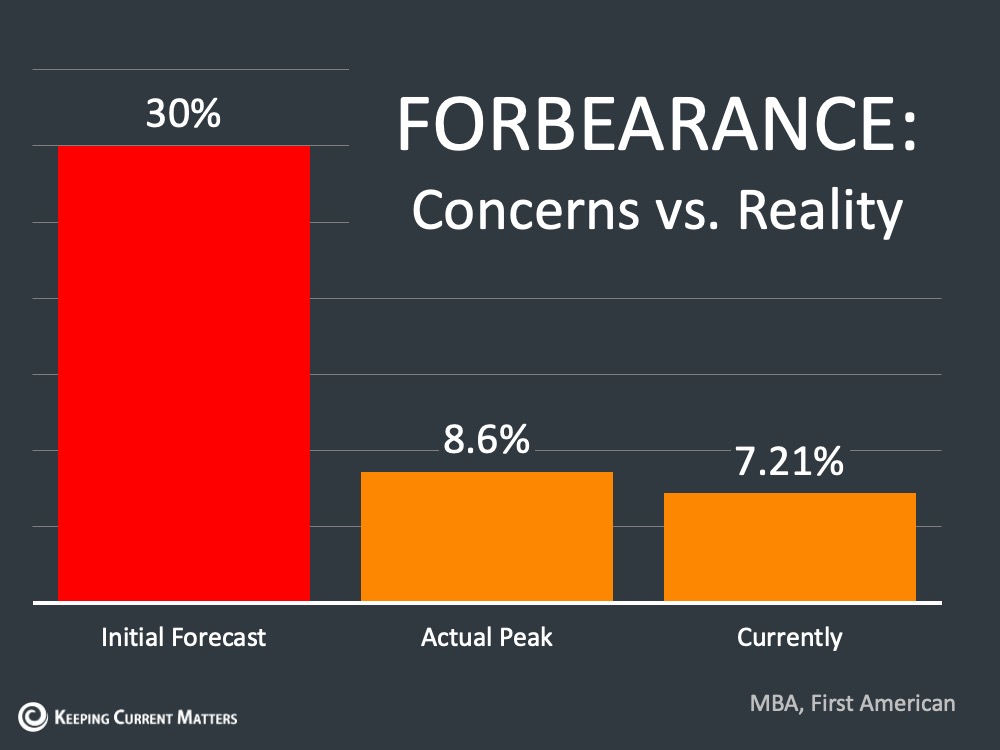
- For 10 weeks straight the number of loans in forbearance has decreased, though the size of the decrease is slowing. We dropped from 7.21% last week to 7.20% this week with about 3.6 million loans in forbearance. (MBA)
- Mortgage delinquency rates are rising for all loan types. In Q2 2020 the delinquency rate increased to 8.22%, up from Q2 2019’s 4.53%. Forbearance programs and foreclosure moratoriums significantly impact the outcomes of these delinquencies.
- In April the MBA initially projected that 30% of loans would go into forbearance. (MBA)
Economic Indicators:
- Elliott Pollack estimates that as many as 30-35% of business will permanently close due to COVID.
- US debt is $14.3 trillion. The total annual US GDP is about $20 trillion. (Federal Reserve Bank of New York)
- 70% or $9.8 trillion in mortgages
- $1.54 trillion in student loans
- $1.3 trillion in car loans
- $820 billion in credit cards
- $380 billion in revolving lines of credit
- $400 billion in miscellaneous
Other Real Estate News:
- Realtor.com is now including flood zones and flood risk information for all properties. Risk data is provided by First Street Foundation. Flood zones data is determined and provided by the Federal Emergency Management Agency (FEMA). (Inman)
- Airbnb announced last week a worldwide ban on parties. They have an occupancy maximum of 16 people and it is effective immediately and remains in effect indefinitely. (Airbnb)
- According to Elliott Pollack, New York City lost 1% of its population in July. He continues that the combination of COVID 19, social unrest, and increased crime rates will push many people out of the major cities.
Jobs & Unemployment:
- No one is forecasting unemployment increasing. (KCM)
- Federal job cuts restrictions will be lifted on October 1 and American Airlines plans to furlough 19,000 employees. (New York Times)
- Elliott Pollack said, “Greater Phoenix is the best performing major employment market in the country so far this year. While employment is down 1.4% compared to the first seven months of 2019, Greater Phoenix has lost fewer jobs in percentage terms than any other major employment market.”
- Last week’s initial unemployment claims decreased by 98,000 from the previous week but were still slightly above 1 million. (US Department of Labor)
- Continuing unemployment decreased by 223,000 down to 14,535,000 bringing us to a revised unemployment rate of 9.9%. (US Department of Labor)
- A total of 58.4 million initial claims have been filed since March.

Final Thoughts:
Projections are useful and the better info we have the better projections we create.
I agree with real estate consultant Jim Belfiore when told Fox 10 Phoenix, “Data suggest nearly 50% of home shoppers have no home to sell today. The supply issue is severe and will continue to be severe, meaning prices are rising rapidly. As for the number of current homeowners in forbearance, it is low here in Arizona, and I do not foresee a significant hiccup in demand or a substantial rise in supply in the next 12 or 24 months. I see a market where we need to encourage more labor in-migration before prices rise beyond the incomes.”
Only time will tell what happens next.
Copyright 2020 by Sarah Perkins


Sarah Perkins is an award winning account executive and has been in title sales since 2004. As the Director of Industry Research & Senior Account Executive, Sarah’s role is to bring real estate transactions to Navi Title. Sarah supports her clients by helping them navigate the ever-changing real estate space through thorough research and understanding of current trends impacting today’s home buyers and sellers.