Tag: #lawyerstitle

  • This Week in (Greater Phoenix) Real Estate 9/28/2020

    Every Monday I spend 15 minutes discussing what happened this week in real estate, lending, and the economy.

    Today’s Takeaways:

    • In August resale home sales increased 10.5% year over year with the most sales since 2006. It was the 102nd straight month of annual gains. (NAR)
    • New homes crossed the one million sales threshold in August, the first time since 2006. (US Census Bureau)
    • Lumber shortages due to mill closures and massive wildfires have driven up prices 170%, adding, on average, $16,000 to the cost of a single-family new build. (NAHB)
    • Given the unexpected, continued demand, despite high unemployment rates, major real estate companies adjusted their future price projections significantly. Zillow initially predicted a 3% decrease in home prices and now is predicting a 3.6% increase. Corelogic the outlier from the start went from a 6.6% decrease to a 0.6% increase. (must have missed the 16% appreciation in greater Phoenix!)

    Supply: Inventory has actually increased by 11%, but it is easy to miss since it is absorbed so quickly.  As of yesterday, our inventory is 64.0% below normal!!! Active listings excluding under contract accepting backups (UCB) remain around 8,100 (we should have 25,000) down 42% year over year and down over 2.5% month over month. This is the time of year when we typically see inventory increases.

    New build permits were up 25.3% in August, year over year and up 11.9% year to date. (RL Brown)

    Demand: Pending sales up 23% year over year, huge despite our low inventory and time of year. Our demand is over 25% above normal. After demand increases began to slow, it has started increasing a little faster again.

    Zillow:

    Zillow announced on Wednesday that it is changing the structure of its iBuyer, Zillow Offers. Soon its iBuyer purchases and sales will be handled by a licensed, salaried, Zillow employee.

    This change will take effect January 2021 in Atlanta, Phoenix, and Tucson with other markets to follow. All properties for sale will be listed on the local MLS which means that Zillow Homes, the brokerage, and its agents are members of NAR. Zillow Offers currently operates in 25 markets nationwide.

    Combined with Zillow’s mortgage company, Zillow Home Loans, and title company, Zillow Closing Services, Zillow can now offer a complete end to end transaction.

    Zillow maintains its stance that it does not want to represent buyers and sellers outside of properties it does not own or purchase directly. Although many believe this is Zillow’s soft launch into traditional real estate.

    Unlike Opendoor and Offerpad who both now offer listing services, Zillow will continue working with its partner Realtors, non Zillow agent-employees, in referring the sellers of properties not purchased by the iBuyer. Zillow Offers currently purchases about 2% of all seller inquiries.

    Given Zillow Homes’ local MLS membership, Zillow will be adjusting its previous data feeds, which currently come from around 10,000 agreements, to come through a direct IDX feed. This will allow it complete access of current listing information and roughly 600 data feeds to manage. This is a game changer for Zillow. Not only does this reduce data costs, it will improve accuracy, timeliness, and provides the ability for far more detailed data aggregation. It will have the ability to have the accuracy of Redfin for its 200 million monthly unique visitors.  Web traffic and effective data aggregation are what built giants like Facebook, Amazon, and Google.

    The IDX feed may impact the brokerages who currently do not syndicate to Zillow.

    The appearance of listings on Zillow will be subject to the local MLS regulations. Buyer’s agents contact information will now be shown separately from the listing agent’s information. Premier Agents will see some changes in customer-facing advertising but not in lead flow.

    Zillow and Trulia will be discontinuing their “featured listings” option.

    Deutsche Bank, one of the world’s leading financial services providers and international investment bank, for the second month in a row upgraded Zillow’s stock price, this time due to Opendoor’s recent announcement of going public. The bank believes that Opendoor’s movement will draw further attention to iBuying thus driving more business to Opendoor and its biggest competitor in the iBuying space, Zillow Offers, meaning more business for Zillow Homes and its agents.  As they say, “a rising tide lifts all boats.”

    The research analysts said, “We see Zillow’s conversion to a more formal brokerage model as it relates to sales of Zillow Offers (ZO) homes in several markets as a natural evolution to improve unit economics in ZO and vertically integrate to better control the user experience and cross sell other Zillow products.”

    The bank sees this as a positive financial move for Zillow, furthering the separation from being a media company to becoming a portal with significantly greater earning potential.

    Mortgage & Forbearance:

    • Mortgage applications increased last week by 6.8% from the previous week. 64.3% of those applications were for refinances, up from 62.8% last week. (MBA)
    • Total loans in forbearance dropped to 6.93%, down from 7.01% last week, continuing the 5-month decline. Roughly 3.5 million loans are in forbearance programs. (MBA)
    • Roughly 680,000 homeowners are late on their mortgage and are eligible for a forbearance plan but are not in a forbearance plan. A recent survey shows the lack of participation is due to confusion, fear, and lack of awareness of such options. (Wall Street Journal)
    • The CFPB, FHFA, HUD, VA, and USDA created a joint effort mortgage and rental assistance platform, for more information visit https://www.consumerfinance.gov/coronavirus/mortgage-and-housing-assistance/

    Final Thoughts:

    Big money keeps getting bigger with sky-high valuations and it is coming after real estate, that isn’t new, but the volume of capital is. I expect demand to continue to be strong, as long as rates stay low. At some point, likely in the not too distant future, more homeowners will realize how much equity they are sitting on and will be inspired to list bringing up inventory levels and providing buyers more options.

  • AZ Forbearance Update (Video)

    Lydia Wietsma with Nexthome Elite Realty and I spent 15 minutes talking about mortgage forbearance, different options, what to plan for in the coming weeks and months.

    Today’s Takeaways:

    The goal of the banks today is different than it was 10 years ago. 10 years ago it was about enabling homeowners to complete short sales. Today it is about keeping struggling homeowners in their homes.

    Total loans in forbearance have dropped for 15 straight weeks. It is now only 6.93% of all loans, which is about 3.5 million loans.

    If 25% are current means that 875,000 are current of the 3.5M in forbearance. Just over 2.6 million are delinquent. About 1 million loans, or 21%, have left forbearance status since the peak in May.

    Foreclosure filings are down 81% year over year. Filings are down because the courts are not moving forward with foreclosures in forbearance. Many courts across the country remain closed due to the pandemic. Foreclosure filings and processes are different across the country.

    Delinquencies are still tracked but not turning into foreclosures due to forbearance protections making true numbers very difficult to track.

    We do know that 30-day delinquencies are down while 60 and 90 day delinquencies are up. There are about 1.8 million more 90 day delinquencies now than there were in February.

    In 2017, right after Hurricane Irma hit, there were the same number of delinquencies as today. There was not a housing crash in 2017.

    Remember in 2008-2010 there were 8.8 million foreclosures nationwide. We are not on track to come close to this number based on what we are seeing now.

  • Greater Phoenix Real Estate Update 9/25/2020

    As we approach the fourth quarter new and/or updated projections for the coming year are emerging. Politics aside, nothing about 2020 has been predictable; economists and analysts struggle to make sense of it all.

    “The US economy and labor market are recovering from the coronavirus-related downturn more quickly than previously expected, economists said in a monthly survey.

    Business and academic economists polled by the Wall Street Journal expect gross domestic product to increase at an annualized rate of 23.9% in the third quarter. That is up sharply from an expectation of an 18.3% growth rate in the previous survey.”

    Harriet Tory, Wall Street Journal

    National Real Estate:

    • In August resale home sales increased 10.5% year over year with the most sales since 2006. It was the 102nd straight month of annual gains. (NAR)
    • New homes crossed the one million sales threshold in August, the first time since 2006. (US Census Bureau)

    “Home sales continue to amaze, and there are plenty of buyers in the pipeline ready to enter the market. Further gains in sales are likely for the remainder of the year, with mortgage rates hovering around 3 percent and with continued job recovery.”

    Dr. Lawrence Yun, nar’s Chief economist
    • Lumber shortages due to mill closures and massive wildfires have driven up prices 170%, adding, on average, $16,000 to the cost of a single-family new build. (NAHB)
    • Given the unexpected, continued demand, despite high unemployment rates, major real estate companies adjusted their future price projections significantly. Zillow initially predicted a 3% decrease in home prices and now is predicting a 3.6% increase. Corelogic the outlier from the start went from a 6.6% decrease to a 0.6% increase. (must have missed the 16% appreciation in greater Phoenix!)

    The AZ Market:

    Cromford Market Index (CMI): Is the best leading indicator available (balance is 100, above 100 is a seller’s market, below 100 is a buyer’s market, prices rise at 110, and drop at 90). Yesterday it was 347.6, way above the pre-COVID peak of 241 and over 200 points above the 145.2 we hit on May 15. The past 7 days saw a 2.5 point increase, a far cry from the 20 point increases we saw in June.

    Supply: Inventory has actually, slightly, increased, but it is easy to miss since it is absorbed so quickly.  As of yesterday, our inventory is 64.0% below normal which is actually up 0.1%!!! Active listings excluding under contract accepting backups (UCB) remain around 8,100 (we should have 25,000) down 42% year over year and down over 2.5% month over month. This is the time of year when we typically see inventory increases.

    New build permits were up 25.3% in August, year over year and up 11.9% year to date. (RL Brown)

    Demand: Pending sales up 23% year over year, huge despite our low inventory and time of year. Our demand is over 25% above normal. After demand increases began to slow, it has started increasing a little faster again.

    Sales & Prices: In August, 35% of homes closed over asking price. Phoenix metro area closed sales are up nearly 19% year over year. The median sales price is $325,000, up 16% year over year. Healthy appreciation is 3% annually.

    Southeast Valley New Listings, Pendings, and Closings:  This week over week comparison for Tempe, Mesa, Chandler, Gilbert, Apache Junction, and Queen Creek since March 15 illustrates our pandemic real estate rollercoaster. What stands out to me is the September spike.

    Commercial Real Estate:

    • With an affordable home shortage of 7 million, mobile home parks continue to be one of the best performing real estate investments and are often considered recession-proof. There are roughly 45,000 parks nationwide. On average they bring a 4% annual rate of return and have low vacancy rates of 4%-6%. (Inman)
    • Startup, Civvl, is a new company created to “connect landlords with gig workers to help with evictions.” The legality is questionable particularly given the CDC’s eviction moratorium. Several tenants’ rights groups have raised concerns as well. (Bisnow)
    • There are roughly 48 million rental units nationwide and The Urban Institute estimates it would cost about $16 billion a month to directly support tenants, which by default would support their landlords.
    • New lawsuits have been filed against the CDC stating that the federal government has overstepped its authority with the nationwide eviction moratorium. (Rose Law Group)

    Zillow:

    Zillow announced on Wednesday that it is changing the structure of its iBuyer, Zillow Offers. Soon its iBuyer purchases and sales will be handled by a licensed, salaried, Zillow employee.

    This change will take effect January 2021 in Atlanta, Phoenix, and Tucson with other markets to follow. All properties for sale will be listed on the local MLS which means that Zillow Homes, the brokerage, and its agents are members of NAR. Zillow Offers currently operates in 25 markets nationwide.

    Combined with Zillow’s mortgage company, Zillow Home Loans, and title company, Zillow Closing Services, Zillow can now offer a complete end to end transaction.

    Zillow maintains its stance that it does not want to represent buyers and sellers outside of properties it does not own or purchase directly. Although many believe this is Zillow’s soft launch into traditional real estate.

    Unlike Opendoor and Offerpad who both now offer listing services, Zillow will continue working with its partner Realtors, non Zillow agent-employees, in referring the sellers of properties not purchased by the iBuyer. Zillow Offers currently purchases about 2% of all seller inquiries.

    Given Zillow Homes’ local MLS membership, Zillow will be adjusting its previous data feeds, which currently come from around 10,000 agreements, to come through a direct IDX feed. This will allow it complete access of current listing information and roughly 600 data feeds to manage. This is a game changer for Zillow. Not only does this reduce data costs, it will improve accuracy, timeliness, and provides the ability for far more detailed data aggregation. It will have the ability to have the accuracy of Redfin for its 200 million monthly unique visitors.  Web traffic and effective data aggregation are what built giants like Facebook, Amazon, and Google.

    The IDX feed may impact the brokerages who currently do not syndicate to Zillow.

    The appearance of listings on Zillow will be subject to the local MLS regulations. Buyer’s agents contact information will now be shown separately from the listing agent’s information. Premier Agents will see some changes in customer-facing advertising but not in lead flow.

    Zillow and Trulia will be discontinuing their “featured listings” option.

    Deutsche Bank, one of the world’s leading financial services providers and international investment bank, for the second month in a row upgraded Zillow’s stock price, this time due to Opendoor’s recent announcement of going public. The bank believes that Opendoor’s movement will draw further attention to iBuying thus driving more business to Opendoor and its biggest competitor in the iBuying space, Zillow Offers, meaning more business for Zillow Homes and its agents.  As they say, “a rising tide lifts all boats.”

    The research analysts said, “We see Zillow’s conversion to a more formal brokerage model as it relates to sales of Zillow Offers (ZO) homes in several markets as a natural evolution to improve unit economics in ZO and vertically integrate to better control the user experience and cross sell other Zillow products.”

    The bank sees this as a positive financial move for Zillow, furthering the separation from being a media company to becoming a portal with significantly greater earning potential.

    Real Estate News:

    • United Wholesale Mortgage (UWM) plans to go public in Q42020 via special purpose acquisition company (SPAC) or blank check company. Gores Holdings IV is already publicly traded and will merge with UWM. The valuation is estimated to reach $16.1 billion, which makes this the largest SPAC deal ever. (Wall Street Journal)
    • LoanDepot is considering an IPO with a potential valuation of $12-$15 billion, which could happen as early as Q42020. (Bloomberg)
    • 28.7% of Redfin’s users looked to move to another area, up from 27.4%, and is the highest percentage yet. Sacramento, Austin, and Phoenix topped the charts for destination cities; affordability being one the biggest drivers.

    Mortgage & Forbearance:

    • Mortgage applications increased last week by 6.8% from the previous week. 64.3% of those applications were for refinances, up from 62.8% last week. (MBA)
    • Total loans in forbearance dropped to 6.93%, down from 7.01% last week, continuing the 5-month decline. Roughly 3.5 million loans are in forbearance programs. (MBA)
    • Roughly 680,000 homeowners are late on their mortgage and are eligible for a forbearance plan but are not in a forbearance plan. A recent survey shows the lack of participation is due to confusion, fear, and lack of awareness of such options. (Wall Street Journal)
    • The CFPB, FHFA, HUD, VA, and USDA created a joint effort mortgage and rental assistance platform, for more information visit https://www.consumerfinance.gov/coronavirus/mortgage-and-housing-assistance/

    Unemployment:

    You may hear about 25-30 million unemployed Americans. There is a variety of unemployment categories; these are the biggest ones from yesterday’s report. Despite the slowing of these drops, most of these are going in the right direction. (US Department of Labor)

    • Initial unemployment claims
      • National: 870,000 an increase of 4,000 from the previous week.
      • Arizona: 10,015 a decrease of 1,328 from the previous week.
    • Continuing unemployment claims
      • National: 12,580,000 a decrease of 167,000 from previous week.
      • Arizona: 194,479 a decrease of 5,705 from the previous week.
    • There were 630,080 initial claims for Pandemic Unemployment Assistance which provides unemployment benefits to independent contractors who otherwise are not eligible for regular benefits. A decrease of 45,074 from the previous week.
    • There were 11,510,888 continuing claims for Pandemic Unemployment Assistance. A decrease of nearly 3 million from the previous week.

    Greater Phoenix continues to be the best performing job market in the country for 2020. Arizona is #3 for best performing state job market, behind Utah and Idaho. (Elliott Pollack)

    An unemployment rate of 4.1%-4.7% is considered full employment. The US Bureau of Labor Statistics and Wall Street Journal survey of economists projects 2023 to be the year we get back to being, at least close to full employment. (KCM)

    Final Thoughts:

    Big money keeps getting bigger with sky-high valuations and it is coming after real estate, that isn’t new, but the volume of capital is. I expect demand to continue to be strong, as long as rates stay low. At some point, likely in the not too distant future, more homeowners will realize how much equity they are sitting on and will be inspired to list bringing up inventory levels and providing buyers more options.

    To quote Bob Dylan, “The times they are a-changin’.”

    Please share this with your colleagues and clients.

    Copyright 2020 by Sarah Perkins

  • Phoenix Area Real Estate Update 9/18/2020

    Last week I received additional questions regarding forbearance, so let’s start there.

    Forebearance:

    • Mortgages in forbearance dropped to 7.01% last week from 7.16% putting roughly 3.5 million homeowners in forbearance plans. (MBA)
    • 9.48% of the forbearance exits were due to permanent loan modifications. (MBA)
    • 33.69% of loans in forbearance are in the initial plan state, 65.35% are in an extension, and 0.96% are re-entering into forbearance.

    The literal meaning of forbearance is “holding back”. It is a temporary postponement of mortgage payments resulting in a form of relief for the borrower in lieu of forcing a property into foreclosure. The borrower will have to pay the postponed payments back later.

    If you see headlines stating “delinquency rates on the rise” those rates include mortgages in forbearance which are planned deferrals.  According to Black Knight Financial, there are about 2 million more delinquent mortgages than there were in February.  This chart shows that 30-day delinquencies are 14% lower than pre-pandemic numbers and the initial wave is subsiding.

    “The COVID-19 pandemic will lead to a rise mortgage defaults and foreclosures. But as the housing market muscles through this economic downturn, it looks as if foreclosures will for a trickle rather than a flood, housing experts says.”

    Jeff Ostrowski, Senior Mortgage Reporter at BankRate

    Unemployment:

    • There were 860,000 initial unemployment claims this week, down 33,000 from last week.
    • Continuing unemployment decreased by 916,000 down to 12,628,000. (US Department of Labor)
    • The leisure and hospitality sector (which tend to be renters) August unemployment rate was 21.3% while the financial activities sector August unemployment rate was 4.2% (essentially full employment) another illustration as to why real estate remains strong. (US Department of Labor)
    • In March and April Amazon hired 175,000 new warehouse employees. Now Amazon plans to hire another 100,000 employees and has 33,000 available positions. Amazon is looking to add over 300,000 employees in 2020! (Bisnow)

    National Real Estate:

    • National median sales price increased by 11% year over year to $328,400. Tight inventory and high demand continue to push prices up. Only San Francisco and NYC have seen significant inventory increases as residents now have more affordable options outside of these cities. (Redfin)
    • A recent report from Realtor.com shows inventory declines are slowing as homeowners are realizing how quickly prices are going up while demand has slowed, only slightly.
    • The week ending September 5 was the 17th straight week of price increases at or above the previous week’s increases, illustrating why we have surfaced pre-pandemic numbers.

    The AZ Market:

    Cromford Market Index (CMI): Is the best leading indicator available (balance is 100, above 100 is a seller’s market, below 100 is a buyer’s market, prices rise at 110, and drop at 90). Yesterday it was 345.1, over 100 points above the pre-COVID peak of 241 and nearly 200 points above the 145.2 we hit on May 15. The past 7 days saw a 2-point increase, a far cry from the 20 point increases we saw in June.

    Supply: Inventory remains low but has stopped dropping. As of yesterday, our inventory is 64.1% below normal. Active listings excluding under contract accepting backups (UCB) are at 8,100 (we should have 25,000) down over 40% year over year and down 2.5% month over month.

    Southeast Valley New Listings: This a bi-weekly comparison of new listings in 2019 and 2020 for Tempe, Mesa, Chandler, Gilbert, Apache Junction, and Queen Creek. 2019 followed the typical annual cycle showing more activity in the first half of the year. 2020 is not following any typical patterns. Which makes it impossible to know what the orange line will do next.

    Demand: Pending sales up 21% year over year, huge despite our low inventory and time of year. Our demand is nearly 24% above normal. The demand continues to rise but at a very slow rate.

    Sales & Prices: In August, 35% of homes closed over asking price. Phoenix metro area closed sales are up nearly 19% year over year. The median sales price is $325,000, up 16% year over year. Healthy appreciation is 3% annually.

    Southeast Valley New Listings, Pendings, and Closings:  This week over week comparison for Tempe, Mesa, Chandler, Gilbert, Apache Junction, and Queen Creek since March 15 illustrates our pandemic real estate rollercoaster. What stands out to me is the lack of end of August closing spike.

    Commercial Real Estate:

    Q4 2020 Projections (Bisnow):

    • Industrial: Strongest performing asset type driving tons of building which could lead to increased vacancy rates.
    • Office: Prior to the pandemic roughly 5% of employees worked from home. In May it was estimated that 42% of employees were working from home. An estimated 15% will work from home as we come out of the recession. Office rents are decreasing and sub-leases are increasing.
    • Hotel: Demand bottomed out at nearly an 84% drop the week of April 11. The increases have been small and the end of the year it is expected demand will still be down 60%-70% year over year.
    • Retail: US retail space was struggling prior to the pandemic with mall closures. Analysts expect 20,000-25,000 store closures this year.
    • Multi-Family: Vacancy has increased slightly from 4.3% to 4.6%, less than expected. Surprisingly enough apartment rent payments are strong. As of August 27, 92% of apartment rents were paid either partially or fully. With the CDC moratorium on evictions many housing associations are voicing their concerns for lack of landlord support.
    • Restaurants: In January restaurants were expected to see a 4% growth rate in 2020. However, according to Yelp in July 16,000 restaurants that were temporarily closed, shut their doors permanently. Aaron Allen & Associates, a restaurant consulting firm expects 231,000 to close permanently this year.

    Real Estate News:

    • Summer vacation rentals across the country are turning into fall and even winter vacation rentals as remote working allows employees new-found freedom. (Redfin)
    • The National Association of Home Builders/Wells Fargo Housing Market Index hit 83 this month, a record high for the 35-year-old index. There is a looming shadow though, lumber prices have increased 170% since April and the raging west coast wildfires are putting lumber stocks at risk. (CNBC)
    • The 4 largest builders in Lexington, KY stopped building altogether due to the sky-high lumber prices. (Sherri Kelley)
    • From February to July the number of young adults, aged 18-29, living with their parents has increased from 47% to 52% or 26.6 million, the first time this number has been above 50%. Closed college campuses and the higher unemployment rates for younger people are the leading causes. (US Census Bureau & Pew Research)
    • Phoenix has the 8th highest rate for data center leasing. Considering we are fairly new to this market and more and more are coming here each year, expect this to increase. (AZ Big Media)

    Opendoor:

    After the rise and fall of iBuyer marketshare, from roughly 0.6%, nationally, in January to 0.1% in July. These companies are scrambling to reinvent themselves. Even Phoenix, where Opendoor launched in 2014, saw the marketshare drop from 6% in January to 1.4% in July.

    iBuyers like Knock.com completely changed course and opted to focus on bridge loans and are no longer purchasing property at all. Others pivoted towards traditional sales and higher agent referrals, Offerpad is now paying a 3% referral fee, up from the previous 1%, and partnerships like Realtor.com and Opendoor.

    Since the beginning none of them have turned a profit. Softbank’s Vision Fund, the largest investor in Opendoor is paying more attention to profitability. If any of the iBuyers lose their funding they will not be able to survive at all, despite any of these recent pivots.

    After the disastrous 2019 IPO attempt by WeWork, another organization funded by Softbank’s Vision Fund, profitability has taken center stage for the multi-billion dollar investor.

    After a few days of rumored talks, on Tuesday, Opendoor announced it is going public. In order to avoid pre-IPO scrutiny, which took down WeWork, Opendoor merged with Social Capital II, a special purpose acquisition company or SPAC, also knows as a blank-check company. Since Social Capital II is already publicly traded Opendoor will not have to explain to Walls Street why they want to go public but still have never turned a profit. Social Capital’s business is solely for taking companies public and has no other business. (Bloomberg)

    Despite an impressive $4.7 billion in revenue in 2019, Opendoor had a net loss of $327 million, up from the $192 million in net losses in 2018. The merger gives Opendoor a valuation of $4.8 billion and a likely infusion of $1 billion in capital.

    Final Thoughts:

    Real estate continues to thrive despite significant headwinds. We continue to watch rentals, eviction moratoriums, and what that means to landlord survival. Home has never been more important and for the 160 million employed American there are options.

    Please share this with your colleagues and clients.

    Copyright 2020 by Sarah Perkins

  • AZ Forbearance Update (Video)

    Lydia Wietsma with Nexthome Elite Realty and I spent 15 minutes talking about mortgage forbearance, different options, what to plan for in the coming weeks and months.

    Today’s Takeaways:

    The literal meaning of forbearance is “holding back”. It is a temporary postponement of mortgage payments resulting in a form of relief for the borrower in lieu of forcing a property into foreclosure. The borrower will have to pay the postponed payments back later. The terms of when and how depends on the details of the forbearance agreement accepted by both parties but one of the biggest benefits of this type of agreement is the lender delays its right to exercise foreclosure if the borrower can catch up to its payment schedule by a certain time. Loan owners, servicers and loan insurers may be willing to negotiate forbearance options because the losses generated by a foreclosure action typically fall on them.

    Lydia works with a loan servicing company and she is getting more and more inspection requests. Not all will go into foreclosure but some will. She is seeing a consistent trickle coming in, no flood. All of these properties are maintained and well-kept; unlike 10 years ago when many properties were trashed before they went to foreclosure. Different mindset and attitude.

    We will more likely see a trickle of foreclosures rather than a flood for several reasons. The housing recovery is a big reason. We have made up everything that was lost and then some.

    Unemployment is high still, yes, but it is going down, putting more and more borrowers in a better place to make their payments.

    Additionally, mortgages in forbearance are also decreasing. The most recent update from the Mortgage Bankers Association shows that we are down to roughly 3.5 million loans are in forbearance.

    Foreclosures require two simultaneously occurring issues; economic distress and negative equity. The average American homeowner has $177,000 in equity and 90% of homeowners have at least 10% equity. We may sellers who need to sell but they will be regular sales versus foreclosures and short sales. (First American, KCM)

  • Phoenix Area Real Estate Update 9/11/2020

    Lately I have been getting more and more questions about foreclosure data and defaults and what we could potentially see coming in the next several months. Even more recently I am hearing about conversations Realtors are having with sellers who plan to sell and then rent because they are afraid to lose equity, like in 2008. These conversations inspired me to research the similarities and differences between the Phoenix metro area real estate markets during 2005-2007 and 2020.

    The intensity of today’s market is somewhat reflective of the 2005 housing market giving many people 2008 PTSD. Although the market may feel similar, in reality, it is very different. You must ignore the headlines and remember the media’s goal is to increase eyeballs for advertisers. Shocking stories sell.

    Every market is different. The Phoenix market is one of extremes, making it easy to use for comparisons over time.

    Lending:

    In 2005 lending was loose. If you could fog a mirror you could get a loan. Lenders went as high as 120% loan to value. People bought houses with $0 out of pocket costs and were over-leveraged. Today’s lending requirements include higher credit scores, minimum down payments, and a job.

    Today’s historic low-interest rates are driving demand higher as properties are more affordable now than they were in 2005 when the average interest rate was roughly 6%. Ivy Zelman with Zelman & Associates, a major national housing research and consulting firm, said low-interest rates are more important to the American consumer than is an economic recession.

    Supply, Demand, & Appreciation:

    In 2005, the easy loans drove up demand quickly. However, demand started decreasing in April 2005 and inventory started increasing in June 2005. Demand hit bottom in October 2007 when supply hit its peak. Demand was 43% below balance and inventory was 114% above balance, meaning we had 57 buyers for 214 listings. Today demand is nearly 23% above balance and inventory is 64% below balance, meaning we have 123 buyers for 36 listings.

    In August 2005 we hit an annual appreciation of 45%. In August 2020 we hit an annual appreciation of 15%. With the appraisal the regulations implemented in 2010 the guidelines prevent collusion and steady the pace of appreciation. This is why appraisals often come in low during times of significant price increases.

    Prices are a lagging indicator and it took about two years for prices to start decreasing, which happened in 2007. We hit 20.6 months of supply in January of 2008. As of yesterday, our supply is 1.4 months.

    Nationally, inventory has been decreasing since 2018 and demand has been increasing since mid-April. Existing home sales increased by 25% in July 2020. June saw an increase of 21%. Based on these increases Dr. Lawrence Yun, NAR’s chief economist, revised his 2020 forecast to 5.4 million existing home sales, a 1.1% increase over 2019’s 5.34 million sales. He also expects 800,000 new home sales this year, a 17% increase over 2019. (NAR)

    True Demand versus False Demand:

    There is a significant difference between true demand and false demand. True demand is when a property is purchased for the purpose of being lived in, whether is it owner occupied or renter occupied. Given the out of control appreciation in 2005 people purchased properties for the sole purpose of parking money to appreciate and resell. There were a number of fraudulent schemes created that took advantage of the appreciation as well. These properties were never lived in. Today properties are purchased to be lived in or rented, i.e. true demand. According to the US Census Bureau, rental vacancy rates and homeowner vacancy rates in 2005 were double what they are today.

    Another way to illustrate true versus false demand is with rent prices. In 2005 rent prices actually decreased due to lack of demand. Today’s rent prices are appreciating about as quickly as sales prices. This is especially true in the single-family market.

    Today’s demand increase is due primarily to #1 low interest rates and #2 people want bigger homes to accommodate working and teaching from home. Commute times are a much lower priority. (NAR)

    A recent Zillow study shows that upwards of 2 million renters could afford a typical starter home just outside of their current metro area. With an increase in remote working, these renters could turn into buyers in the near future.

    New Construction:

    New home construction boomed in 2005. Builders built even when they knew they were over building for the market. In 2007 new construction came to a near standstill and last month was the first time new home sales compared to the volume in 2005. In the past 10 years new construction has not kept up with household formation. We currently have a national housing shortage of about 5 million houses. (NAR)

    Phoenix is the fastest growing city in the country. From 2010-2019 more than 234,300 people moved to the valley. (US Census) During the time of large population growth we had minimal home building.

    Local real estate expert, Jim Belfiore says new home sales peaked last month as it was the highest new home sales month since late 2005. He expects a strong housing market through 2021 based on low interest rates, low inventory, and population growth. Belfiore said, “The growth of sales has slowed.” He expects prices to continue to rise due to limited supply and continued demand. Remember when you are going 180 MPH and slow down to 120 MPH, it feels like you hit a brick wall. It may take a moment to realize you are still going 120 MPH.

    According to CoStar, Phoenix may have an over-supply of new industrial real estate. So far this year 9.6 million square feet has been completed with another 10.6 million square feet under construction.

    A single-family new construction home has an impact on the economy of $327,681. Of that number $188,962 goes into wages and salaries. (National Association of Homebuilders)

    Today’s Underlying Fragilities:

    Our current environment does not come without its complications. The 2005 bubble and bust were caused by real estate. Today, real estate is bolstering the entire economy and is a big part of the solution.  Regardless, we will face significant hurdles in the coming months.

    Unemployment:

    The vast majority of people who lost their jobs are under 25 years old and make less than $50,000 a year. According to NAR, only 3% of homeowners are under 25. The unemployment rates have impacted renters significantly more than homeowners. About 10.5 million of the 22 million jobs that were lost have come back and our unemployment rate now stands at 8.4%. Unsurprisingly, unemployment rates are inversely proportional to education level. The unemployment rate for those with a college degree or higher is 5.3% and the rate for those without a high school diploma is 12.6%. Homeownership rates for those with at least a college degree are 23% higher than those without a high school diploma. (US Bureau of Labor Statistics)

    Last week initial unemployment filings hit 884,000, the same as the week prior. Those on continuing unemployment increased by 93,000 to 13,385,000. (US Department of Labor)

    The chart below shows the past 10 years of unemployment and our unemployment rate today is lower than it was in 2010.

    Mortgage & Forbearance:

    About 3.6 million mortgages or 7.16% are in forbearance, a 5-month low. There is a lot of misleading information surrounding forbearance. There are many different programs ranging in length of 3-12 months. Not all mortgages in forbearance are behind on their payments. Since this is not public data, I cannot confirm but have read that 25%-67% of mortgages in forbearance remain current. (MBA) Additionally, about 90% of loans in forbearance have at least 10% equity. The average American homeowner has $177,000 in equity. It is unlikely we will have a large wave of foreclosures. (KCM) From 2008-2010 there were 8.8 million foreclosures nationwide.

    Often used for first time home buyers, FHA loans make up about 10-12% of loans in forbearance, which is the largest group of any one loan type. (MBA)

    Mortgage applications increased last week by 2.9% after 3 weeks of declines. (MBA) The application increase is likely due to the new all-time low-interest rates hit last week at 2.86%. (Freddie Mac)

    Election:

    Presidential elections tend to decrease buyer demand from about October 15-November 15. Then demand fully recovers by January. There is very little indication of price changes due to elections. (KCM)

    A study done by Kiplinger shows that during election years from 1980-2016, average appreciation is 4.15%. During off years from 1978-2014 the average appreciation is 4.37%. With 2020’s national appreciation pushing 9% those averages may adjust. (NAR)

    COVID Resurgence:

    Ivy Zelman also said, “Our home is our castle, more so than ever before.” We are living, working, and teaching our kids at home. And for the 160 million working Americans, during this time of change and uncertainty finding the right home is more important than ever before. She believes that our housing market will stay strong throughout the pandemic because of this. She expects a cooling, not a drop, once there is a widely used vaccine and regular life has resumed.

    Final Thoughts:

    Local economist Elliott Pollack states that the Phoenix metro housing market will remain strong. Between the strength of our job market, affordable prices, stability, and good weather people will continue to move here from other parts of the country.

    Based on this data, homeowners who sell and then rent will lose the additional equity we are likely to gain in the coming months.

    Please share this with your colleagues and clients.

    Copyright 2020 by Sarah Perkins

  • Phoenix Area Real Estate Update 9/4/2020

    This weekly update has certainly evolved since I started it in April (I suppose everything has changed since April!). I would love your feedback, what should I add? What should I remove? Would you prefer it only covers real estate or do you like the economic and unemployment info? Would you prefer shorter and specific topics that change weekly? Please share your real opinions with me, I write this for you and want to make it better.

    National Real Estate:

    Residential real estate is providing the most significant boost to the economy. While other industries struggle residential real estate is going gangbusters and is a part of the solution.

    “Perhaps in the middle of 2021, we will have more semblance of a balanced market.”

    Dr. Lawrence Yun, NAR
    • Matthew Gardner, Windermere’s Chief Economist revised his 2020 projections to 5.2 million sales and expects it would be much higher if there were more inventory.
    • 5.34 million homes sold in 2019. (NAR)
    • Dr. Lawrence Yun, Chief Economist for NAR believes 2020 will surpass 2019 in total sales and then significantly surpass 2019 in 2021. (NAR)
    • With the continued demand, significant lifestyle changes, and incredibly low supply Yun does not believe we are in a bubble. The increase in builder permits is a sign of inventory to come which will help keep price appreciation in check.
    • Pending home sales increased from June to July by 5.9% and are up 15.5% year over year. (NAR)

    The AZ Market:

    Local economist Elliott Pollack states that the Phoenix metro housing market will remain strong. Between the strength of our job market, affordable prices, stability, and good weather people will continue to move here from other parts of the country.

    Cromford Market Index (CMI): Is the best leading indicator available (balance is 100, above 100 is a seller’s market, below 100 is a buyer’s market, prices rise at 110, and drop at 90). Yesterday it was 342.6, over 100 points above the pre-COVID peak of 241 and nearly 200 points above the 145.2 we hit on May 15. The past 7 days saw a 1.5 point increase, a far cry from the 20 point increases we saw in June.

    Supply: Inventory remains low but has stopped dropping. As of yesterday, our inventory is 64.4% below normal. Active listings excluding under contract accepting backups (UCB) are at 8,000 (we should have 25,000) down 40% year over year and down over 3% month over month.

    Southeast Valley New Listings: This a bi-weekly comparison of new listings in 2019 and 2020 for Tempe, Mesa, Chandler, Gilbert, Apache Junction, and Queen Creek. 2019 followed the typical annual cycle showing more activity in the first half of the year. 2020 is not following any typical patterns. Which makes it impossible to know what the orange line will do next.

    Demand: Pending sales up 18% year over year, huge despite our low inventory. Our demand is over 22% above normal. The demand continues to rise but at a very slow rate.

    Sales & Prices: Phoenix metro area closed sales are up 1% month over month and up over16% year over year. The median sales price is $325,000, up 14% year over year. Healthy appreciation is 3% annually.

    Southeast Valley New Listings, Pendings, and Closings:  This week over week comparison for Tempe, Mesa, Chandler, Gilbert, Apache Junction, and Queen Creek since March 15 illustrates our pandemic real estate rollercoaster. What stands out to me is the lack of end of the month closing spike. Next week’s chart will be more telling.

    Commercial Real Estate:

    • About 25% of New York City office employers are reducing their office space by 20% and 16% are moving out of the city. (Bisnow)
    • After 10 years of declines and closures, 2020 is especially bad for American malls. Coresight Research expects another 1,000 malls or roughly 25% of remaining malls to close in the next five years.
    • Department and apparel stores are taking the biggest hit with revenue declines of 200% and 150% respectively. (Moody’s)
    • Retail owners have started the eviction process for many tenants nationwide. (Wall Street Journal)
    • 77% of retail tenants are current on their payments, better than the 54% who made payments in April. (Wall Street Journal)
    • 28% of industrial California companies are looking to expand or move to Phoenix, up from around 18% last year. (Phoenix Business Journal)
    • Despite eviction moratoriums, a recent survey of civil rights and legal aid attorneys found that 91% reported illegal evictions taking place throughout the country. (National Housing Law Project)

    Real Estate News:

    The Centers for Disease Control and Prevention (CDC) instituted a temporary national residential rental eviction moratorium through 12/31/2020. The CDC has the authority implement such measures to prevent the spread of COVID-19. (Forbes)

    Eligibility:

    • Individuals must earn less than $99,000 a year or couples filing jointly $198,000 or less.
    • Received a stimulus check this year.
    • Certify inability to pay rent is due to COVID with evidence of previous support applications.
    • Show that they would become homeless if evicted.

    Unintended Consequences?

    • This only delays eviction; it does not prevent it.
    • The order does not prevent additional fees, penalties, or interest from being added.
    • NAR President Vince Malta and National Multifamily Housing Council President Doug Bibby both spoke out against the moratorium stating without additional funding both landlords and renters will suffer.

    “While NAR appreciates and is supportive of administration efforts to ensure struggling Americans can remain in their homes, this order as-written will bring chaos to our nation’s critical rental housing sector and put countless property owners out of business.”

    Vince Malta, NAR President

    Other Real Estate News:

    • NAR membership is up 2% year over year and increased 1% from June to July. Membership is now a record high of 1,409,727. (NAR)
    • Pinterest will pay $89.5M to get out of its 490,000 square foot lease in San Francisco. Their post-COVID plans include hiring talent without location restrictions, i.e. working from home anywhere.
    • Last December California’s state insurance commissioner instituted a 12-month ban on insurance companies from canceling homeowner insurance policies on properties in and around recent wildfire locations, protecting roughly 800,000 houses. The ban is not renewable and no new agreement has been reached. High cost, low coverage insurance is available to those who cannot get private insurance coverage. Yet another reason more Californians move to Arizona daily. (New York Times)
    • Zumper, a digital marketplace for rental housing launched Rent Guarantee, a program that helps small landlords by guaranteeing up to 12 months of rental payments. (Inman)

    Unemployment:

    The American economy added 1.4 million jobs in August bringing the national unemployment rate to 8.4%. This is the first time it has been below 10% since March. (Department of Labor)

    Mortgage & Forbearance:

    Mortgage rates have a greater impact on American borrowers than does a recession. Let that sink in, the reason our real estate market continues to appreciate with such intensity is because the buyers are still coming to the market. They do so because of the affordability created from low rates. If you look at interest rates during the past recessions, when they dropped, real estate appreciated. During the tech bubble recession during 2000/2001 homes appreciated by 6.5%. (Ivy Zelman)

    The recent Federal Reserve changes include Chairman Powell saying he would let inflation rise to about 2% in order to keep rates low and promote job growth without inflation fears. Given that bonds and inflation are arch enemies and the FED is the largest buyer of bonds, the FED has the control. (Federal Reserve)

    Mortgage purchase applications stayed flat week over week but are up 28% year over year. Refinance applications dropped 3% week over week and are up 40% year over year. Refinance applications made up 62.5% of all mortgage applications last week. (MBA)

    After 10 weeks straight of decreases, loans in forbearance stayed flat this week. 7.2% of mortgages are in forbearance which is roughly 3.6 million loans. (MBA)

    Economy:

    • Unsurprisingly tourism has taken a GIANT hit with estimated losses of $341 billion since March. (New York Times)
    • Hospitals are struggling as elective procedures are canceled. It is expected that hospitals will see losses of $323 billion from March through December. (American Hospital Association)
    • Telemedicine is way up. Before March about 11% of patients used telemedicine, today 46% of patients are using telemedicine. (Bisnow)
    • Supply chain disruption is subtle but real. Prior to COVID about 6% of consumer goods were out of stock at any given time. Today 21% of paper products, 18% of household cleansers, and 18% of canned vegetables are out of stock. Do not worry, grooming supplies are at all surplus with only 4% of products are out of stock. (Elliot Eisenberg)

    Final Thoughts:

    Real estate continues to thrive despite significant headwinds. Home has never been more important and for the 160 million employed American there are options.

    Copyright 2020 by Sarah Perkins

  • Phoenix Area Real Estate Update 8/28/2020

    Projections, forecasts, and predictions are educated guesses and are the only guides we have available today. Navigating uncharted territory without a compass is challenging at best. Nothing about this year’s real estate activity fits into the usual cyclical patterns.  Data companies are updating their projections seemingly daily.

    Projections are based on trends and it takes at least 3 weeks to see an emerging trend. Before the trends, there is consumer sentiment. Will you please help me gauge consumer sentiment by completing a quick 2-minute survey? If so, here is the link https://theazmarket.com/8-28-2020-consumer-sentiment-survey/

    National Real Estate:

    Home has never been more important. Today we live, work, play, and teach at home. This is why real estate is the shining star in the midst of so much bad news.

    • With a 58% increase in new starts from June to July, multi-family new builds made up the majority of the 22.6% new housing starts in July over June. The new builds are the only thing keeping prices from skyrocketing out of control. (Bisnow)
    • In July, single family starts were up 7.4% year over year. (Elliot Eisenberg)
    • New single-family sales are were up in July 36.3% year over year. (US Census Bureau & HUD)
    • Resale closings in July were up 24.7% from June which were up 20.7% from May. July’s closings were up 8.7% year over year. (NAR)
    • After 101 straight months of price increases the national median sales price is $304,100; the highest ever and an 8.5% increase over July 2019. (NAR)
    • The median listing price increased 10.1% year over year for week ending August 15. (Realtor.com)
    • People are buying larger houses. In July sales of houses with a square footage range of 3,000 – 5,000 are up 21.2%. (Redfin) Reasons for the increased space:
      • 21% dedicated office space to work from home.
      • 21% outdoor/recreation space.
      • 7% home-schooling space.
    • During Q2 2020 San Francisco is the only city in the country without an increase in prices. (FHFA house price index)

    CoreLogic recently adjusted their future pricing projections significantly. They initially projected a 6.6% value decrease over the next 12 months. Their revised projections are’ a 1% value decrease and are now much closer to the other real estate pricing projections.

    “Although housing prices have consistently moved higher when the favorable mortgage rates are factored in, an overall home purchase was more affordable in 2020’s second quarter compared to one year ago.”

    Dr. Lawrence Yun, Chief Economist for NAR

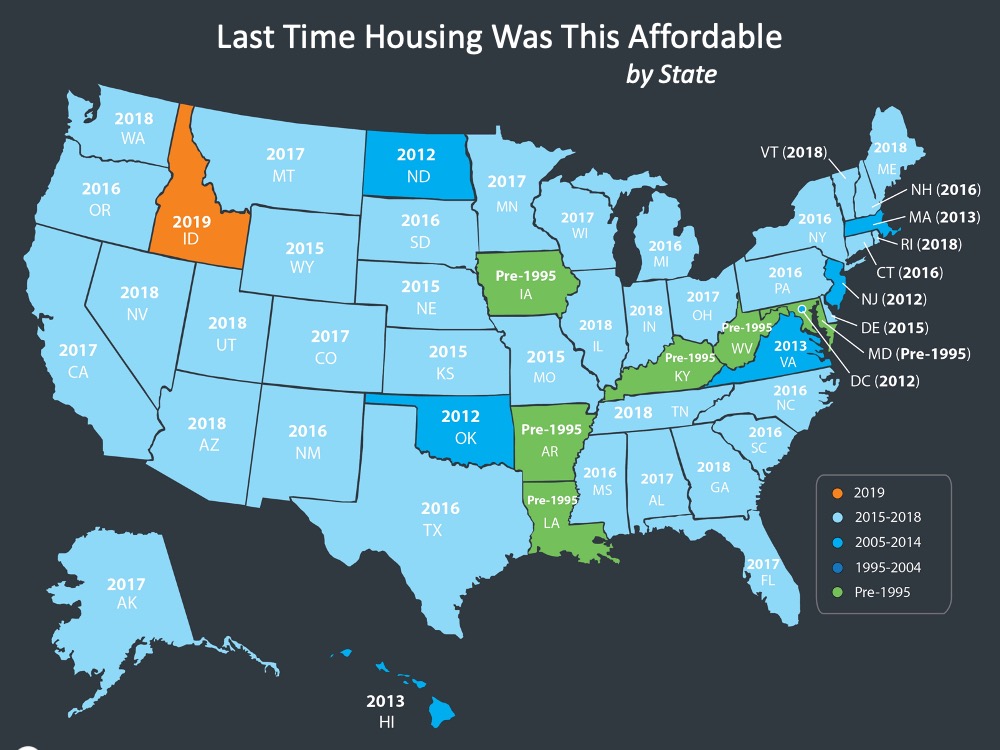
    This chart from KCM shows, by state, the last time homes were at the same affordability level as today. For many states it has been 25+ years!

    The AZ Market:

    Local economist Elliott Pollack believes that the Phoenix metro housing market will remain strong. Between the strength of our job market, affordable prices, stability, and good weather people will continue to move here from other parts of the country.

    Cromford Market Index (CMI): Is the best leading indicator available (balance is 100, above 100 is a seller’s market, below 100 is a buyer’s market, prices rise at 110, and drop at 90). Yesterday it was 341.1, MORE THAN 100 POINTS above the pre-COVID peak of 241 and nearly 200 points above the 145.2 we hit on May 15.

    Supply: Inventory remains low but is not dropping at incredible rates. As of yesterday, our inventory is 64.4% below normal. Active listings excluding under contract accepting backups (UCB) are at 8,000 (we should have 25,000) down 40% year over year and down over 4% month over month.

    Southeast Valley New Listings: This a bi-weekly comparison of new listings in 2019 and 2020 for Tempe, Mesa, Chandler, Gilbert, Apache Junction, and Queen Creek. 2019 followed the typical annual cycle showing more activity in the first half of the year. 2020 is not following any typical patterns. Which makes it impossible to know what the orange line will do next.

    Demand: Pending sales up 16% year over year. This is significant given the low inventory. Our demand is nearly 22% above normal. The demand continues to rise but at a slow rate.

    Sales & Prices: Phoenix metro area closed sales are up 3.2% month over month and up 15% year over year. The median sales price is $320,500, up 14.5% year over year. Healthy appreciation is 3% annually.

    Southeast Valley New Listings, Pendings, and Closings:  This week over week comparison for Tempe, Mesa, Chandler, Gilbert, Apache Junction, and Queen Creek since March 15 shows the listing progress we have made. It remains to be seen whether or not last week’s dip in new listings is a trend or an anomaly. Demand continues to increase slightly, absorbing the new listings quickly.

    Commercial Real Estate:

    • With office buildings only at 10-15% capacity, commercial office owners are implementing expensive upgrades to make the tenants more comfortable working at the offices again. (Bisnow)
    • Delinquencies for hotel commercial mortgage-backed securities hit an all-time high in July at 23.45% or $20.6 billion in loan volume. (Trepp Analytics)
    • According to Joe Blackbourn, CEO of Everest Holdings, there are about 13.5 million square feet in planned or in-development industrial and warehouse building in greater Phoenix.
    • Temporary furloughs are becoming permanent layoffs in many New York City hotels. This trend is expected to become the norm for hotels across the country. It is also expected that it will take years for the hotel industry to recover. (Bisnow)

    Mortgage & Forbearance:

    • Mortgage applications are down 6.5% week over week, mostly due to a 10% decrease in refinance applications, likely due to the recent slight increase in rates. (MBA)
    • Purchase mortgage applications are up 33% year over year. (MBA)
    • VA loan originations we up 113% in Q2 2020 from Q2 2019. (Department of Veterans Affairs)
    • Fannie Mae and Freddie Mac are delaying the implementation of the 0.5% fee added to refinances from September to December. (FHFA)
      • The fee will not be charged on refinances with balances under $125,000.
      • When the additional fee was announced it was met with significant opposition from MBA and NAR.
    • Christina Hughes Babb, a DC News Reporter said, “More than 1 million households in forbearance are still paying their mortgage. Both MBA and Black Knight show that about a quarter of households in active forbearance plans are still making their mortgage payments.”
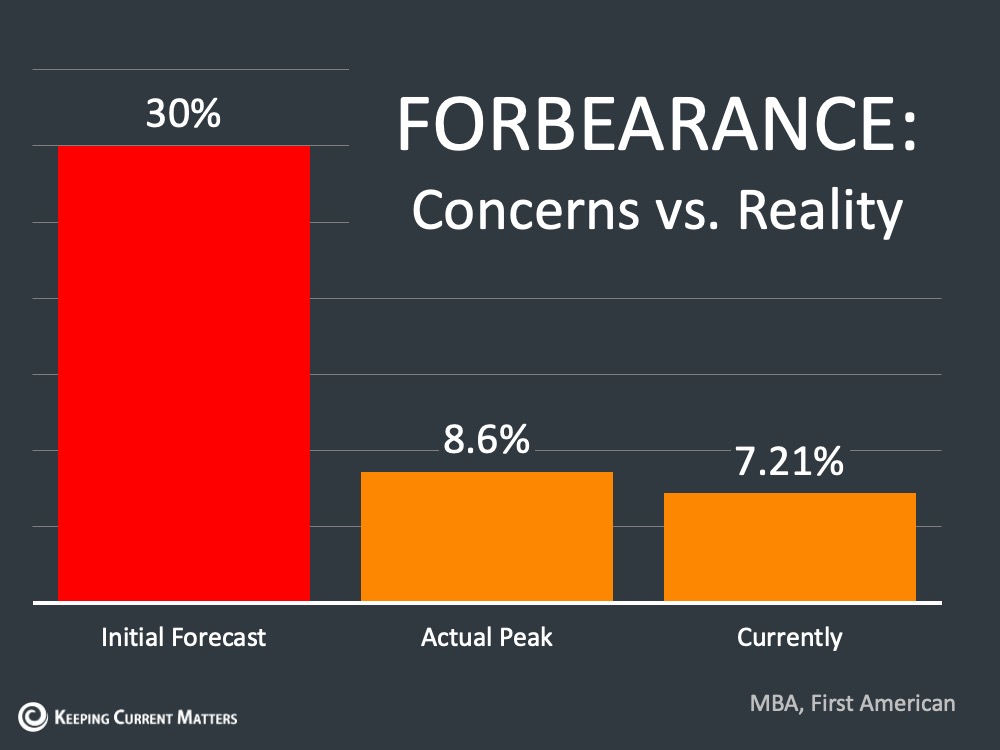
    • For 10 weeks straight the number of loans in forbearance has decreased, though the size of the decrease is slowing. We dropped from 7.21% last week to 7.20% this week with about 3.6 million loans in forbearance. (MBA)
    • Mortgage delinquency rates are rising for all loan types. In Q2 2020 the delinquency rate increased to 8.22%, up from Q2 2019’s 4.53%. Forbearance programs and foreclosure moratoriums significantly impact the outcomes of these delinquencies.  
    • In April the MBA initially projected that 30% of loans would go into forbearance. (MBA)

    Economic Indicators:

    • Elliott Pollack estimates that as many as 30-35% of business will permanently close due to COVID.
    • US debt is $14.3 trillion. The total annual US GDP is about $20 trillion. (Federal Reserve Bank of New York)
      • 70% or $9.8 trillion in mortgages
      • $1.54 trillion in student loans
      • $1.3 trillion in car loans
      • $820 billion in credit cards
      • $380 billion in revolving lines of credit
      • $400 billion in miscellaneous

    Other Real Estate News:

    • Realtor.com is now including flood zones and flood risk information for all properties. Risk data is provided by First Street Foundation. Flood zones data is determined and provided by the Federal Emergency Management Agency (FEMA). (Inman)
    • Airbnb announced last week a worldwide ban on parties. They have an occupancy maximum of 16 people and it is effective immediately and remains in effect indefinitely. (Airbnb)
    • According to Elliott Pollack, New York City lost 1% of its population in July. He continues that the combination of COVID 19, social unrest, and increased crime rates will push many people out of the major cities.

    Jobs & Unemployment:

    • No one is forecasting unemployment increasing. (KCM)
    • Federal job cuts restrictions will be lifted on October 1 and American Airlines plans to furlough 19,000 employees. (New York Times)
    • Elliott Pollack said, “Greater Phoenix is the best performing major employment market in the country so far this year.  While employment is down 1.4% compared to the first seven months of 2019, Greater Phoenix has lost fewer jobs in percentage terms than any other major employment market.”
    • Last week’s initial unemployment claims decreased by 98,000 from the previous week but were still slightly above 1 million. (US Department of Labor)
    • Continuing unemployment decreased by 223,000 down to 14,535,000 bringing us to a revised unemployment rate of 9.9%. (US Department of Labor)
    • A total of 58.4 million initial claims have been filed since March.

    Final Thoughts:

    Projections are useful and the better info we have the better projections we create.

    I agree with real estate consultant Jim Belfiore when told Fox 10 Phoenix, “Data suggest nearly 50% of home shoppers have no home to sell today. The supply issue is severe and will continue to be severe, meaning prices are rising rapidly. As for the number of current homeowners in forbearance, it is low here in Arizona, and I do not foresee a significant hiccup in demand or a substantial rise in supply in the next 12 or 24 months.  I see a market where we need to encourage more labor in-migration before prices rise beyond the incomes.”

    Only time will tell what happens next.

    Copyright 2020 by Sarah Perkins

  • Afternoon Bite 8/24/2020 (Video)

    Every Monday afternoon Amber Kovarik and I talk about what happened this week in our local and national real estate market in 15 minutes or less.

    Today’s Takeaways:

    Many economists are calling this a K shaped recovery. That means that some are having a positive recovery or are fully recovered while for others the struggle continues to worsen. Economist and real estate consultant, Elliott Pollack calls it the “have and have not economy.” Those with jobs have saved money and are in good financial standing. Those who have lost their jobs, who are usually not homeowners, are finding themselves with fewer job prospects and, with the expiration of the CARES Act, significantly smaller unemployment checks.

    Economy:

    • Retail spending is up. National retail spending increased by 1.2% from June to July, increased 1.7% from February to July, and increased by 2.7% from July 2019. (Elliott Pollack & Company)
    • AZ retail spending increased by 4% in June and was up 13.7% over June 2019. (Elliott Pollack & Company)
    • People are buying stuff though, not services. Many young couples who had $30,000 saved for their weddings are now canceling their weddings and using that money for a down payment.
    • Small businesses are struggling. 97% of businesses in AZ are considered small businesses.

    Unemployment:

    • Initial unemployment claims in the US increased last week by 1.1 million, 135,000 more than the previous week. Continuing unemployment claims dropped by 636,000 to just over 14.8 million. (US Department of Labor)
    • Phoenix has the best performing job market in the country. It is not that more jobs were added, it is that fewer jobs were lost. (Elliott Pollack & Company)
    • Amazon announced it is bringing 3,500 new jobs to the valley, including a 500 employee tech hub in Tempe and a 150,000 square foot fulfillment center at Falcon Field in Mesa. (Arizona Republic)

    Mortgage:

    • For the ninth week in a row mortgages in forbearance decreased. It dropped from 7.44% to 7.21% or to roughly 3.6 million loans. Yes, we have a long way to go but an improvement is still an improvement. (MBA)
    • Mortgage loan applications declined 3.3% week over week. (MBA)

    Schools:

    Buyer trends are shifting, they want home offices, Zoom rooms, and home-schooling rooms. This week there was an article in Inman that said, “buyers are much less interested in things that used to be important: proximity to offices, shopping and urban centers, high-quality public schools, and even the prestige of neighborhoods.”

    Real Estate:

    • Commercial real estate is struggling. The biggest thing we have to watch is what happens with rentals given the unemployment challenges.
    • About 22% of single-family homes in the Phoenix metro area are rentals. (Elliott Pollack & Company)
    • 96% of rental owners are small Mom and Pop businesses.
    • Residential real estate is the shining star and what is pulling us in the right direction. Without the good things happening in real estate the entire country would be in far worse shape.
      • SupplyThe available inventory continues to stabilize. Inventory remains low but is not dropping at incredible rates.
      • Demand: Pending sales up 16% year over year. This is significant given the low inventory. Our demand is over 21% above normal. The demand continues to rise but at a slowing rate.
      • Sales & Prices: Phoenix metro area closed sales are up 5% month over month and up 15% year over year. The median sales price is $320,000, up over 14% year over year. Healthy appreciation is 3% annually.
    • The National Association of Homebuilders/Wells Fargo Housing Market Index, which shows builder confidence, increased to 78, the highest reading since 1998.
    • Appraisals are getting trickier. They are taking longer to come in. Waiving the appraisal contingency is not working as well as it used to. Many appraisals are not coming in at value.
  • Afternoon Bite 8/10/2020 (Video)

    Every Monday afternoon Amber Kovarik and I talk about what happened this week in our local and national real estate market in 15 minutes or less.

    Today’s Takeaways:

    Schools:

    • Before there are trends there is consumer sentiment. The conversations about “what do we do next?”
      • Private school and move?
      • Quit job and move?
      • What happens to the top performing school districts when the families move away?
    • Schools are a big part of location, location, location. If they are closed does the demand for a top-notch school district go down?
    • With kids at home, parents cannot go back to work or look for a new job; which will keep the unemployment numbers high.
    • Parents that are working from home are now also simultaneously teaching from home.
    • 85% of college students want to return to campus. Colleges and universities want to reopen but how? Some economists question whether major universities will be able to weather this storm. What would Tempe look like without ASU? (Chronicles of Higher Education)
    • Big 10 voted today to cancel the entire 2020 football season. This will be the first year since 1869 with no college football.

    Jobs:

    • In July 1.8 million new jobs were created.
    • Total filings are 55 million, continuing unemployment is at 16.1 million.
    • Nationally week over week filings decreased after 2 weeks of increases, those were the first increases since March. Hopefully we do not see more increases.
    • Arizona’s new unemployment filings continues to fall. We have not had any week over week increases since the beginning and Phoenix remains the strongest job market in the country.

    Forbearance:

    • Mortgages in forbearance declined for the seventh week in a row, down to 7.67% of all mortgages or roughly 3.8 million loans. (MBA)
    • With the expiration of the CARES Act, some foreclosure protections have ended and mortgage services are chomping at the bit to get the ball rolling on foreclosures. Remember these services are contractually obligated to make these loans whole, having to pay the difference to the lienholder in the secondary market.
    • 77% of loans in forbearance have at least 20% equity.
    • Many borrowers have no idea about options. This is a very important conversation to be having with your contacts.

    Real Estate:

    • Nationwide we are struggling with low inventory. The Phoenix listing market seems to have stabilized, just at an extremely low level. We are 63% below where we should be. Instead of 8,400 active listings we should have at least 24,000! Demand continues to outpace supply pushing prices higher. Right now we are running at an 11% appreciation rate. In years passed we were shocked that we hit 8%! And remember healthy appreciation is 3%.
    • 1031 Exchanges may be on the chopping block again. Getting rid of the nearly 100-year-old tax program to fund Joe Biden’s childcare and elder-care proposal. What does that mean for real estate? (Inman)